
 Buyer protection

Research on donkey milk · Study 44
One protein, three types of milk: β-casein compared in the laboratory
A research team from China isolated β-casein, one of the most important milk proteins, from cow's, goat's and donkey milk. Structure, technical properties and behaviour in a simulated digestion modelled on the infant gut were compared.
What it's about
Why β-casein in particular?
Caseins make up most of the protein in cow's milk, and β-casein is one of the most important of them. In donkey milk the casein proportion is considerably lower, and its β-casein differs from that of the cow in its sequence of building blocks.
β-casein is known mainly from the discussion about "A1" and "A2" milk. This concerns a single site in the protein, position 67. The researchers wanted to know how β-casein from the three species differs in structure, properties and breakdown, and examined it individually for this purpose.
What exactly was studied?
Briefly explained
Terms from the study
A casein protein in milk. Its sequence of building blocks differs from species to species.
Two variants of cow β-casein. They differ at position 67: histidine (A1) or proline (A2).
The proportion of protein bonds cleaved during digestion. The higher it is, the further the breakdown.
β-casomorphin-7, a fragment that can form when A1 β-casein is broken down. Its significance is debated in science.
Casein precipitated from skimmed milk, β-casein separated at pH 4.5 and 35 °C.
Purity, size, charge, structure, solubility, foaming and emulsifying behaviour measured.
Gastric phase with pepsin at pH 4.0, intestinal phase with trypsin at pH 6.6, 120 minutes each.
Degree of breakdown and radical scavenging activity compared before and after digestion.
Interactive · The data at a glance
Cow, goat and donkey compared directly
How pure the protein obtained was, how large its particles are, how it behaves technically, how far it was broken down – and what is at position 67. Switch between the views.
050100 %
080160 nm
0816
YPFPGPIYPFTGPIYPYAEPVAll values from the text of the freely available original publication. Values that are only available there as a graphic are not shown here.
Key findings
What the researchers report
Smaller particles, more stable solution
118.4 nm instead of 152.0 nmThe β-casein from donkey milk formed the smallest particles in solution and had the strongest negative charge (−13.66 mV). The authors interpret this as a sign of a more stable solution.
Breakdown between goat and cow
+12.78 percentage pointsIn the gastric phase, breakdown rose only moderately for all three samples. In the intestinal phase, the increase for donkey, at 12.78 points, lay between goat (14.78) and cow (9.92).
Ahead after digestion
•OH and ABTS testsUndigested, cow β-casein showed the strongest activity. After digestion, the fragments from donkey β-casein were ahead, in front of cow and goat. Measurements were taken only in the test tube.
The authors see β-casein from goat's and donkey milk as a possible alternative to cow β-casein for food research. They themselves describe the genetic classification of donkey β-casein as still unclear. Whether the peptides mentioned are actually formed during digestion was not investigated.
Critical assessment
Basic research on a single protein
What the study shows
What it does not show
Research question for DON DONKEY’S®
What is the structure of the β-casein in our donkey milk?
The study describes β-casein from the donkey milk of a single farm in China. We are interested in the protein profile of our donkey milk – and whether it changes through freezing or drying into powder.
Original publication
Investigation of the structural, functional, and digestive properties of beta-casein from cow, goat, and donkey milk
Original title of the publication.
Liu G., Wang N., Chen X., Jin Y., Wan J., Zhao Y., Zhao Y., Wang C.
Food Chemistry: X · 2025 · volume 28, article 102543 · open access
Liaocheng University · Qilu University of Technology (Jinan), China
DOI: 10.1016/j.fochx.2025.102543 · Full text: PubMed Central
Transparency: according to the publication, the donkey milk came from a company in the Chinese donkey industry. The work was funded by Chinese state research programmes. A laboratory study with isolated protein – no product-related statement for DON DONKEY’S®.
Summarised and reviewed by the DON DONKEY’S editorial team on the basis of the original publication · as of October 2026
The study summarised above was carried out independently of DON DONKEY’S® and does not relate to our products. It serves solely to inform about the state of research.
DON DONKEY’S® donkey milk and donkey milk powder are foods. They are not intended to prevent, treat or cure any disease and do not replace medical advice. Donkey milk is not a substitute for breast milk or infant formula.

From our shop
DON DONKEY’S® donkey milk
100 % donkey milk · raw milk, frozen
On this page we report the findings of a published study. Independently of that, you will find our donkey milk here: 100 % donkey milk, frozen as raw milk.
100 ml bottle / 100ml · Unit price: €249,00 / 1 l · incl. VAT, plus shipping
Also in our shop
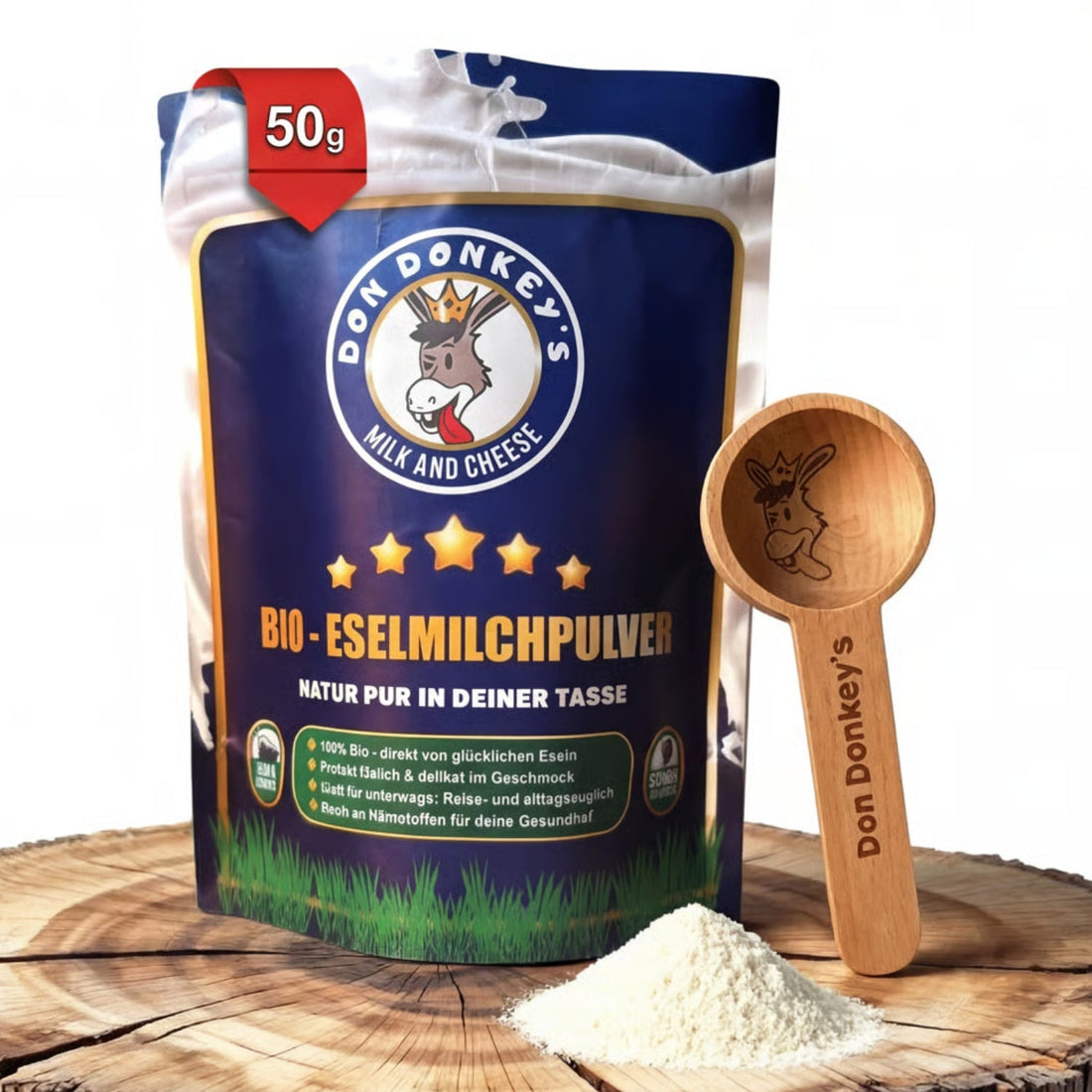
Donkey Milk Powder
Donkey milk in powder form
For anyone who prefers a longer shelf life: our donkey milk in powder form – easy to store and portion.
20g · Unit price: €1.245,00 / 1 kg · incl. VAT, plus shipping