
 Buyer protection

Research on donkey milk · Study 43
Donkey milk, fermented with its own strain
In 2026, a Spanish research team searched raw donkey milk for lactic acid bacteria, selected a suitable strain and used it to ferment donkey milk. They then measured in the test tube how strongly the samples inhibit the enzyme ACE and how antioxidant they are.
What it's about
The starter culture comes from the milk itself
For yoghurt or cheese, proven starter cultures are usually used. This team took a different approach: it let raw milk from the Spanish donkey breed Zamorano-Leonés sour spontaneously and searched it for bacteria suitable for targeted fermentation.
The result was a single strain: Lactococcus lactis subsp. lactis CECT 31096. It was used to ferment pasteurised donkey milk, which was compared in the laboratory with unfermented milk.
What exactly was studied?
Briefly explained
Four terms you need here
Milk sours without an added culture – only through the bacteria already in it.
Uses genetic analysis to determine which bacterial groups are present in a sample.
An enzyme involved in blood pressure regulation in the body. Tested here only in the test tube.
The amount of a sample that halves enzyme activity in the test. Smaller means: stronger inhibition in the test.
Raw donkey milk fermented spontaneously at 37 °C until it reached pH 4.6.
34 isolates were obtained from the milk, ten of them possible lactic acid bacteria.
Five L. lactis isolates were tested, one examined in detail by genome sequencing.
Pasteurised donkey milk was fermented with the strain and examined in the laboratory.
Interactive · The data at a glance
From 34 isolates to one strain
How the researchers found their strain, what the ACE test showed, how the antioxidant values changed – and how the strain was checked for safety. Switch between the views.
Figures from the abstract of the original publication. We do not reproduce further detailed values (e.g. on the antioxidant tests) here.
Key findings
What the researchers report
Lactic acid bacteria take over during souring
environmental bacteria → lactic acid bacteriaAt first, bacteria from the environment dominated in the raw milk. By the end of spontaneous fermentation, lactic acid bacteria had prevailed.
Stronger enzyme inhibition in the test tube
IC50 7.23 → 3.17 g/LLess than half the amount of the fermented milk was needed to halve ACE in the test. After laboratory digestion, the value fell to 1.25 g/L.
More phenols and peptides
antioxidant laboratory values higherFermentation increased soluble free phenols and peptides. As a result, reducing power and antioxidant capacity also increased in the test.
The authors also report an improved physicochemical and nutritional profile of the fermented milk and see the strain as a possible candidate for fermented donkey milk products.
Critical assessment
An enzyme test is not a blood pressure reading
What the study shows
What it does not show
Research question for DON DONKEY’S®
Which bacteria live in donkey milk?
What is exciting about this study is the approach: the culture comes from the donkey milk itself. For us, this is a question of food science – which bacteria occur naturally in raw donkey milk, and how does the milk change when it sours?
Original publication
Development of donkey milk fermented with Lactococcus lactis subsp. lactis CECT 31096 and characterization of the antioxidant and antihypertensive activity
García-Martín E., Martín-Diana A. B., Jiménez-Pulido I. J., Rico D., de la Cruz-Sánchez R., Monte E., Quijada N. M., Requena T., Olmo R.
International Journal of Food Microbiology · 2026 · volume 456, article 111779 · open access
DOI: 10.1016/j.ijfoodmicro.2026.111779
A laboratory study with fermented donkey milk – no product-related statement for DON DONKEY’S®.
The study summarised above was carried out independently of DON DONKEY’S® and does not relate to our products. It serves solely to inform about the state of research.
DON DONKEY’S® donkey milk and donkey milk powder are foods. They are not intended to prevent, treat or cure any disease and do not replace medical advice.

From our shop
DON DONKEY’S® donkey milk
100 % donkey milk · raw milk, frozen
On this page we report the findings of a published study. Independently of that, you will find our donkey milk here: 100 % donkey milk, frozen as raw milk.
100 ml bottle / 100ml · Unit price: €249,00 / 1 l · incl. VAT, plus shipping
View all sizes & purchase options →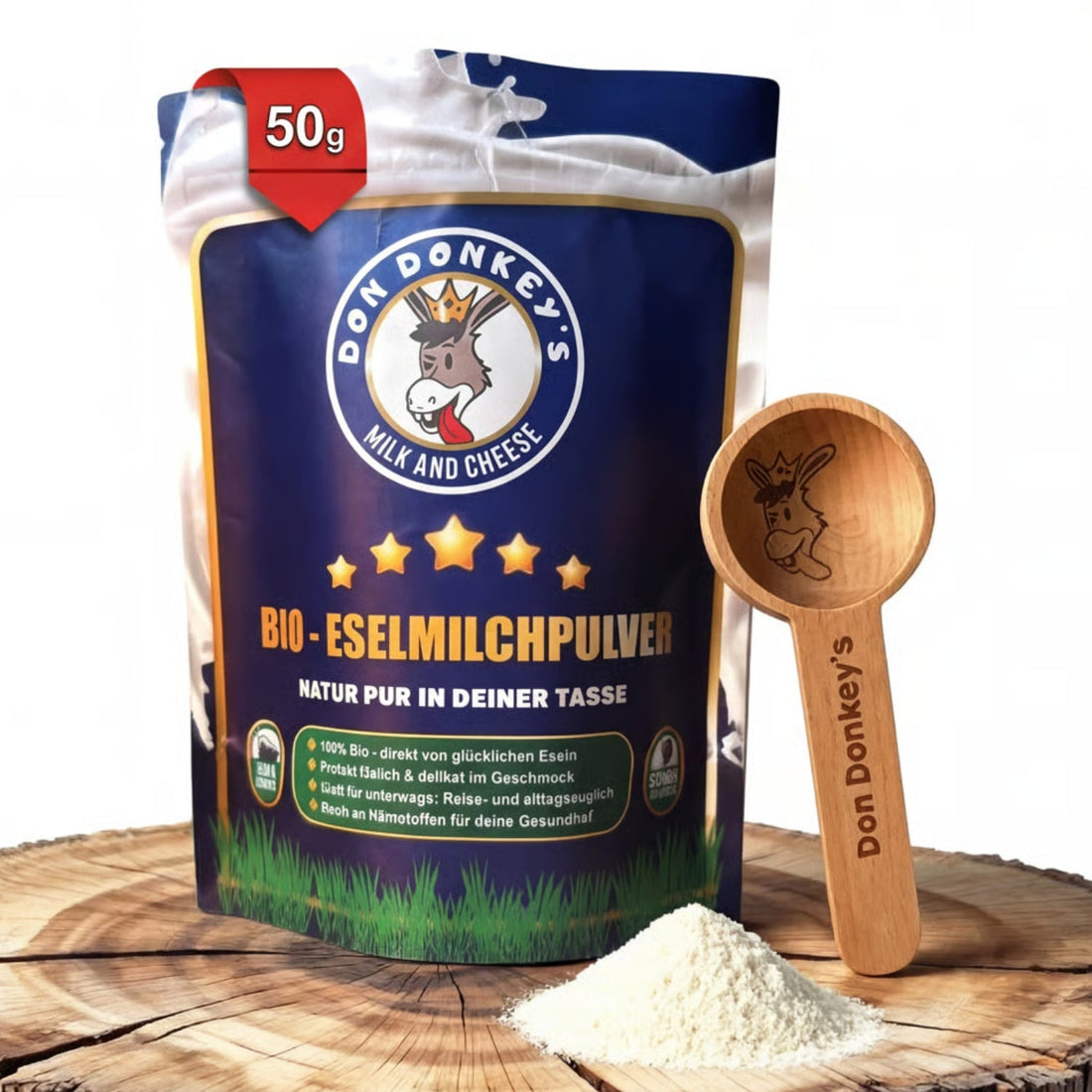
Also in our shop
Donkey Milk Powder
Donkey milk in powder form
For anyone who prefers a longer shelf life: our donkey milk in powder form – easy to store and portion.
20g · Unit price: €1.245,00 / 1 kg · incl. VAT, plus shipping
View all sizes & purchase options →