
 Buyer protection

Research on donkey milk · Study 41
Breast milk in the digestion simulator
In 2024, Giribaldi et al. simulated in the laboratory how a preterm infant digests fortified breast milk. The question: does it change which protein fragments – so-called peptides – are formed when the fortifier comes from donkey milk instead of cow's milk?
What it's about
What protein becomes during digestion
Very small preterm infants often receive breast milk with a fortifier – an additive that supplies extra protein and nutrients. Fortifiers made from cow's milk whey, whose protein is already pre-digested, are standard. In the Italian FortiLat series (studies 12 to 15 and 40), a donkey-milk-based fortifier with intact proteins was tested.
This work looks one level deeper: during digestion, protein breaks down into peptides. The scientific literature attributes certain properties to some of these fragments. The researchers wanted to know whether the peptide pattern changes depending on the fortifier.
What exactly was studied?
Briefly explained
The terms used in this study
An additive that enriches breast milk for very small preterm infants with protein and nutrients.
A short protein fragment formed during digestion – here 6 to 50 amino acids long.
Capturing as many of the peptides in a sample as possible at once – by mass spectrometry.
A device simulates the stomach and intestine with enzymes and acid – without an infant or animal.
Breast milk was fortified with each fortifier to the same protein and energy content.
The model simulated the stomach and small intestine of a four-week-old preterm infant.
Samples were taken at seven time points – three in the stomach, four in the intestine.
Each peptide was identified, assigned to its protein of origin and compared with databases.
Interactive · The data at a glance
2,214 fragments, few differences
How was the experiment run, where do the peptides come from, when do they appear – and what does the database comparison show? Switch between the views.
start
30 min
90 min
30 min
60 min
90 min
180 min
Figures from the original publication, rounded. A deviation of more than ±10 % at p < 0.05 was considered a difference.
Key findings
What the researchers report
Breast milk peptides hardly changed
1,254 peptides from breast milkThe amount and type of peptides from the breast milk were very similar with both fortifiers. Only around one in ten shared peptides differed in frequency – mainly in the simulated intestine.
Lactoferrin fragments remained longer
lactoferrin · α-lactalbuminWith the donkey milk fortifier, fragments of the breast milk protein lactoferrin were more often detectable until the end of the intestinal phase. Certain α-lactalbumin peptides, on the other hand, appeared somewhat later than with the cow's milk fortifier.
914 additional fragments
5 matches in the database comparison914 peptides of its own came from the donkey milk fortifier. Five of them match sequences to which the literature attributes antioxidant or ACE-inhibiting properties – this was not tested here.
The authors see the donkey milk fortifier as a possible alternative to the cow's milk fortifier and formulate this as a hypothesis for the clinical nutrition of preterm infants. One co-author is a co-inventor of a patent on the donkey milk fortifier studied; the other authors declare no conflicts of interest.
Critical assessment
Basic research in the test tube
What the study shows
What it does not show
Research question for DON DONKEY’S®
What happens to donkey milk protein during digestion?
The study shows how precisely it is possible to track which protein fragments are formed during digestion. For us, a prompt to learn more about the protein structure of our milk – without any promise of effects.
Original publication
Peptidomic profile of human milk as influenced by fortification with different protein sources: An in vitro dynamic digestion simulation
Giribaldi M., Nebbia S., Briard-Bion V., Jardin J., Ménard O., Dupont D., Coscia A., Cresi F., Lamberti C., Cavallarin L., Deglaire A.
Food Chemistry · online 2024 · volume 462 (2025), article 140886
DOI: 10.1016/j.foodchem.2024.140886
Full text: CNR (IRIS), open access
A laboratory experiment with an experimental specialty product for preterm infants – no product-related statement for DON DONKEY’S®.
The study summarised above was carried out independently of DON DONKEY’S® and does not relate to our products. It serves solely to inform about the state of research.
DON DONKEY’S® donkey milk and donkey milk powder are foods. They are not infant food or a substitute for breast milk, are not intended to prevent, treat or cure any disease, and do not replace medical advice.

From our shop
DON DONKEY’S® donkey milk
100 % donkey milk · raw milk, frozen
On this page we report the findings of a published study. Independently of that, you will find our donkey milk here: 100 % donkey milk, frozen as raw milk.
100 ml bottle / 100ml · Unit price: €249,00 / 1 l · incl. VAT, plus shipping
View all sizes & purchase options →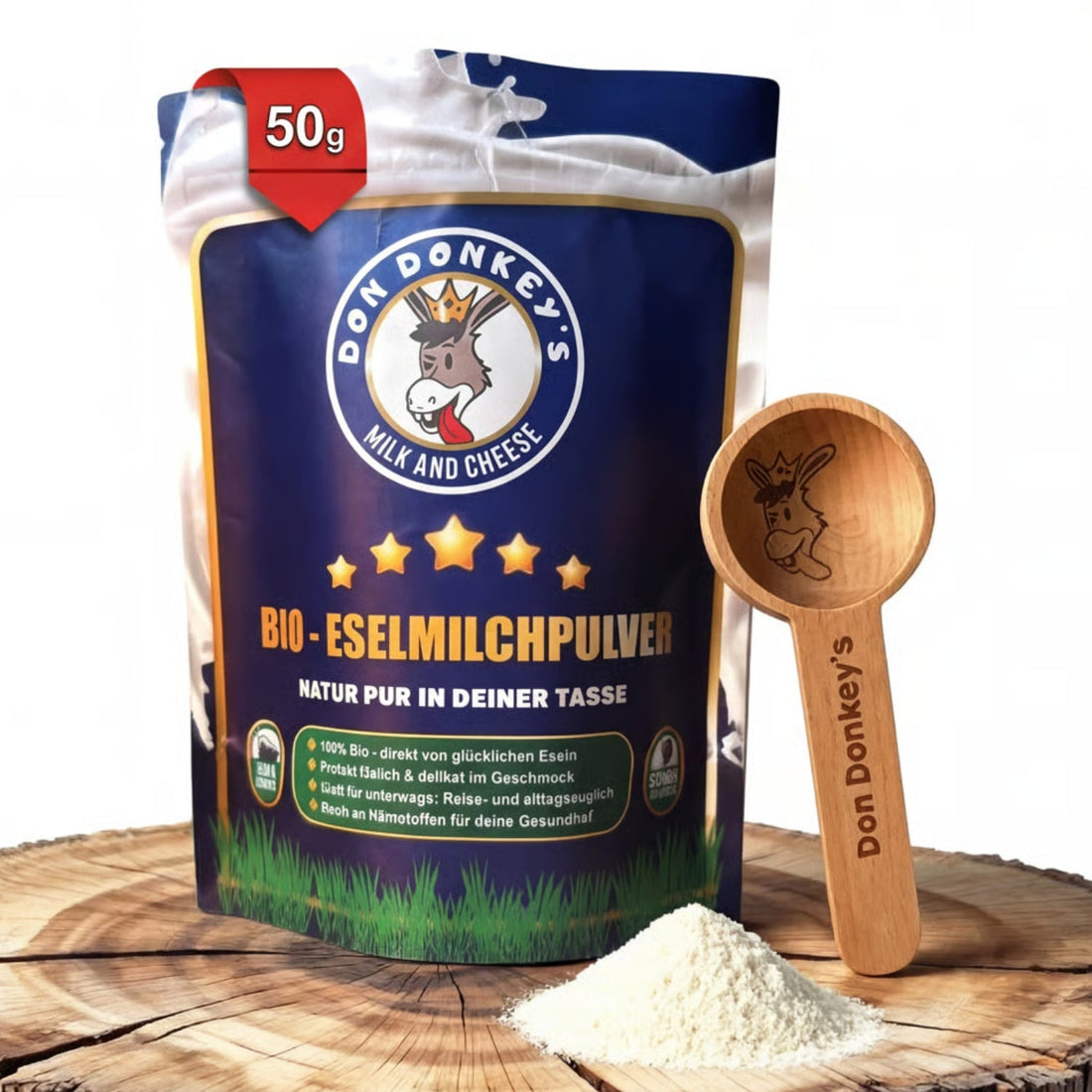
Also in our shop
Donkey Milk Powder
Donkey milk in powder form
For anyone who prefers a longer shelf life: our donkey milk in powder form – easy to store and portion.
20g · Unit price: €1.245,00 / 1 kg · incl. VAT, plus shipping
View all sizes & purchase options →