
 Buyer protection

Research on donkey milk · Study 4
Raw donkey milk and its microbial profile
In 2020, Massouras et al. examined 115 raw milk samples from 23 jennies in Greece: which bacteria live in the milk, what is its composition – and does it inhibit the growth of other bacteria in the laboratory?
What it's about
What lives in fresh donkey milk?
On a donkey farm in the Argos region of the Peloponnese live Cypriot and Arcadian donkeys – two breeds common in Greece. Researchers at the Agricultural University of Athens examined their milk from November to March.
They counted ten bacterial groups, determined the composition and identified the predominant bacterial species genetically. In addition, they tested whether the milk inhibits the growth of 42 bacterial strains in the laboratory.
Milking was done by hand twice a day; the morning and evening milk of each jenny was pooled into one sample.
What exactly was studied?
Briefly explained
The terms used in this study
Milk is placed in small wells of a culture plate on which bacteria grow. If a clear ring remains around the well, growth has been inhibited.
A precisely known bacterial strain used to test whether a sample has an inhibitory effect. Here there were 42 strains from six groups.
Bacteria that ferment milk sugar into lactic acid. Starter cultures for yoghurt and cheese, for example, are obtained from them.
The number of the animal's own cells in the milk – a common measure of the udder health of the animals.
23 jennies were milked by hand twice a day, from November to March.
Each of the 115 samples was tested for ten microbial groups and the cell count.
85 bacterial isolates were grouped and selected ones identified genetically.
20 µl of milk each was tested against 42 test strains, 24 hours at 37 °C.
Interactive · The data at a glance
115 samples, five views
How many samples, how high the bacterial count, which bacteria, which components – and what did the inhibition test show? Switch between the views.
Illustration of the values reported in the original publication. The bars show the range of the mean values of the six animal groups; the arrangement of the dots is schematic.
Key findings
What the researchers report
Good microbiological quality (per authors)
Total bacterial counts were low in all six animal groups. The authors interpret this as good microbiological quality of the milk.
Mainly lactic acid bacteria
Enterococci, Lactococcus lactis and Levilactobacillus brevis predominated. In addition, the researchers detected Staphylococcus aureus, Bacillus cereus and Clostridium spp., which they classify as potentially pathogenic.
Targeted inhibition of two strains
No inhibition was found against the remaining 40 test strains – including E. coli, salmonella and S. aureus. The authors interpret the effect as strain-dependent.
Whether salmonella, Listeria or E. coli occurred in the milk itself was not reported – these bacteria served only as test strains. An inhibition zone is a laboratory finding. In their conclusion, the authors call for strict hygiene and quality controls and for heat treatment before consumption.
Critical assessment
Good quality, a nuanced picture
What the study shows
What it does not show
Research question for DON DONKEY’S®
Which bacteria live in our milk?
The Greek study shows how diverse the microflora of fresh donkey milk is. For us it is a prompt: we would like to get to know the microbial profile of our own milk using comparable methods.
Original publication
Microbial Profile, Antibacterial Properties and Chemical Composition of Raw Donkey Milk
Massouras T., Bitsi N., Paramithiotis S., Manolopoulou E., Drosinos E. H., Triantaphyllopoulos K. A.
Animals · 2020 · 10(11):2001
Agricultural University of Athens, Greece
DOI: 10.3390/ani10112001
Full text: PMC7694164
The publication describes the milk of a specific donkey herd in Greece. It does not allow any product-related statement for DON DONKEY’S®.

From our shop
DON DONKEY’S® donkey milk
100 % donkey milk · raw milk, frozen
On this page we report the findings of a published study. Independently of that, you will find our donkey milk here: 100 % donkey milk, frozen as raw milk.
100 ml bottle / 100ml · Unit price: €249,00 / 1 l · incl. VAT, plus shipping
Also in our shop
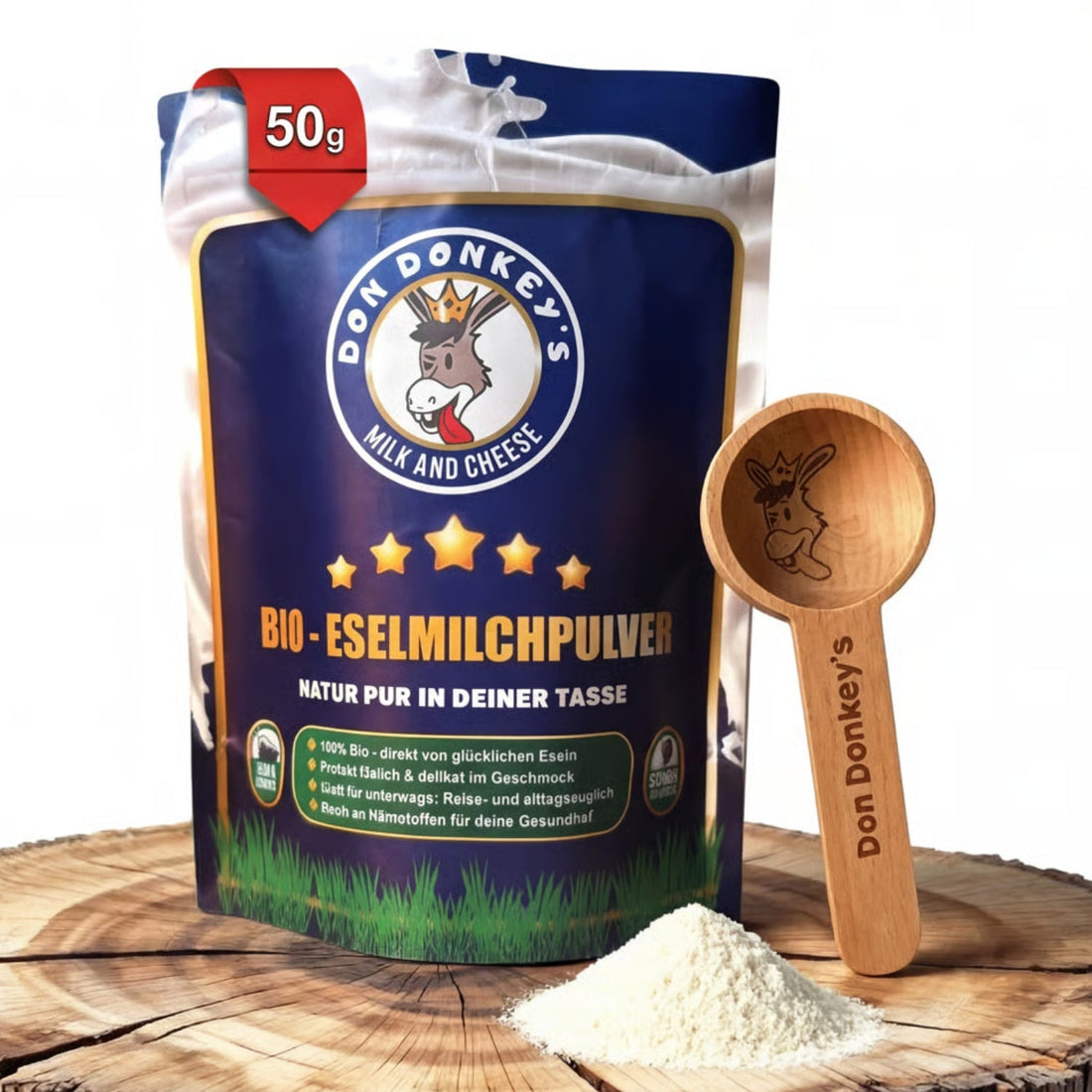
Donkey Milk Powder
Donkey milk in powder form
For anyone who prefers a longer shelf life: our donkey milk in powder form – easy to store and portion.
20g · Unit price: €1.245,00 / 1 kg · incl. VAT, plus shipping