
 Buyer protection

Research on donkey milk · Study 38
Raw donkey milk in a laboratory experiment
In 2026, Mazzone et al. examined how a gastric tumour cell line (AGS) responds in the laboratory when raw donkey milk from an Italian farm is mixed into its culture medium.
What it's about
Whole milk instead of individual components
Unlike many laboratory studies, this Italian team did not work with isolated components but with raw donkey milk: collected from 31 jennies on a farm in Abruzzo and processed within 24 hours.
The milk was mixed into the cells' culture medium in four proportions – from 25 to 100 per cent. Migration, viability, cell stress, cell cycle and the activity of nine genes were measured.
Research groups from the universities of Chieti-Pescara and Molise were involved.
What exactly was studied?
Briefly explained
The terms used in this study
A cell line from human gastric tumour tissue used in basic research.
An enzyme that leaks out of cells when their membrane is damaged. More LDH in the medium means more damaged cells.
A reactive oxygen species produced in the mitochondria – the power plants of the cell.
Opponents in programmed cell death (apoptosis). BAX promotes it, BCL-2 slows it down.
Milk from 31 healthy jennies, by stage of lactation and as pooled milk.
Chilled, processed within 24 hours and skimmed by centrifugation.
AGS cells received medium with 25, 50, 75 or 100 % donkey milk.
Migration, viability, LDH, superoxide, cell cycle and gene activity.
Interactive · The data at a glance
Four proportions, five measurements
How was the milk used, how did the cells respond to the individual proportions – and what changed in cell stress, cell cycle and genes? Switch between the views.
75 % donkey milk
G1 phase ↓
S phase ↑
G2 phase ↑
100 % donkey milk
G1 phase –
S phase –
G2 phase ↑
Illustration of the findings reported in the original publication. Some measured values are only given graphically there; the graphics are schematic.
Key findings
What the researchers report
Depending on the proportion
25 % ↑ · 50 % = · 75–100 % ↓Low proportions of donkey milk slightly increased cell viability, 50 % had no effect. Only at 75 and 100 % did it decrease – and at 100 % the cells migrated considerably less.
More LDH and superoxide
LDH ≈ 2× at 100 %At 100 % donkey milk, about twice as much LDH leaked out of the cells. Superoxide in the mitochondria rose with the proportion. The cell cycle also shifted.
No classic cell death
BAX ↓ · inflammation genes ↑The cell death gene BAX was not increased but less active. The authors therefore speak of an effect that probably does not run via apoptosis. Several inflammation genes rose at 100 %.
The authors describe the effects as dependent on concentration and context and call for studies on organoids and animal models. The results come from cell cultures and do not allow any statement about the prevention or treatment of cancer in humans.
Critical assessment
Basic research – nothing more
What the study shows
What it does not show
Research question for DON DONKEY’S®
How stable is our milk over the lactation?
The Italian team found no major differences in composition between early, middle and late stages of lactation. For us, this is a prompt to document our own milk over the year.
Original publication
Potential Anticancer Activity of Donkey Milk in Human Gastric Adenocarcinoma (AGS) Cell Line
Mazzone M., Di Marcantonio M. C., Fatica A., Mencarelli N., Gallorini M., Sindaco M., Muraro R., Cataldi A., Salimei E., Mincione G.
Biology · 2026 · 15(15):1279
DOI: 10.3390/biology15151279
Full text: MDPI Biology
The publication describes cell experiments. It does not allow any product-related statement for DON DONKEY’S® or any statement about cancer in humans.
The study summarised above was carried out independently of DON DONKEY’S® and does not relate to our products. It serves solely to inform about the state of research.
DON DONKEY’S® donkey milk and donkey milk powder are foods. They are not intended to prevent, treat or cure any disease – including cancer – and do not replace medical advice or treatment.

From our shop
DON DONKEY’S® donkey milk
100 % donkey milk · raw milk, frozen
On this page we report the findings of a published study. Independently of that, you will find our donkey milk here: 100 % donkey milk, frozen as raw milk.
100 ml bottle / 100ml · Unit price: €249,00 / 1 l · incl. VAT, plus shipping
Also in our shop
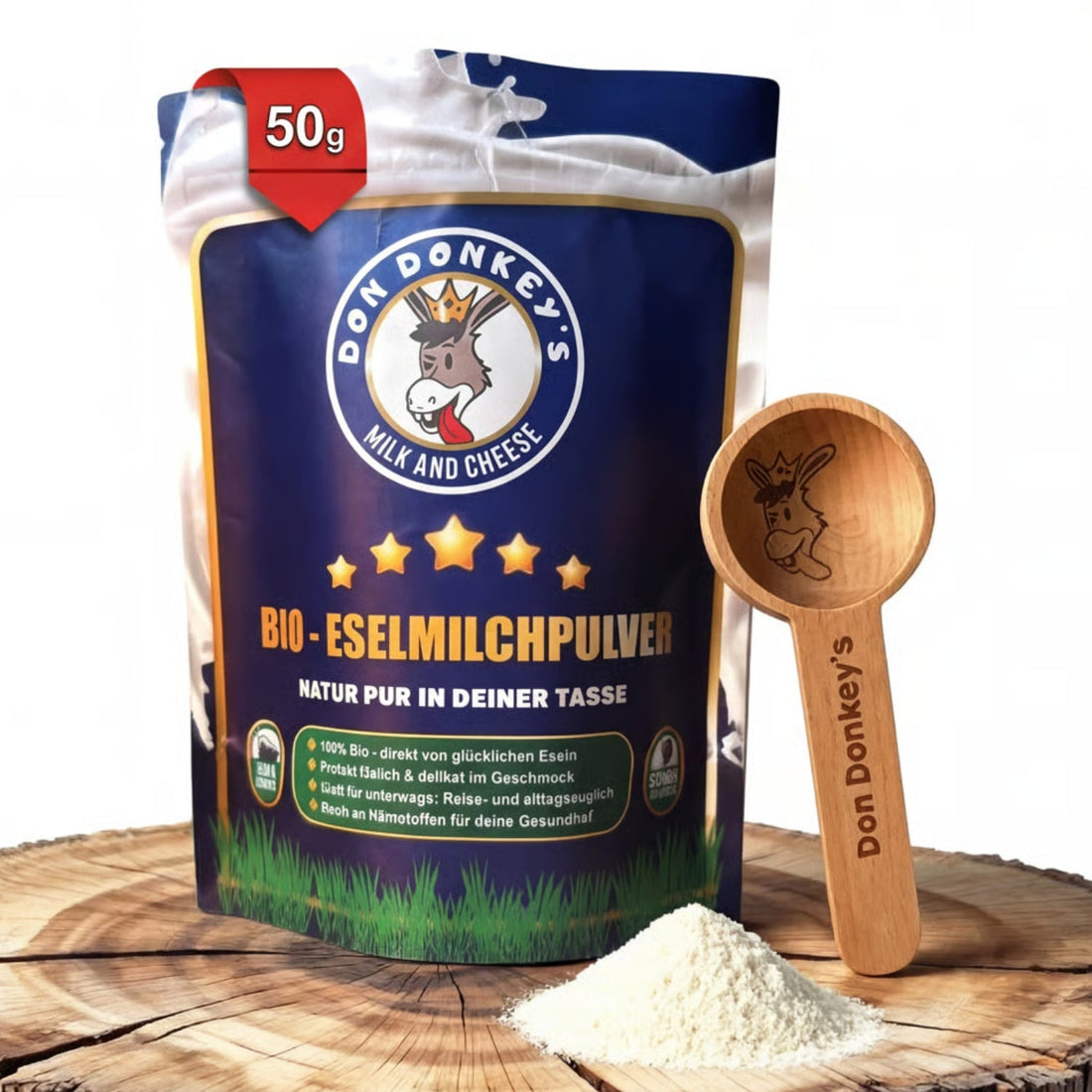
Donkey Milk Powder
Donkey milk in powder form
For anyone who prefers a longer shelf life: our donkey milk in powder form – easy to store and portion.
20g · Unit price: €1.245,00 / 1 kg · incl. VAT, plus shipping