
 Buyer protection

Research on donkey milk · Study 34
Donkey milk and the gastric mucosa
In 2025, Sami et al. examined whether giving donkey milk to rats for ten days influences how severely the gastric mucosa is damaged by alcohol.
What it's about
A stress test for the stomach
High-proof alcohol attacks the protective mucus layer of the stomach. In research this is deliberately induced in rats to test whether prior administration of certain substances influences the mucosal damage.
A research team from Iran gave rats donkey milk orally every day for ten days. A comparison group received the stomach medication ranitidine, a control group water.
The mucosa was then examined histologically and two markers of oxidative stress were measured in the stomach tissue.
What exactly was studied?
Briefly explained
The terms used in this study
Highly concentrated alcohol is given orally to rats and briefly damages the gastric mucosa.
A medication that reduces stomach acid. It served as a comparison group to classify the model.
Malondialdehyde forms when fats in cell membranes are damaged by oxidative stress.
An antioxidant produced by the body (GSH) that protects cells against oxidative stress.
Donkey milk, ranitidine or water orally every day for ten days.
Before the test, the rats received no food for 24 hours.
Ethanol was given orally to damage the mucosa.
One hour later, stomach tissue, MDA and glutathione were examined.
Interactive · The data at a glance
Ten days, one hour
How was the experiment run, which groups were there – and what was found in the mucosa and stress markers? Switch between the views.
Illustration of the findings reported in the abstract of the original publication. Individual measured values are not given there; the graphics are schematic.
Key findings
What the researchers report
Less damage
histological examinationAccording to the authors, in rats that had received donkey milk for ten days, the mucosal damage caused by ethanol was significantly less severe.
Less MDA
malondialdehyde ↓In the stomach tissue, the stress marker MDA was lower. It indicates how strongly fats in the cell membranes are attacked by oxidative stress.
More glutathione
GSH ↑The content of the body's own antioxidant glutathione in the stomach tissue was higher than in rats without pretreatment.
The authors speak of protective and antioxidant effects in the rat model. The results come from an artificially induced animal model and cannot be transferred to humans.
Critical assessment
A signal in the animal model
What the study shows
What it does not show
Research question for DON DONKEY’S®
What is the antioxidant capacity of our milk?
The study draws attention to oxidative stress. For us, this is a prompt to have the antioxidant capacity of our fresh milk and our powder measured.
Original publication
Protective Effects of Donkey Milk on Ethanol-Induced Gastric Ulcer in Rat
Sami M., Azizi S., Kheirandish R., Ebrahimnejad H., Alizadeh S.
Veterinary Medicine and Science · 2025 · 11(1):e70156
DOI: 10.1002/vms3.70156
Full text: PubMed Central
The publication describes an animal experiment with donkey milk. It does not allow any product-related statement for DON DONKEY’S®.

From our shop
DON DONKEY’S® donkey milk
100 % donkey milk · raw milk, frozen
On this page we report the findings of a published study. Independently of that, you will find our donkey milk here: 100 % donkey milk, frozen as raw milk.
100 ml bottle / 100ml · Unit price: €249,00 / 1 l · incl. VAT, plus shipping
Also in our shop
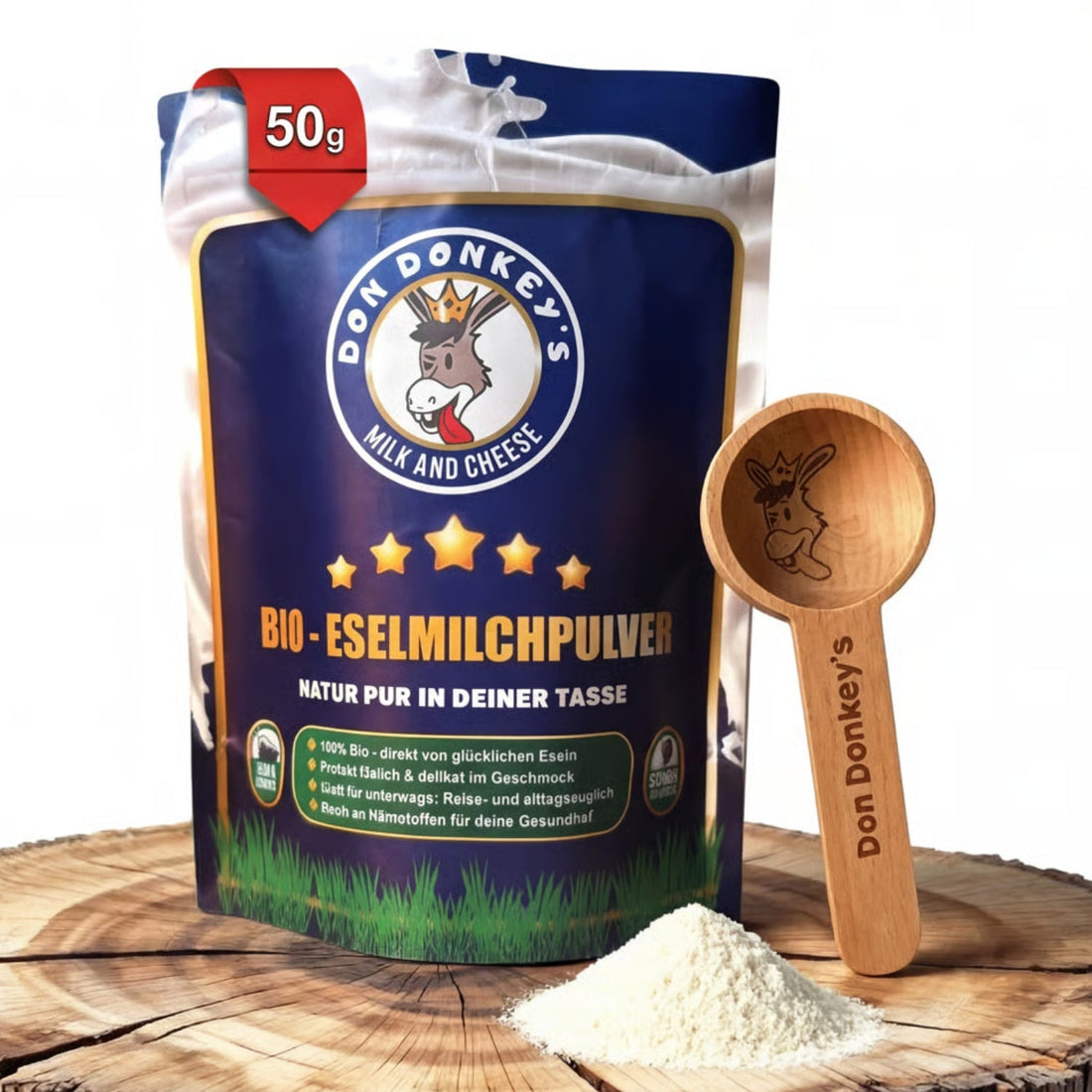
Donkey Milk Powder
Donkey milk in powder form
For anyone who prefers a longer shelf life: our donkey milk in powder form – easy to store and portion.
20g · Unit price: €1.245,00 / 1 kg · incl. VAT, plus shipping