
 Buyer protection

Research on donkey milk · Study 32
Donkey milk and skin cells
In 2020, Kocic et al. examined in the laboratory how connective tissue cells of the skin respond to donkey milk and human breast milk – measured by their internal signalling pathways.
What it's about
What skin cells "hear"
Fibroblasts form the connective tissue of the skin. Whether they divide, rest or pass on inflammatory signals is controlled via a chain of signalling proteins inside the cell.
A research team from Serbia, Slovenia, the UK and Germany applied diluted donkey milk and human breast milk to such cells and measured which of these signalling proteins became more or less active.
For comparison, the researchers tested two individual milk components: β-casein and the peptide β-casomorphin-7.
What exactly was studied?
Briefly explained
The terms used in this study
Connective tissue cell of the skin. It produces collagen and other supporting proteins and is involved in skin renewal.
The milk of the first days after birth. Its composition differs from that of the later, mature milk.
Kinases that pass on signals inside the cell – among other things for growth and division.
Proteins that can switch on inflammatory processes in the cell.
Colostrum and mature milk from five jennies and five breastfeeding women.
Briefly heated to 60 °C, frozen, adjusted to the same protein content and diluted 1:100.
The diluted samples remained on the skin cells for 24 hours.
Flow cytometry was used to determine how much of the signalling proteins the cells contained.
Interactive · The data at a glance
Six samples, six signals
How was the experiment set up, how do donkey milk and breast milk differ – and what happened to growth and inflammatory signals? Switch between the views.
Illustration of the findings reported in the original publication. Exact measured values for each group are only given graphically there; the factors are rounded and the graphics schematic.
Key findings
What the researchers report
p-Erk clearly more active
approx. 3–4-fold · all milk samplesThe active form of the kinase Erk1/2 rose to about three to four times in all treated groups, and to about five times after β-casein. Akt as well as JNK and p-JNK (up to +45 %) were also increased.
NF-κB and STAT-1 quieter
NF-κB p65 ↓ · p-STAT-1 ↓Donkey milk – colostrum as well as mature milk – lowered the amount of NF-κB p65 in the cells. After mature donkey milk, activated STAT-1 was also significantly lower.
Similar, but not the same
CD26 · cell viabilityBreast milk increased the surface marker CD26, donkey milk did not. None of the milk samples significantly affected cell viability – only the single peptide β-casomorphin-7 did.
The authors suspect that peptides other than casein are behind the effects of donkey milk on inflammatory signals and consider donkey milk interesting for regenerative and aesthetic skin research. The results come from mouse cell cultures and cannot be transferred to humans.
Critical assessment
A look inside the cell
What the study shows
What it does not show
Research question for DON DONKEY’S®
Which peptides are in our milk?
The authors suspect peptides other than casein are behind the findings. For us, this is a prompt to look more closely at the protein profile of our mature milk.
Original publication
The Regenerative Potential of Donkey and Human Milk on the Redox-Sensitive and Proliferative Signaling Pathways of Skin Fibroblasts
Kocic H., Langerholc T., Kostic M., Stojanovic S., Najman S., Krstic M., Nesic I., Godic A., Wollina U.
Oxidative Medicine and Cellular Longevity · 2020 · 2020:5618127
DOI: 10.1155/2020/5618127
Full text: PubMed Central
The publication describes a cell experiment with donkey milk and breast milk. It does not allow any product-related statement for DON DONKEY’S®.

From our shop
DON DONKEY’S® donkey milk
100 % donkey milk · raw milk, frozen
On this page we report the findings of a published study. Independently of that, you will find our donkey milk here: 100 % donkey milk, frozen as raw milk.
100 ml bottle / 100ml · Unit price: €249,00 / 1 l · incl. VAT, plus shipping
Also in our shop
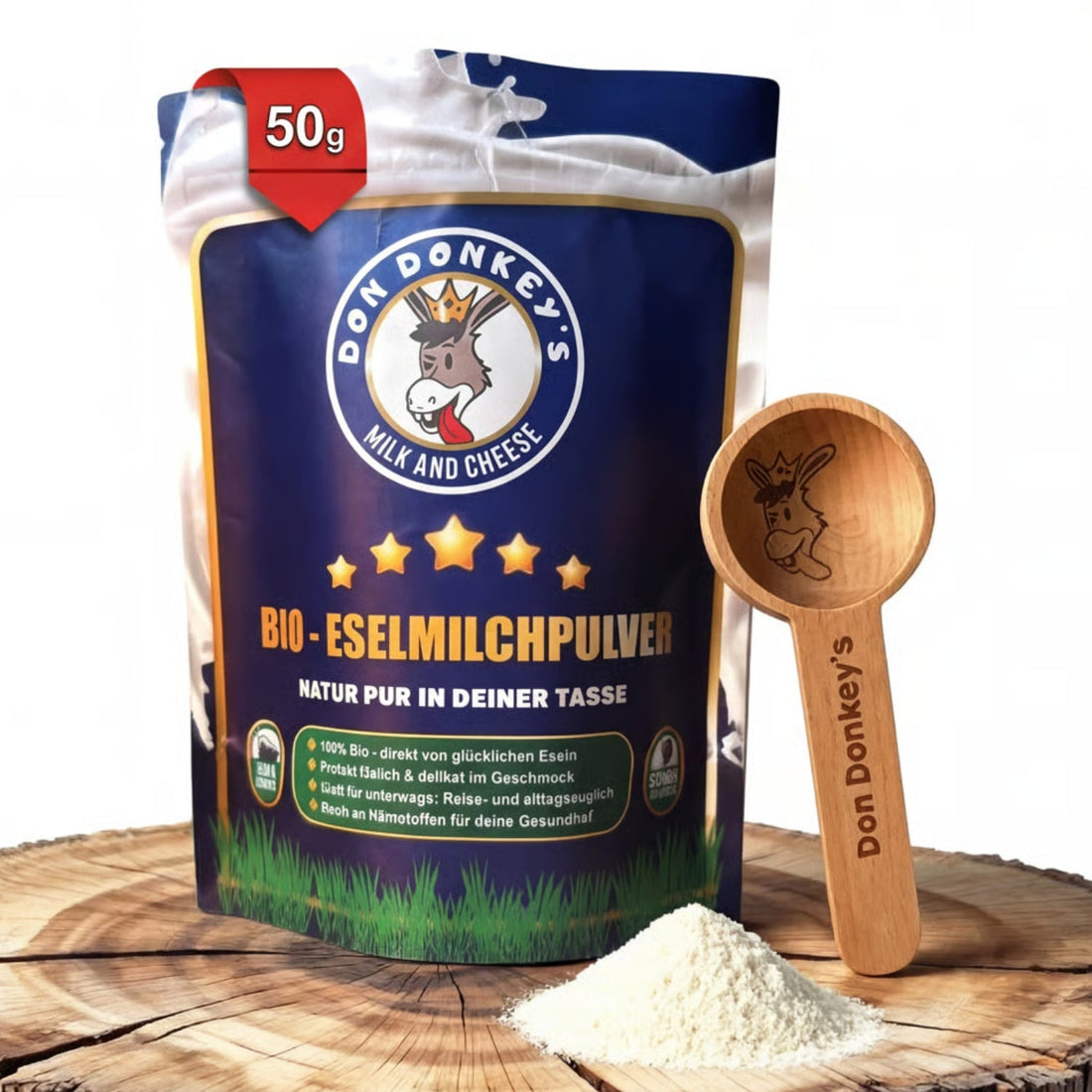
Donkey Milk Powder
Donkey milk in powder form
For anyone who prefers a longer shelf life: our donkey milk in powder form – easy to store and portion.
20g · Unit price: €1.245,00 / 1 kg · incl. VAT, plus shipping