
 Buyer protection

Donkey milk research · Study 213
Donkey milk in a digestion model: 46 peptides and a lab test for ACE inhibition
After a laboratory-simulated gastrointestinal digestion of donkey milk, the researchers identified 46 peptides, 30 of them from β-casein. In the test tube, the digest inhibited angiotensin-converting enzyme (ACE) with an IC50 of 273.0 ± 27.9 µg/mL; the synthetically produced β-casein peptide VAPFPQPVVP reached an IC50 of 48.8 ± 2.3 µM.
At a glance · tap the cards
The key figures
Study design
How it was studied
Lab study from Spain. Donkey milk was subjected to simulated gastrointestinal digestion in the test tube, first with pepsin and then with a mixture of pancreatic enzymes. The digest was analysed for peptides by HPLC-MS/MS and tested for its ability to inhibit angiotensin-converting enzyme (ACE). One of the most abundant peptides, the β-casein fragment f(176–185) with the sequence VAPFPQPVVP, was synthesised and tested on its own. Assessed based on the abstract; origin and number of milk samples, enzyme amounts and digestion times are not stated there.
Results
What the study measured
HPLC-MS/MS identified 46 peptides in the digest, 30 of them from β-casein.
In the lab assay, the whole digest inhibited ACE with an IC50 of 273.0 ± 27.9 µg/mL.
The β-casein fragment f(176–185) with the sequence VAPFPQPVVP was among the most abundant peptides in the digest.
When synthesised, this peptide showed what the authors describe as very potent ACE inhibition, with an IC50 of 48.8 ± 2.3 µM.
To the authors’ knowledge, this was the first report of a bioactive peptide from donkey milk.
Authors’ conclusion: Simulated digestion of donkey milk produces peptides with ACE-inhibitory activity in the lab, including a particularly active fragment of β-casein. Whether such peptides are formed in this form in the human gut, are absorbed and influence blood pressure is not shown by this study.
Critical appraisal
Strengths and limitations
Only the abstract assessedClear limitation
Milk origin, number of samples, enzyme amounts and digestion times are missing. Funding and conflicts of interest could not be checked.
Test tube instead of bodyClear limitation
Digestion was simulated with enzymes. Absorption, breakdown and effect in the body were not studied.
Synthetic single peptideNote
The low IC50 applies to the synthesised peptide in pure form, not to the concentration in which it would be present after drinking milk.
Origin of the groupNote
The available material does not name the institutions; the attribution to Spain is based on the study context.
From mixture to single peptideStrength
The authors identified peptides, tested the mixture and then examined one abundant peptide on its own – a traceable approach.
Editorial note: The paper shows which peptides can arise from donkey milk in a digestion model and provides concrete lab values for ACE inhibition. This is basic research on constituents. No statement about blood pressure or health in humans can be derived from it. To the research archive.
Research question for DON DONKEY’S®
Do thawed raw donkey milk and donkey milk powder give comparable peptide patterns in the same digestion model, for example for the β-casein fragment f(176–185)?
Original publication
In vitro simulated gastrointestinal digestion of donkeys’ milk. Peptide characterization by high performance liquid chromatography–tandem mass spectrometry
Original title: In vitro simulated gastrointestinal digestion of donkeys’ milk. Peptide characterization by high performance liquid chromatography–tandem mass spectrometry
Bidasolo I. B., Ramos M., Gomez-Ruiz J. A.
International Dairy Journal · 2012 · 24(2), 146–152
Research group in Spain; institution not stated in the available material
DOI: 10.1016/j.idairyj.2011.04.014
Transparency: funding and conflicts of interest could not be checked from the abstract. No product-related statement for DON DONKEY’S®.
Summarised and checked by the DON DONKEY’S editorial team against the original publication · As of: November 2026
The study summarised above was carried out independently of DON DONKEY’S® and does not relate to our products. It serves solely to inform about the state of research.
DON DONKEY’S® donkey milk and donkey milk powder are foods. They are not intended to prevent, treat or cure any disease and do not replace medical advice.

From our shop
DON DONKEY’S® donkey milk
100 % donkey milk · raw milk, frozen
On this page we report the findings of a published study. Independently of that, you will find our donkey milk here: 100 % donkey milk, frozen as raw milk.
100 ml bottle / 100ml · Unit price: €249,00 / 1 l · incl. VAT, plus shipping
Also in our shop
Donkey Milk Powder
Donkey milk in powder form
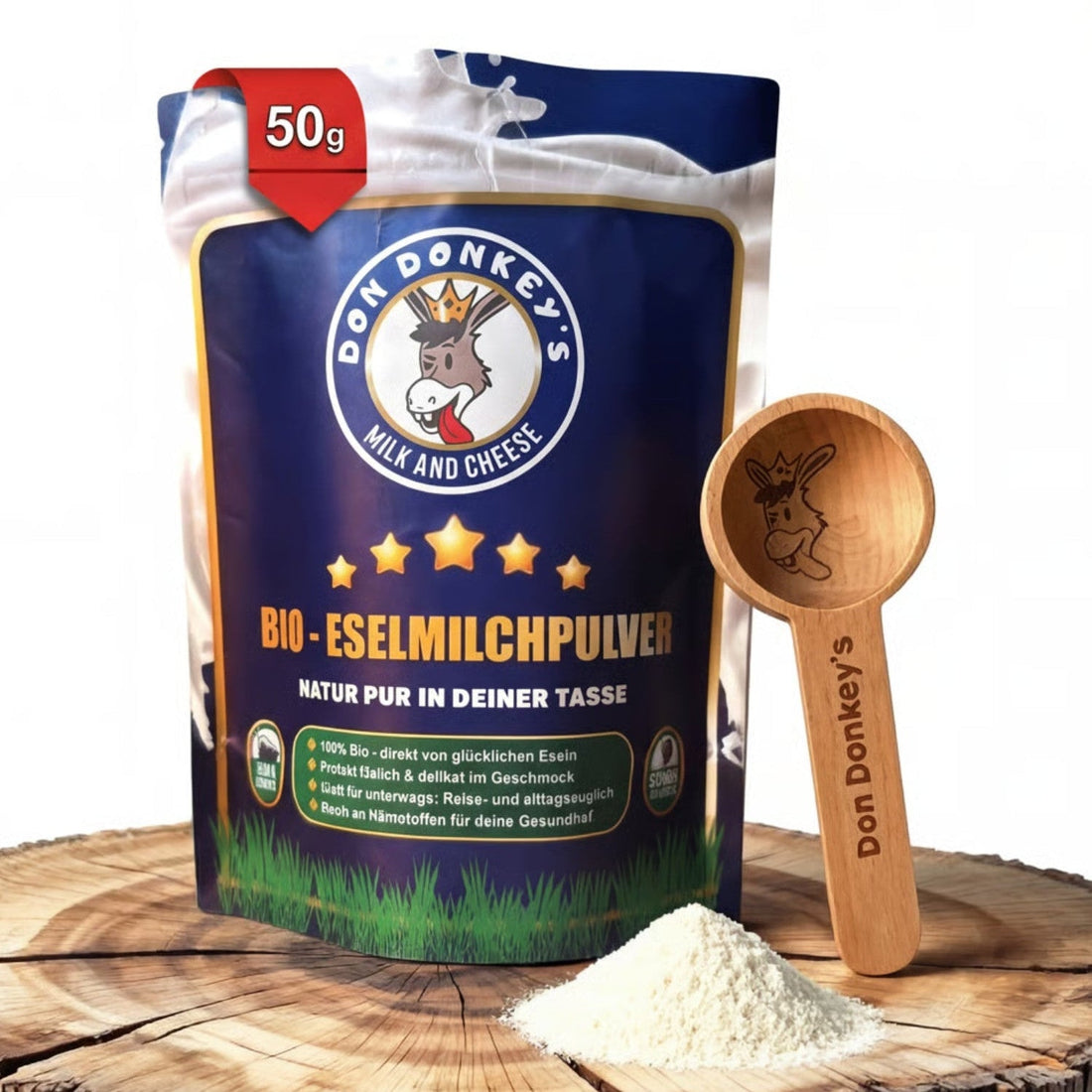
For anyone who prefers a longer shelf life: our donkey milk in powder form – easy to store and portion.
20g · Unit price: €1.245,00 / 1 kg · incl. VAT, plus shipping