
 Buyer protection

Donkey milk research · Study 212
Donkey milk kefir: honey, rosemary oil and cold storage
In donkey milk kefir, the antioxidant activity measured in the lab depended strongly on the added ingredient: ABTS values were highest with rosemary oil, FRAP values with sulla honey. During refrigerated storage activity increased and peaked after 15 days; honey kefir achieved the highest consumer acceptance.
At a glance · swipe or use the arrows
The key figures
Study design
How it was studied
Food analysis from Italy. Donkey milk kefir was produced plain and fortified with sulla honey or with rosemary essential oil and stored refrigerated. During storage, phenolic and thiol contents and antioxidant activity were determined using two lab assays (ABTS and FRAP). In addition, consumers rated the kefir variants in a sensory evaluation. Assessed based on the abstract; total storage time, amounts added, number of assessors and measured values are not stated there.
Results
What the study measured
The type of flavouring strongly influenced antioxidant activity in the lab assays: rosemary oil kefir had the highest ABTS values, honey kefir the highest FRAP values.
In both fortified kefirs the thiol content decreased. The authors suggest polyphenol–protein complexes as the cause, which might influence the availability of bioactive components.
Antioxidant activity increased significantly during refrigerated storage and was highest after 15 days.
The donkey milk kefir was well accepted in the sensory evaluation.
Adding sulla honey resulted in the highest acceptability; kefir with rosemary oil was less well accepted.
Authors’ conclusion: The results provide a basis for fortified donkey milk kefir with “specific nutraceutical characteristics”. Lab values in the product and acceptance were measured; any effect in humans was not examined.
Critical appraisal
Strengths and limitations
Only the abstract assessedClear limitation
Amounts added, total storage time, measured values and number of assessors are missing. Funding and conflicts of interest could not be checked.
Lab assay is not the bodyClear limitation
ABTS and FRAP measure chemical reactions in the test tube. No antioxidant effect upon consumption follows from them.
Ingredients bring their own activityNote
Honey and rosemary oil have antioxidant properties of their own. The higher values are therefore not due to the donkey milk alone.
Origin of the groupNote
The available material does not name the institutions; the attribution to Italy is based on the study context.
Storage course and sensory dataStrength
Values were tracked during refrigerated storage and complemented by a consumer rating – practical data for product development.
Editorial note: The paper shows how ingredients and storage change the lab-measured properties of a donkey milk kefir and how consumers accept the variants. This is useful for product development. It allows no statements about health effects. To the research archive.
Research question for DON DONKEY’S®
How do pH, taste and lab values of a kefir made from our thawed donkey milk develop over 15 days of refrigerated storage?
Original publication
Phenolic content and antioxidant activity of donkey milk kefir fortified with sulla honey and rosemary essential oil during refrigerated storage
Original title: Phenolic content and antioxidant activity of donkey milk kefir fortified with sulla honey and rosemary essential oil during refrigerated storage
Perna A., Simonetti A., Gambacorta E.
International Journal of Dairy Technology · 2019 · 72(1), 74–81
Research group in Italy; institution not stated in the available material
Transparency: funding and conflicts of interest could not be checked from the abstract. No product-related statement for DON DONKEY’S®.
Summarised and checked by the DON DONKEY’S editorial team against the original publication · As of: November 2026
The study summarised above was carried out independently of DON DONKEY’S® and does not relate to our products. It serves solely to inform about the state of research.
DON DONKEY’S® donkey milk and donkey milk powder are foods. They are not intended to prevent, treat or cure any disease and do not replace medical advice.

From our shop
DON DONKEY’S® donkey milk
100 % donkey milk · raw milk, frozen
On this page we report the findings of a published study. Independently of that, you will find our donkey milk here: 100 % donkey milk, frozen as raw milk.
100 ml bottle / 100ml · Unit price: €249,00 / 1 l · incl. VAT, plus shipping
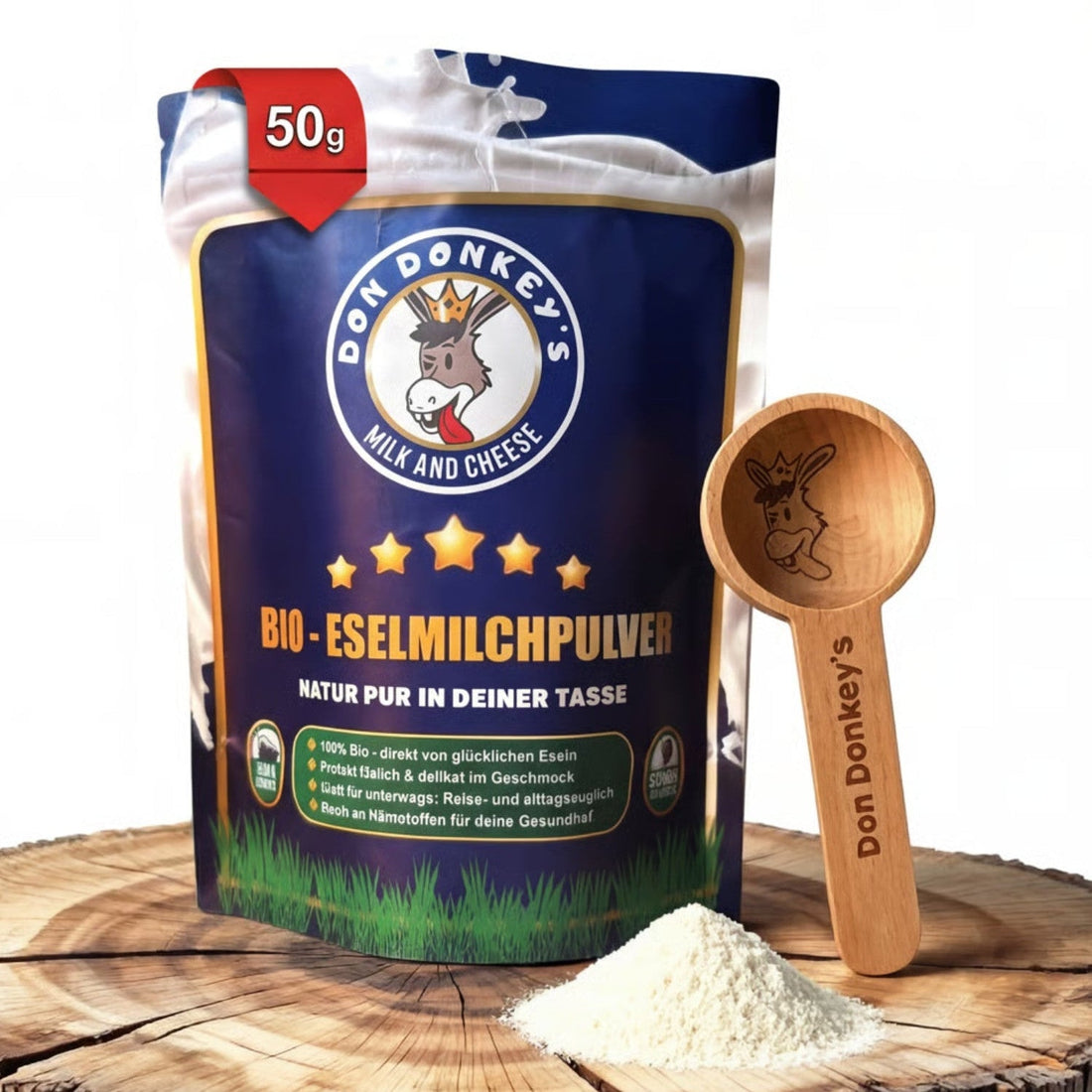
Also in our shop
Donkey Milk Powder
Donkey milk in powder form
For anyone who prefers a longer shelf life: our donkey milk in powder form – easy to store and portion.
20g · Unit price: €1.245,00 / 1 kg · incl. VAT, plus shipping