
 Buyer protection

Donkey milk research · Study 211
Donkey milk in the cheese dairy: less late blowing in semi-hard cheese
The more raw donkey milk was added to cow milk during cheesemaking, the less often late blowing defects occurred in semi-hard cheese after 120 days of ripening; pH, total bacterial count and Clostridium tyrobutyricum spores also decreased. 80 consumers found no sensory differences between the cheeses.
At a glance · tap the cards
The key figures
Study design
How it was studied
Cheesemaking trial by the School of Agricultural, Forestry, Food and Environmental Sciences, University of Basilicata (Potenza, Italy). Different amounts of raw donkey milk were added to two groups of 4 vats, each containing a fixed amount of bulk cow milk. One group was deliberately inoculated with about 3 log10 CFU/mL Clostridium tyrobutyricum CLST01, the other was not. After 120 days of ripening, physical, chemical and microbiological parameters of the semi-hard cheeses were determined; the non-inoculated cheeses were evaluated by 80 regular cheese consumers. Assessed based on the abstract; the exact donkey milk proportions, replicates and measured values are not stated there.
Results
What the study measured
With increasing donkey milk share, pH and total bacterial count decreased in both cheese groups.
Clostridium tyrobutyricum spores also decreased – both naturally occurring and artificially inoculated ones.
The authors observed a progressive reduction in late blowing defects the more donkey milk was added during cheesemaking.
80 consumers found no differences in sensory attributes between the non-inoculated cheeses; acceptability was unchanged.
The authors regard the results as confirming the antimicrobial activity of lysozyme in donkey milk.
Authors’ conclusion: Raw donkey milk is recommended as a possible and viable alternative to egg lysozyme for controlling late blowing in cheese. The study concerns cheese defects caused by clostridia in the product; no statements about effects of donkey milk in humans can be derived from it.
Critical appraisal
Strengths and limitations
Only the abstract assessedClear limitation
Donkey milk amounts added, measured values, replicates and statistics are missing. According to the database the study received public funding; details and conflicts of interest could not be checked.
Lysozyme not measured directlyNote
Whether the effect is due to lysozyme alone is, according to the abstract, the authors’ interpretation. A lysozyme measurement in the cheese is not reported there.
One clostridial strainNote
A single strain was used for inoculation. Other strains and natural contamination in practice may behave differently.
Small trial scaleNote
Two groups of 4 vats are usual for a cheesemaking trial but allow only limited statements about large-scale production.
Inoculated and non-inoculated groupsStrength
Comparing natural and deliberately increased clostridial load, plus a consumer test with 80 people, gives the trial a practical design.
Editorial note: An interesting technological finding: donkey milk as an ingredient in cheesemaking was associated with less late blowing in this trial, without consumers noticing differences in taste. This concerns cheese quality, not health. Without the full text, the amounts needed remain unknown. To the research archive.
Research question for DON DONKEY’S®
Is the lysozyme activity of our frozen donkey milk preserved after thawing – measurable by batch analysis before and after storage?
Original publication
Effect of jenny milk addition on the inhibition of late blowing in semihard cheese.
Original title: Effect of jenny milk addition on the inhibition of late blowing in semihard cheese.
Cosentino C., Paolino R., Valentini V., Musto M., Ricciardi A., Adduci F., D’Adamo C., Pecora G., Freschi P.
Journal of Dairy Science · 2015 · 98(8), 5133–5142
School of Agricultural, Forestry, Food, and Environmental Sciences, University of Basilicata, Potenza, Italy (according to the authors)
Transparency: publicly funded according to the database entry (non-US government support); funder details and conflicts of interest could not be checked from the abstract. No product-related statement for DON DONKEY’S®.
Summarised and checked by the DON DONKEY’S editorial team against the original publication · As of: November 2026
The study summarised above was carried out independently of DON DONKEY’S® and does not relate to our products. It serves solely to inform about the state of research.
DON DONKEY’S® donkey milk and donkey milk powder are foods. They are not intended to prevent, treat or cure any disease and do not replace medical advice.

From our shop
DON DONKEY’S® donkey milk
100 % donkey milk · raw milk, frozen
On this page we report the findings of a published study. Independently of that, you will find our donkey milk here: 100 % donkey milk, frozen as raw milk.
100 ml bottle / 100ml · Unit price: €249,00 / 1 l · incl. VAT, plus shipping
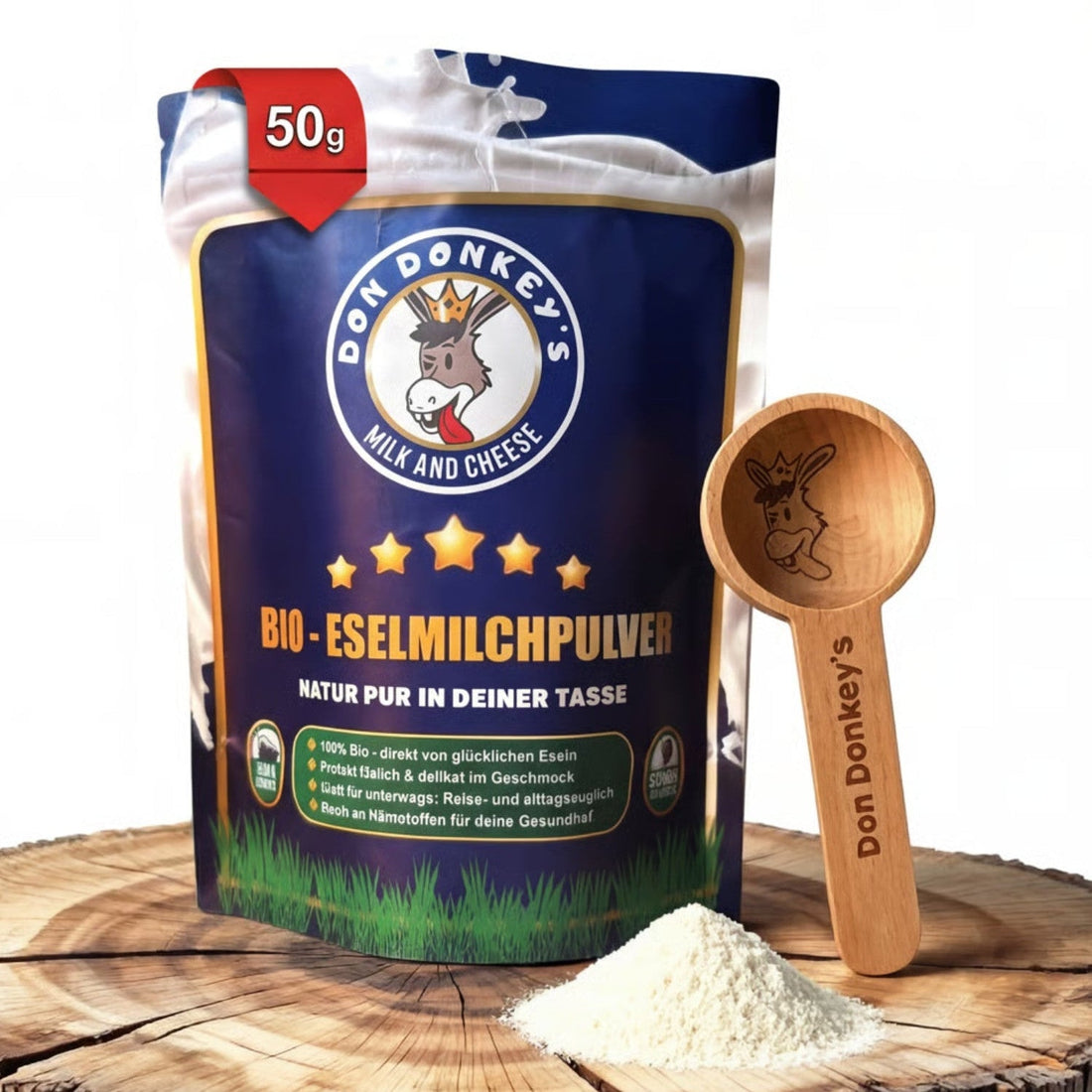
Also in our shop
Donkey Milk Powder
Donkey milk in powder form
For anyone who prefers a longer shelf life: our donkey milk in powder form – easy to store and portion.
20g · Unit price: €1.245,00 / 1 kg · incl. VAT, plus shipping