
 Buyer protection

Donkey milk research · Study 209
Animal health and milk quality: a check in 31 Amiata jennies
In 31 lactating Amiata jennies the authors found strongyles (intestinal parasites) in 96.77% of animals, while all blood tests for Brucella, Leptospira, Salmonella abortus equi and two equine viruses were negative. In the milk, Staphylococcus aureus was detected in 3.22% of the first samples; 124 milk samples contained on average 0.40 g fat, 1.57 g protein and 7.23 g lactose per 100 mL.
At a glance · tap the cards
The key figures
Study design
How it was studied
Study by the Istituto Zooprofilattico Sperimentale for Lazio and Tuscany (Scandicci) together with the University of Pisa on a donkey dairy farm in Tuscany (Italy). 31 lactating Amiata jennies were examined clinically (body condition, temperature, pulse, respiration). Faecal samples (parasites), cervical swabs (bacteria causing reproductive disorders), blood samples (serology for Brucella spp., Leptospira spp., Salmonella abortus equi, equine arteritis virus, equine herpesvirus type 1) and individual milk samples (mastitis pathogens in two samplings, composition, fatty acids, lysozyme, somatic cell count; n = 124 for composition) were collected. The full text from PMC was used; however, the methods section was only partly available, so the sampling period and analytical methods are not described in detail.
Interactive chart · values from the study
Findings in 31 jennies (prevalence)
Source: Table 3 of the study. Not shown: agents at 0% (including all serologically tested infections).
Second analysis
Fatty acid classes in Amiata donkey milk
Source: Table 4 of the study, means (n = 124 milk samples).
Results
What the study measured
Clinically, the animals had a mean body condition score of 3.6 (range 3 to 4), a body temperature of 37.06 °C, 40.52 heartbeats and 21.16 breaths per minute.
Faecal samples showed strongyles in 96.77%, Dictyocaulus arnfieldi in 19.35% and Oxyuris equi in 3.22% of animals; Fasciola hepatica was not detected.
Cervical swabs yielded Streptococcus equi zooepidemicus (9.68%) and Klebsiella pneumoniae (6.44%), but not Taylorella equigenitalis or Pseudomonas aeruginosa. All serological tests were negative.
In the first milk sample Staphylococcus aureus was detected in 3.22%, in the second sample Streptococcus equi zooepidemicus in 6.44%; the other mastitis pathogens tested were not found.
The milk (n = 124) contained on average 1.57 g protein, 0.75 g casein, 0.40 g fat and 7.23 g lactose per 100 mL; lysozyme activity 3986.21 U/mL, somatic cells 9.06 × 10³ per mL.
Saturated fatty acids made up 56.65%, monounsaturated 22.17% and polyunsaturated 21.18% of total fat; the n6:n3 ratio was 1.65.
Authors’ conclusion: Parasite infections should be tackled selectively with as little anthelmintic use as possible, withdrawal periods must follow EU and national rules, and the detection of S. aureus highlights the importance of milking hygiene. Beyond this, the authors consider donkey milk suitable for children with cow milk protein allergy and adults with dyslipidaemia – this was not examined in this study, and we do not adopt it. Donkey milk is not a substitute for breast milk or infant formula; infant feeding belongs in medical hands.
Critical appraisal
Strengths and limitations
One farm, one breedClear limitation
All 31 jennies came from one farm in Tuscany. Other herds, breeds and husbandry systems may show different findings.
Health claims without dataClear limitation
Statements about allergies, blood lipids and cardiovascular disease are not based on measurements from this study. Animals and milk were studied, not people.
Methods section incompleteNote
The full text was only partly available. Sampling period, interval between the two milk samplings and analytical methods could not be checked.
Small numbers for rare findingsNote
With 31 animals, prevalences of around 3% correspond to very few animals. Such values are correspondingly uncertain.
Broad, transparent testing programmeStrength
Parasites, reproductive pathogens, serology, udder health and milk quality were assessed in the same animals and reported with table values. Public funding, no conflicts of interest declared.
Editorial note: The study links animal health with milk quality and provides concrete values for parasites, pathogens, composition and cell count. Of practical relevance are the pointers on deworming, withdrawal periods and milking hygiene. The far-reaching health statements at the end of the abstract go beyond the study’s own data. To the research archive.
Research question for DON DONKEY’S®
Which animal health data – deworming plan, withdrawal periods, cell count and udder findings – can be documented per partner farm and batch and made traceable for customers?
Original publication
Amiata Donkey Milk Chain: Animal Health Evaluation and Milk Quality.
Original title: Amiata Donkey Milk Chain: Animal Health Evaluation and Milk Quality.
Ragona G., Corrias F., Benedetti M., Paladini M., Salari F., Altomonte I., Martini M.
Italian Journal of Food Safety · 2016 · 5(3), 5951
Istituto Zooprofilattico Sperimentale del Lazio e della Toscana, Scandicci; Department of Veterinary Sciences and Interdepartmental Centre of Agro-Environmental Research “Enrico Avanzi”, University of Pisa, Italy (according to the paper)
Transparency: funded by the regional government of Tuscany (public call for research projects in nutraceutics). The authors declare no conflicts of interest. No product-related statement for DON DONKEY’S®.
Summarised and checked by the DON DONKEY’S editorial team against the original publication · As of: November 2026
The study summarised above was carried out independently of DON DONKEY’S® and does not relate to our products. It serves solely to inform about the state of research.
DON DONKEY’S® donkey milk and donkey milk powder are foods. They are not intended to prevent, treat or cure any disease and do not replace medical advice.

From our shop
DON DONKEY’S® donkey milk
100 % donkey milk · raw milk, frozen
On this page we report the findings of a published study. Independently of that, you will find our donkey milk here: 100 % donkey milk, frozen as raw milk.
100 ml bottle / 100ml · Unit price: €249,00 / 1 l · incl. VAT, plus shipping
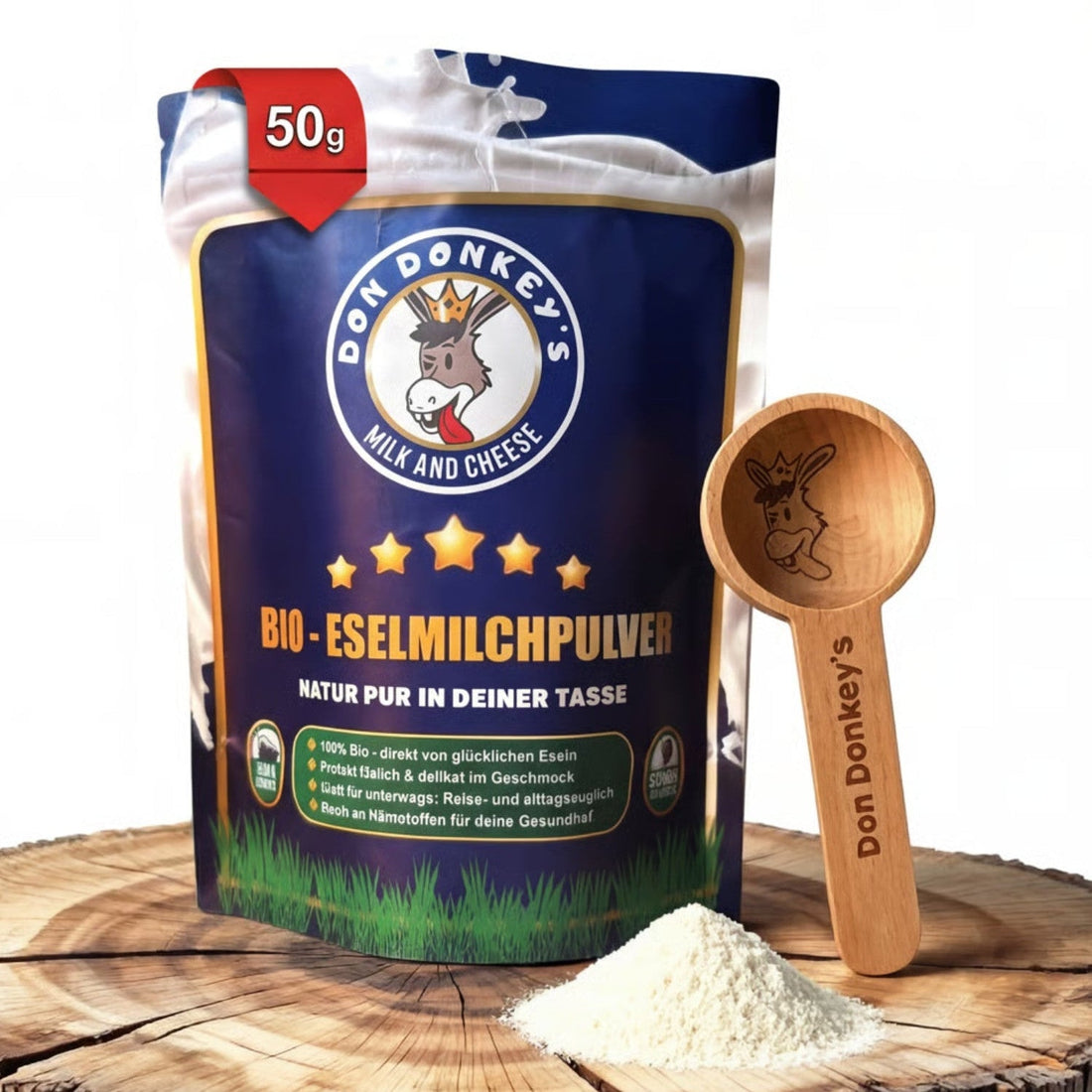
Also in our shop
Donkey Milk Powder
Donkey milk in powder form
For anyone who prefers a longer shelf life: our donkey milk in powder form – easy to store and portion.
20g · Unit price: €1.245,00 / 1 kg · incl. VAT, plus shipping