
 Buyer protection

Donkey milk research · Study 208
Donkey milk from Greece and Cyprus: composition, hygiene, taste
Donkey milk from Greece and Cyprus contained on average 0.52 g fat, 1.22 g protein and 7.01 g lactose per 100 mL at a pH of 7.14. Aflatoxin M1, beta-lactam residues, Escherichia coli, Salmonella and Listeria monocytogenes were not detected in any sample.
At a glance · swipe or use the arrows
The key figures
Study design
How it was studied
Milk analysis of donkey milk from Greece and Cyprus. Nutritional parameters (pH, fat, protein, lactose), residues (aflatoxin M1, beta-lactam antibiotics), hygiene parameters (somatic cell count, total bacterial count, Escherichia coli, Salmonella spp., Listeria monocytogenes) and appearance, aroma and taste in a sensory evaluation were examined. Assessed based on the abstract; the number of farms and samples, sampling period, the values for cell and bacterial counts and differences between the two countries are not stated there.
Interactive chart · values from the study
Main constituents of the donkey milk (means)
Source: study abstract, average values of all samples.
Results
What the study measured
The milk had a mean pH of 7.14 and contained 0.52 g fat, 1.22 g protein and 7.01 g lactose per 100 mL.
Aflatoxin M1 and beta-lactam residues were not detected in any sample.
According to the authors, somatic cell counts and total bacterial counts were very low; the abstract gives no figures.
Escherichia coli, Salmonella spp. and Listeria monocytogenes were not detected in any sample.
In the sensory evaluation the milk was described as white and thin, with a slightly sweet, pleasant taste, a pleasant milky aroma and no persistent aftertaste.
Authors’ conclusion: The donkey milk examined from Greece and Cyprus showed the described nutritional composition, no detected residues or pathogens and good sensory properties. The findings apply to the samples examined and are not a general statement about donkey milk from these countries.
Critical appraisal
Strengths and limitations
Only the abstract assessedClear limitation
Number of farms and samples, variability and the cell and bacterial counts are missing. Funding and conflicts of interest could not be checked.
SnapshotNote
Whether and over what period samples were taken repeatedly is not clear from the abstract. Seasonal variation remains open.
Countries not reported separatelyNote
The abstract gives pooled means. Whether milk from Greece and Cyprus differed is not apparent.
Sensory method not describedNote
The abstract does not state how many assessors took part or how ratings were made.
Broad testing programmeStrength
Composition, residues, hygiene parameters and sensory properties were assessed together in one study.
Editorial note: The paper provides a compact quality overview of donkey milk from two Mediterranean countries, including residue and pathogen testing. Without the full text, the sample and individual values remain unknown, so the findings can only be generalised to a limited extent. To the research archive.
Research question for DON DONKEY’S®
Can we document fat, protein, lactose and pH as well as testing for aflatoxin M1 and antibiotic residues for every batch of our donkey milk and publish them transparently?
Original publication
Assessment of donkey milk chemical, microbiological and sensory attributes in Greece and Cyprus
Original title: Assessment of donkey milk chemical, microbiological and sensory attributes in Greece and Cyprus
Malissiova E., Arsenos G., Papademas P., Fletouris D., Manouras A., Aspri M., Nikolopoulou A., Giannopoulou A., Arvanitoyannis I.
International Journal of Dairy Technology · 2016 · 69(1), 143–146
Research group from Greece and Cyprus; institutions not stated in the available material
Transparency: funding and conflicts of interest could not be checked from the abstract. No product-related statement for DON DONKEY’S®.
Summarised and checked by the DON DONKEY’S editorial team against the original publication · As of: November 2026
The study summarised above was carried out independently of DON DONKEY’S® and does not relate to our products. It serves solely to inform about the state of research.
DON DONKEY’S® donkey milk and donkey milk powder are foods. They are not intended to prevent, treat or cure any disease and do not replace medical advice.

From our shop
DON DONKEY’S® donkey milk
100 % donkey milk · raw milk, frozen
On this page we report the findings of a published study. Independently of that, you will find our donkey milk here: 100 % donkey milk, frozen as raw milk.
100 ml bottle / 100ml · Unit price: €249,00 / 1 l · incl. VAT, plus shipping
Also in our shop
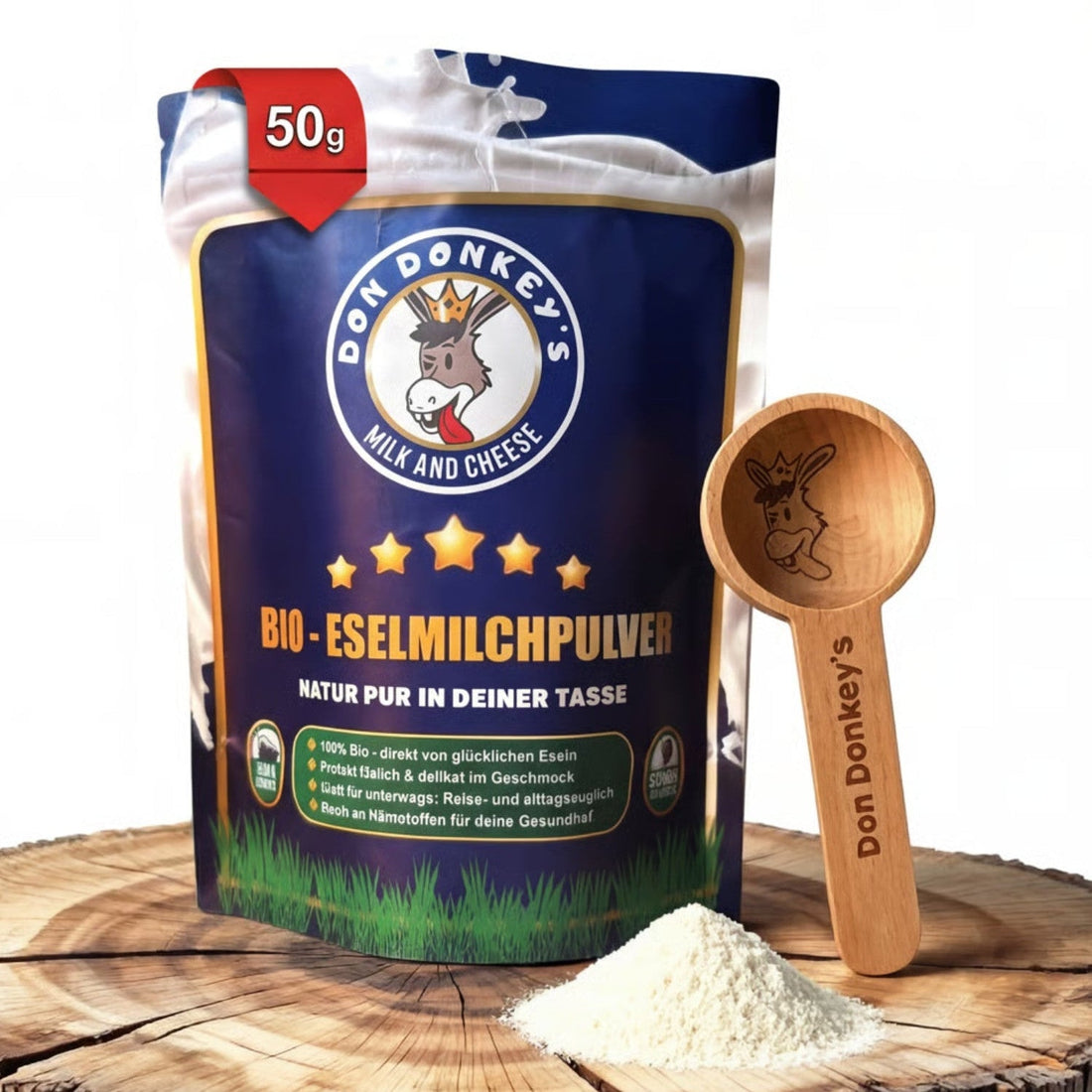
Donkey Milk Powder
Donkey milk in powder form
For anyone who prefers a longer shelf life: our donkey milk in powder form – easy to store and portion.
20g · Unit price: €1.245,00 / 1 kg · incl. VAT, plus shipping