
 Buyer protection

Donkey milk research · Study 207
Which small protein fragments does donkey milk contain? 1330 peptides identified in the lab
Using two complementary purification methods, a team from Rome identified a combined 1330 naturally occurring peptides in donkey milk, mostly derived from the most abundant milk proteins. In laboratory assays, the isolated peptides showed ACE-inhibitory and antioxidant activity.
At a glance · tap the cards
The key figures
Study design
How it was studied
Analytical lab study by the Department of Chemistry, Sapienza University of Rome (Italy). To capture the naturally occurring peptides (the peptidome) in donkey milk, two methods for removing native proteins and fat were compared: precipitation of all proteins with cold acetone and precipitation of the caseins with acetic acid at pH 4.6. Peptides were identified by mass spectrometry, tested in the test tube for ACE inhibition and antioxidant activity and screened bioinformatically for known bioactive sequences. Assessed based on the abstract; number and origin of the milk samples and the measured values of the activity assays are not stated there.
Results
What the study measured
The two purification methods, cold acetone and casein precipitation at pH 4.6, yielded partly different peptides and, according to the authors, were complementary.
Together they gave 1330 peptide identifications for donkey milk.
The peptides derived mainly from the most abundant proteins in the milk.
In the test tube, the isolated peptides showed ACE-inhibitory and antioxidant activity. The abstract does not report specific values.
The bioinformatic analysis was used to search the peptide lists for potentially bioactive sequences.
Authors’ conclusion: The improved analytical workflow yields a high number of identified peptides in donkey milk and is a starting point for finding peptides that might be responsible for observed bioactivities. Laboratory ACE inhibition data allow no statement about blood pressure or other effects in humans.
Critical appraisal
Strengths and limitations
Only the abstract assessedClear limitation
Number and origin of the milk samples, measured values of the activity assays and the peptide lists are missing. Funding and conflicts of interest could not be checked.
Test tube is not the bodyClear limitation
Whether the peptides survive digestion, are absorbed and act in relevant amounts was not studied.
Evaluative introductionNote
The abstract describes donkey milk as a particularly suitable mammalian milk for humans. That is the authors’ view, not a result of these measurements.
Methods paperNote
The focus is on the analytical workflow. Statements about the typical composition of donkey milk from different sources are not its aim.
Two methods compared directlyStrength
Comparing two purification routes shows how strongly results depend on sample preparation and increases the number of peptides captured.
Editorial note: The paper expands knowledge of naturally occurring peptides in donkey milk and shows how much sample preparation shapes the result. The activity assays are first laboratory indications. They are not sufficient for statements about effects in humans. To the research archive.
Research question for DON DONKEY’S®
Does the natural peptide profile of our donkey milk remain comparable after freezing, thawing and freeze-drying into powder – measured with the same purification method?
Original publication
Peptidome characterization and bioactivity analysis of donkey milk.
Original title: Peptidome characterization and bioactivity analysis of donkey milk.
Piovesana S., Capriotti A. L., Cavaliere C., La Barbera G., Samperi R., Zenezini Chiozzi R., Laganà A.
Journal of Proteomics · 2015 · 119, 21–29
Department of Chemistry, Sapienza University of Rome, Italy (according to the authors)
DOI: 10.1016/j.jprot.2015.01.020
Transparency: funding and conflicts of interest could not be checked from the abstract. No product-related statement for DON DONKEY’S®.
Summarised and checked by the DON DONKEY’S editorial team against the original publication · As of: November 2026
The study summarised above was carried out independently of DON DONKEY’S® and does not relate to our products. It serves solely to inform about the state of research.
DON DONKEY’S® donkey milk and donkey milk powder are foods. They are not intended to prevent, treat or cure any disease and do not replace medical advice.

From our shop
DON DONKEY’S® donkey milk
100 % donkey milk · raw milk, frozen
On this page we report the findings of a published study. Independently of that, you will find our donkey milk here: 100 % donkey milk, frozen as raw milk.
100 ml bottle / 100ml · Unit price: €249,00 / 1 l · incl. VAT, plus shipping
Also in our shop
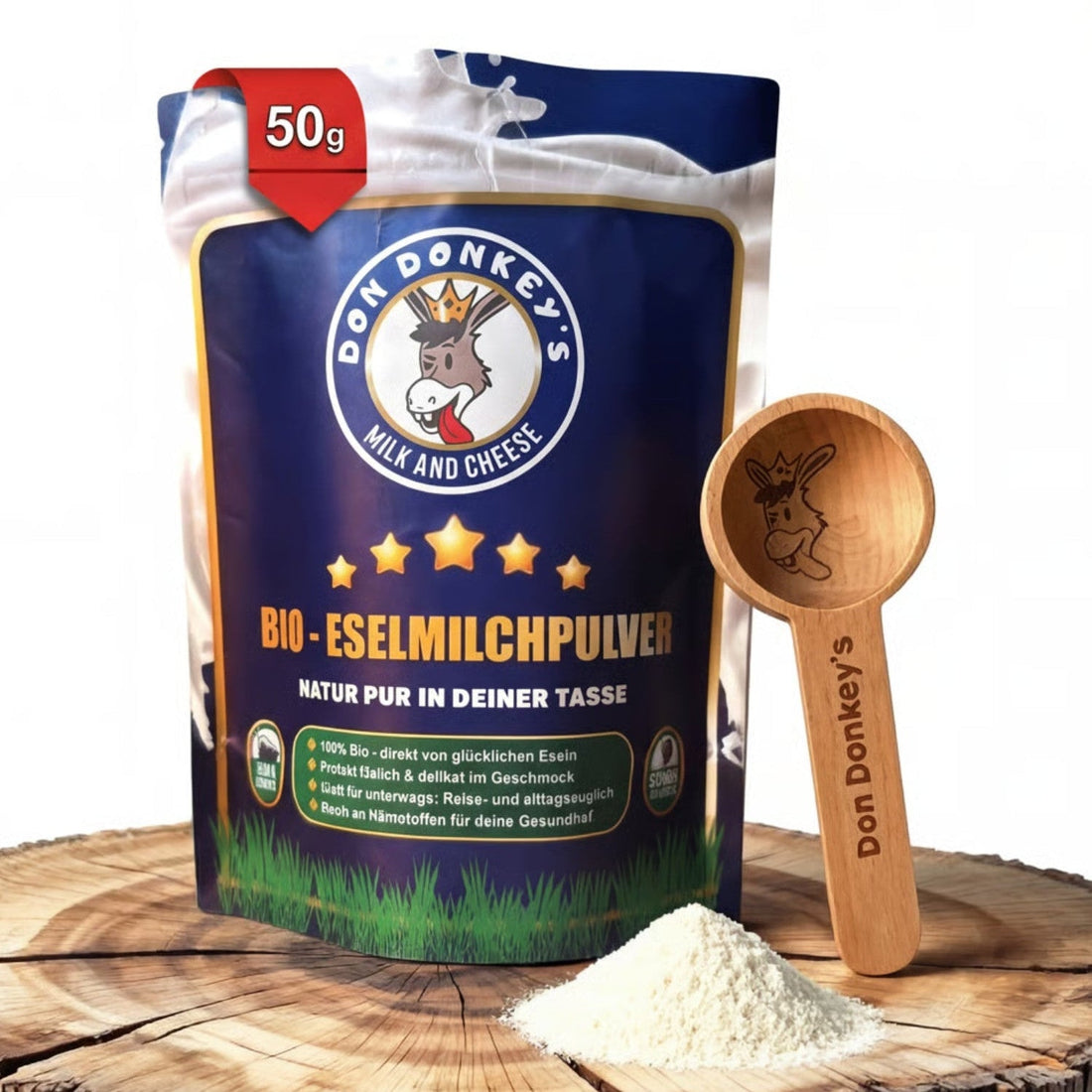
Donkey Milk Powder
Donkey milk in powder form
For anyone who prefers a longer shelf life: our donkey milk in powder form – easy to store and portion.
20g · Unit price: €1.245,00 / 1 kg · incl. VAT, plus shipping