
 Buyer protection

Donkey milk research · Study 206
Fat in donkey milk: stable over lactation, different in winter
In milk from Amiata jennies, fat content and fat globule diameter remained fairly stable from day 30 to day 300 of lactation. Season showed clearer differences: winter milk had larger and fewer fat globules per mL, fewer short-chain saturated and more long-chain and monounsaturated fatty acids (P < 0.01).
At a glance · swipe or use the arrows
The key figures
Study design
How it was studied
Milk analysis from Italy in Amiata jennies. Individual milk samples were taken monthly from each jenny, starting on day 30 of lactation until day 300. Fat content, size (diameter) and number of fat globules per mL and the fatty acid profile were examined in relation to lactation phase and production season. Assessed based on the abstract; number of animals, farm, feeding and specific measured values are not stated there.
Results
What the study measured
Fat content and fat globule diameter were fairly stable during lactation. The number of fat globules per mL decreased significantly only in the last phase of lactation.
The fatty acid profile changed little during lactation: short-chain fatty acids decreased progressively, monounsaturated fatty acids showed an increasing trend.
Winter milk had a larger average fat globule diameter and fewer fat globules per mL.
In winter, the share of short-chain saturated fatty acids was lower and the share of long-chain and monounsaturated fatty acids higher (each P < 0.01).
In the cooler season, the authors found significantly less C18:0 (stearic acid) and more palmitoleic, oleic and vaccenic acid.
Authors’ conclusion: The lipid fraction of donkey milk did not show notable changes during lactation; season had a stronger influence on fat globules and fatty acids. The study describes composition, not the nutritional relevance of these differences.
Critical appraisal
Strengths and limitations
Only the abstract assessedClear limitation
Number of animals, fat contents in figures and fatty acid shares are missing. Funding and conflicts of interest could not be checked.
Season and feeding intertwinedNote
Winter often also means different feed. Whether the differences stem from temperature, feed or both cannot be separated based on the abstract.
One breedNote
Milk from Amiata jennies was studied. Other breeds and husbandry systems may differ.
Fatty acids are sharesNote
Fatty acids are described as percentages of fat. Donkey milk is low in fat, so the absolute amounts per glass are correspondingly small.
Individual samples over 270 daysStrength
Monthly individual samples from the same animals from day 30 to day 300 allow a genuine time course rather than a snapshot.
Editorial note: The study shows that the milk fat of donkey milk changes more with season than with lactation stage. For batch information this is a practical pointer. Without the full text, the sample and the size of the differences remain unknown. To the research archive.
Research question for DON DONKEY’S®
Do fat content and fatty acid profile differ measurably between our winter and summer batches, and do these differences persist after freezing and thawing?
Original publication
Changes in donkey milk lipids in relation to season and lactation
Original title: Changes in donkey milk lipids in relation to season and lactation
Martini M., Altomonte I., Manica E., Salari F.
Journal of Food Composition and Analysis · 2015 · 41, 30–34
Research group in Italy; institution not stated in the available material (Amiata jennies)
DOI: 10.1016/j.jfca.2014.12.019
Transparency: funding and conflicts of interest could not be checked from the abstract. No product-related statement for DON DONKEY’S®.
Summarised and checked by the DON DONKEY’S editorial team against the original publication · As of: November 2026
The study summarised above was carried out independently of DON DONKEY’S® and does not relate to our products. It serves solely to inform about the state of research.
DON DONKEY’S® donkey milk and donkey milk powder are foods. They are not intended to prevent, treat or cure any disease and do not replace medical advice.

From our shop
DON DONKEY’S® donkey milk
100 % donkey milk · raw milk, frozen
On this page we report the findings of a published study. Independently of that, you will find our donkey milk here: 100 % donkey milk, frozen as raw milk.
100 ml bottle / 100ml · Unit price: €249,00 / 1 l · incl. VAT, plus shipping
Also in our shop
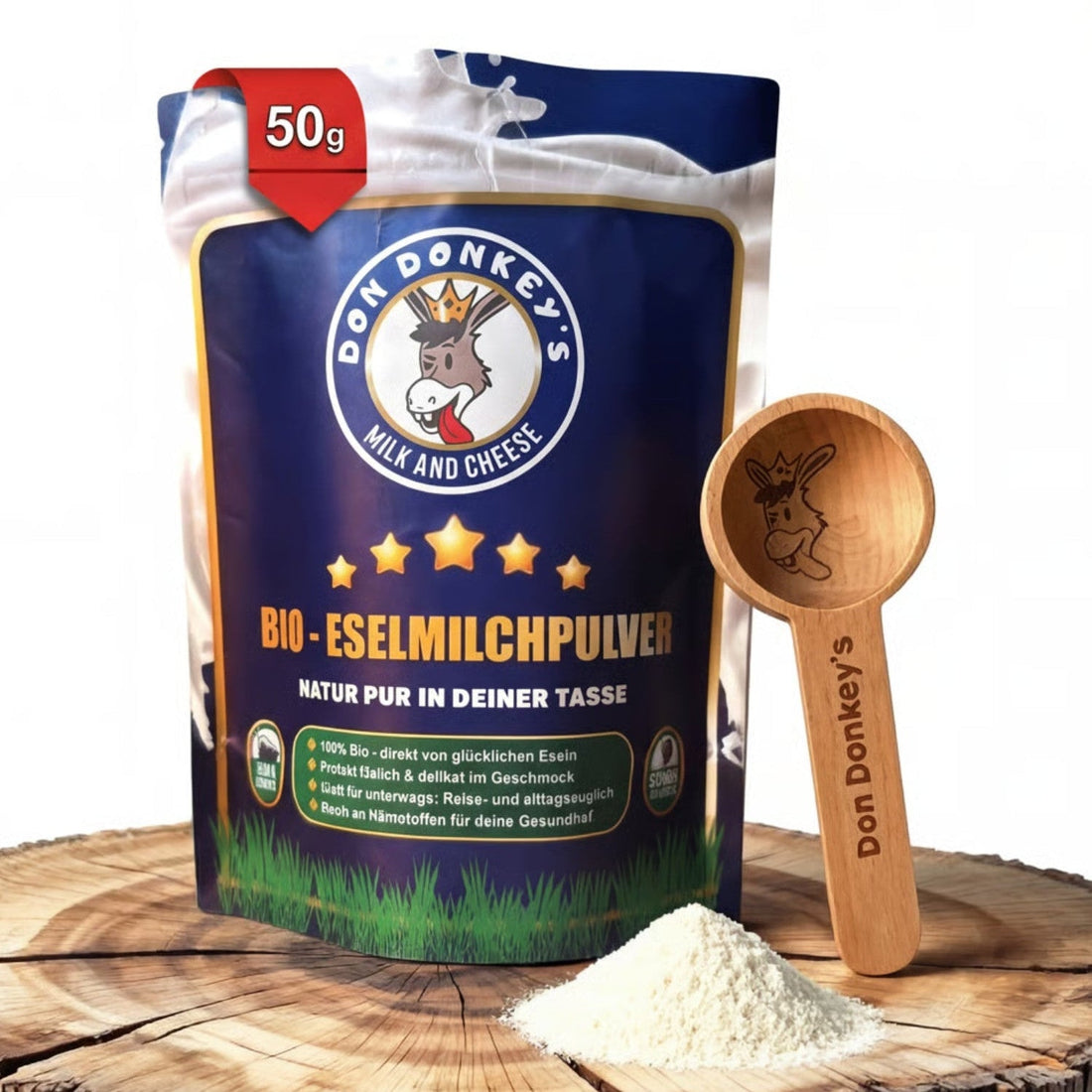
Donkey Milk Powder
Donkey milk in powder form
For anyone who prefers a longer shelf life: our donkey milk in powder form – easy to store and portion.
20g · Unit price: €1.245,00 / 1 kg · incl. VAT, plus shipping