
 Buyer protection

Donkey milk research · Study 204
Three milks in the lab: donkey milk, human milk and infant formula
In a GC-MS comparison of 3 milk types, the profile of small water-soluble compounds in Sardinian donkey milk was, according to the authors, closer to human milk than to cow milk-based infant formula. The formula was richer in sugars and poorer in amino acids; the donkey milk contained less fat and more lysozyme than human milk.
At a glance · swipe or use the arrows
The key figures
Study design
How it was studied
Milk analysis from Italy using donkey milk from Sardinia. The authors first described the composition of the donkey milk (including fat, lysozyme and bacterial count). Water-soluble small molecules – amino acids, organic acids and mono- and disaccharides – were then measured by GC-MS in donkey milk, human milk and cow milk-based infant formula and compared using multivariate statistics. In addition, changes in the profiles of donkey and human milk over lactation were followed. Assessed based on the abstract; the number of animals, donors and samples, the type of formula and specific measured values are not stated there.
Results
What the study measured
According to the abstract, the Sardinian donkey milk had a low fat content and higher lysozyme levels than human milk.
The bacterial count of the donkey milk was below the recommended threshold. The abstract does not state which threshold or which values were measured.
In the multivariate analysis, the metabolite profile of donkey milk was closer to human milk than to cow milk-based infant formula.
By comparison, the formula was richer in sugars and lower in amino acids.
Over lactation, the protein content of donkey milk increased. In human milk, pyroglutamic acid increased and myo-inositol decreased.
Authors’ conclusion: The authors regard donkey milk as a “valuable food” and describe its metabolite profile as more similar to human milk than to cow milk-based formula. Similarity in the profile of small molecules says nothing about suitability, nutrient adequacy or tolerability in infants. Donkey milk is not a substitute for breast milk or infant formula; infant feeding belongs in medical hands.
Critical appraisal
Strengths and limitations
Only the abstract assessedClear limitation
Sample numbers, origin of the human milk, type of formula and all measured values are missing. Funding and conflicts of interest could not be checked.
Similar does not mean equivalentClear limitation
Small water-soluble molecules were compared. Fat, vitamins and other components that are critical for infants are not part of this comparison; the donkey milk was also lower in fat.
Allergy only as backgroundNote
The authors mention donkey milk as a possible alternative in cow milk protein allergy. The study examines neither tolerability nor children.
One regionNote
The donkey milk came from Sardinia. Whether other herds, breeds or feeding regimes show similar profiles remains open.
Three milks, one methodStrength
Donkey milk, human milk and formula were compared with the same analytical method and statistics, plus changes over lactation.
Editorial note: The paper provides a methodologically consistent comparison of small molecules in three types of milk. It shows no more than a similarity in the measured profile; nothing can be inferred from it about infant feeding. Without the full text, the sample and measured values remain unknown. To the research archive.
Research question for DON DONKEY’S®
How does the profile of amino acids and sugars in our frozen donkey milk change over storage time and after thawing – measured in batches from different stages of lactation?
Original publication
Characterization of donkey milk and metabolite profile comparison with human milk and formula milk
Original title: Characterization of donkey milk and metabolite profile comparison with human milk and formula milk
Murgia A., Scano P., Contu M., Ibba I., Altea M., Bussu M., Demuru M., Porcu A., Caboni P.
LWT – Food Science and Technology · 2016 · 74, 427–433
Research group in Italy; institution not stated in the available material (origin of the milk according to the abstract: Sardinia)
DOI: 10.1016/j.lwt.2016.07.070
Transparency: funding and conflicts of interest could not be checked from the abstract. No product-related statement for DON DONKEY’S®.
Summarised and checked by the DON DONKEY’S editorial team against the original publication · As of: November 2026
The study summarised above was carried out independently of DON DONKEY’S® and does not relate to our products. It serves solely to inform about the state of research.
DON DONKEY’S® donkey milk and donkey milk powder are foods. They are not intended to prevent, treat or cure any disease and do not replace medical advice.

From our shop
DON DONKEY’S® donkey milk
100 % donkey milk · raw milk, frozen
On this page we report the findings of a published study. Independently of that, you will find our donkey milk here: 100 % donkey milk, frozen as raw milk.
100 ml bottle / 100ml · Unit price: €249,00 / 1 l · incl. VAT, plus shipping
Also in our shop
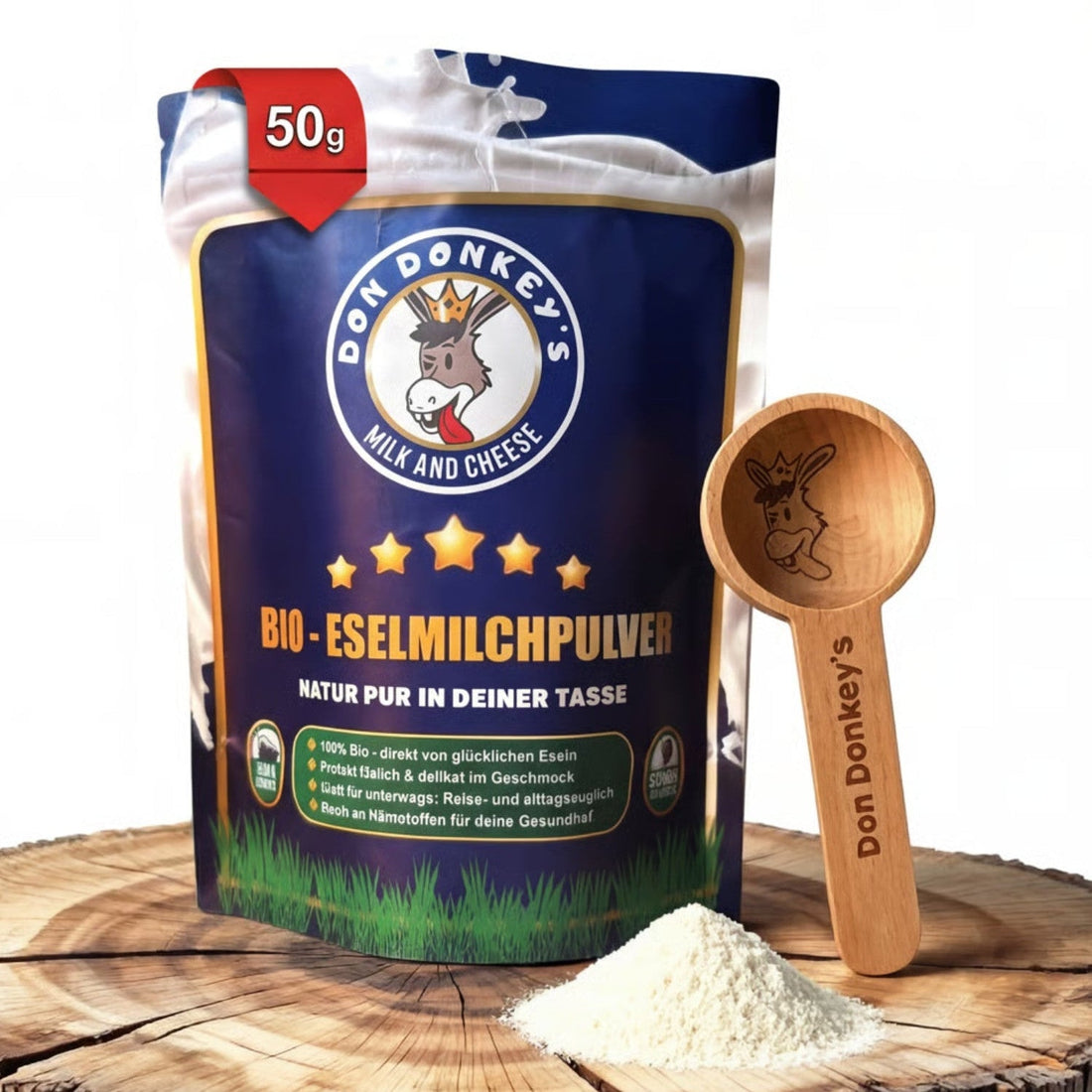
Donkey Milk Powder
Donkey milk in powder form
For anyone who prefers a longer shelf life: our donkey milk in powder form – easy to store and portion.
20g · Unit price: €1.245,00 / 1 kg · incl. VAT, plus shipping