
 Buyer protection

Donkey milk research · Study 200
Cheese from donkey milk: can an enzyme help the weak curd?
When microbial transglutaminase (5.0 U/g milk protein) was added to acidified donkey milk together with the rennet, the curd was firmer than without the enzyme according to the authors, and coagulation was faster. Moisture, protein, fat and cheese yield did not change significantly with the enzyme.
At a glance · tap the cards
The key figures
Study design
How it was studied
Food technology lab study from the University of Bari (Italy). In four independent trials, donkey milk was made into cheese using four patterns: control without enzyme; PAT1 with microbial transglutaminase (MTGase, 5.0 U/g milk protein) at 40 °C 15 minutes before the starter culture; PAT2 with enzyme together with the starter culture (40 °C); PAT3 with enzyme together with the rennet (42 °C) in acidified milk (pH 6.3). The pH course during acidification, cheesemaking parameters, composition and colour of the cheese at 24 hours and the protein fractions of cheese and whey (urea and SDS-PAGE) were recorded. Assessed based on the abstract; the full text was not available to the editorial team. Milk volume per trial, origin of the milk, measured values and statistics are therefore not known.
Results
What the study measured
Background according to the authors: donkey milk is low in total solids, fat and casein, especially κ-casein, and forms only a very weak gel on renneting.
Adding transglutaminase had no significant effect on moisture, protein, fat or cheese yield.
With the enzyme added together with the rennet (PAT3), the curd was firmer than in the control according to the authors. PAT3 also shortened gel formation time, the time from rennet addition to moulding and the weight loss of the cheese at 24 hours.
Cheeses from PAT3 had the lowest lightness and the highest yellowness values.
In SDS-PAGE, the enzyme altered the protein pattern in the 37–75 kDa range. In PAT3, α- and β-casein bands in the whey were fainter, which the authors interpret as better casein retention in the cheese.
Authors’ conclusion: Transglutaminase can be used in cheesemaking from donkey milk to firm the curd; the enzyme should be added together with the rennet. A higher cheese yield was not observed. Whether the cheese is appealing in taste or how it ripens was not part of the study.
Critical appraisal
Strengths and limitations
Only the abstract assessedClear limitation
Measured values for curd firmness, times and colour as well as statistics are missing. Funding and conflicts of interest could not be checked.
Only one enzyme doseNote
All protocols used 5.0 U/g protein. Whether other amounts work better or worse remains open.
Only 24 hours consideredNote
Cheese composition and colour were recorded at 24 hours. According to the abstract, ripening, shelf life and sensory attributes were not studied.
No yield increaseNote
The firmer curd did not lead to more cheese. The practical benefit lies rather in handling.
Repeated trials with controlsStrength
Four independent runs, each with a control without enzyme, allow a direct comparison of the protocols.
Editorial note: The paper shows a technical route to ease the well-known coagulation problem of donkey milk. The effect mainly concerns firmness and the cheesemaking process, not yield. Data for assessing taste and keeping quality are lacking. To the research archive.
Research question for DON DONKEY’S®
How does thawed donkey milk coagulate compared with freshly milked milk – and how do coagulation time and curd firmness differ between batches from different partner farms?
Original publication
Production of cheese from donkey milk as influenced by addition of transglutaminase
Original title: Production of cheese from donkey milk as influenced by addition of transglutaminase
D’Alessandro A.G., Martemucci G., Loizzo P., Faccia M.
Journal of Dairy Science · 2019 · 102(12), 10867–10876
Department of Agricultural and Environmental Sciences (DiSAAT) and Department of Soil, Plant and Food Sciences (DiSSPA), University of Bari Aldo Moro, Italy (according to the paper)
Transparency: funding and conflicts of interest could not be checked from the abstract. No product-related statement for DON DONKEY’S®.
Summarised and checked by the DON DONKEY’S editorial team against the original publication · As of: November 2026
The study summarised above was carried out independently of DON DONKEY’S® and does not relate to our products. It serves solely to inform about the state of research.
DON DONKEY’S® donkey milk and donkey milk powder are foods. They are not intended to prevent, treat or cure any disease and do not replace medical advice.

From our shop
DON DONKEY’S® donkey milk
100 % donkey milk · raw milk, frozen
On this page we report the findings of a published study. Independently of that, you will find our donkey milk here: 100 % donkey milk, frozen as raw milk.
100 ml bottle / 100ml · Unit price: €249,00 / 1 l · incl. VAT, plus shipping
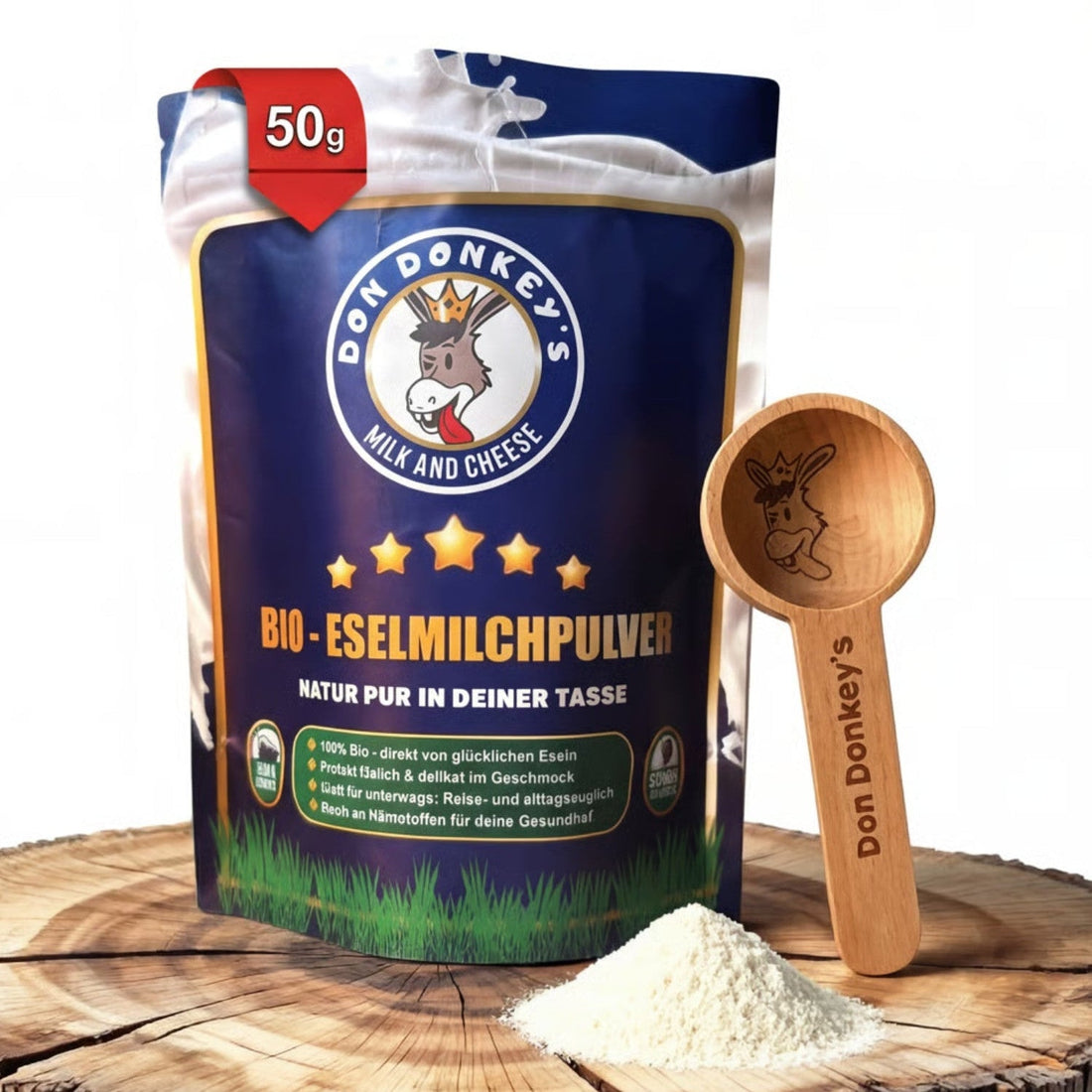
Also in our shop
Donkey Milk Powder
Donkey milk in powder form
For anyone who prefers a longer shelf life: our donkey milk in powder form – easy to store and portion.
20g · Unit price: €1.245,00 / 1 kg · incl. VAT, plus shipping