
 Buyer protection

Donkey milk research · Study 199
Calcium, phosphorus, sulphur: which part of donkey milk carries the minerals
In milk from 16 jennies, 62.9% of calcium and 53.1% of phosphorus were bound to casein, with the rest mostly in solution. Sulphur was 63.6% associated with whey proteins, sodium entirely in the aqueous phase. The fat carried hardly any minerals.
At a glance · swipe or use the arrows
The key figures
Study design
How it was studied
Milk analysis by the University of Camerino (Italy). Individual milk samples were collected by machine milking from 16 clinically healthy lactating jennies; milk yield, gross composition, casein content and pH were determined. Milk was centrifuged (fat removed, skim milk), skim milk ultracentrifuged (casein pellet, whey supernatant) and the whey ultrafiltered (aqueous phase). All fractions were analysed by ICP-MS for calcium, phosphorus, sulphur, magnesium, potassium and sodium; the shares bound to fat, casein and whey proteins were calculated. Assessed based on the abstract; the full text was not available to the editorial team. Absolute contents, breed, lactation stage and feeding are therefore not known.
Interactive chart · values from the study
Share of each element bound to casein
Source: study abstract, milk from 16 jennies. Potassium: no share bound to casein; sodium: entirely in the aqueous phase. About one quarter of sulphur was bound to casein (no exact figure given).
Results
What the study measured
Sodium was entirely in the aqueous phase; potassium was not bound to casein at all. The fat fraction carried very little or none of the elements studied.
62.9% of calcium and 53.1% of phosphorus were bound to casein, the rest being mostly in the aqueous phase. Magnesium was mostly dissolved, with 32.6% on casein.
Relative to casein (mmol/g casein), colloidal calcium and phosphorus were more than double the literature values for cow milk. The authors attribute this to more colloidal calcium phosphate on the casein micelles.
Milk pH correlated negatively with phosphorus in the ultracentrifuged (r = −0.81) and ultrafiltered fraction (r = −0.66), and positively with colloidal calcium (r = 0.59) and the ratio of colloidal calcium to casein (r = 0.68). Colloidal calcium and phosphorus correlated at r = 0.64.
Less than 5% of calcium, phosphorus and potassium was bound to whey proteins, for magnesium about 9%. Sulphur was 63.6% bound to whey proteins and only about one quarter to casein.
Authors’ conclusion: Donkey milk casein micelles carry proportionally more colloidal calcium phosphate than cow milk according to literature data; the high sulphur share of whey proteins points to more sulphur-containing amino acids in whey than in casein. The study describes distribution within the milk – how well these minerals are absorbed by humans was not studied.
Critical appraisal
Strengths and limitations
Only the abstract assessedClear limitation
Absolute contents of the elements, variability and details on breed and lactation stage are missing. Funding and conflicts of interest could not be checked.
Comparison with literature valuesNote
The comparison with cow milk relies on values from other studies, not on cow milk measured in parallel.
Calculated sharesNote
The amounts bound to fat, casein and whey proteins were calculated from the fractions. Separation methods can shift the distribution slightly.
Distribution is not availabilityClear limitation
Where a mineral is bound in milk says nothing yet about how much of it the body absorbs.
Individual samples, clean fractionationStrength
16 individual samples, stepwise separation into four fractions and uniform ICP-MS analysis make the distribution easy to follow.
Editorial note: The paper provides solid baseline data on how minerals are distributed in donkey milk. This is relevant for processing, as casein-bound calcium phosphate can influence behaviour during heating or drying, for example. No nutritional conclusions can be drawn from it. To the research archive.
Research question for DON DONKEY’S®
Does the casein-bound share of calcium and phosphorus in our donkey milk stay the same after freezing and thawing and in donkey milk powder – verifiable with the same fractionation?
Original publication
Distribution of calcium, phosphorus, sulfur, magnesium, potassium, and sodium in major fractions of donkey milk
Original title: Distribution of calcium, phosphorus, sulfur, magnesium, potassium, and sodium in major fractions of donkey milk
Fantuz F., Ferraro S., Todini L., Cimarelli L., Fatica A., Marcantoni F., Salimei E.
Journal of Dairy Science · 2020 · 103(10), 8741–8749
School of Biosciences and Veterinary Medicine and School of Science and Technology, University of Camerino, Italy (according to the paper)
Transparency: funding and conflicts of interest could not be checked from the abstract. No product-related statement for DON DONKEY’S®.
Summarised and checked by the DON DONKEY’S editorial team against the original publication · As of: November 2026
The study summarised above was carried out independently of DON DONKEY’S® and does not relate to our products. It serves solely to inform about the state of research.
DON DONKEY’S® donkey milk and donkey milk powder are foods. They are not intended to prevent, treat or cure any disease and do not replace medical advice.

From our shop
DON DONKEY’S® donkey milk
100 % donkey milk · raw milk, frozen
On this page we report the findings of a published study. Independently of that, you will find our donkey milk here: 100 % donkey milk, frozen as raw milk.
100 ml bottle / 100ml · Unit price: €249,00 / 1 l · incl. VAT, plus shipping
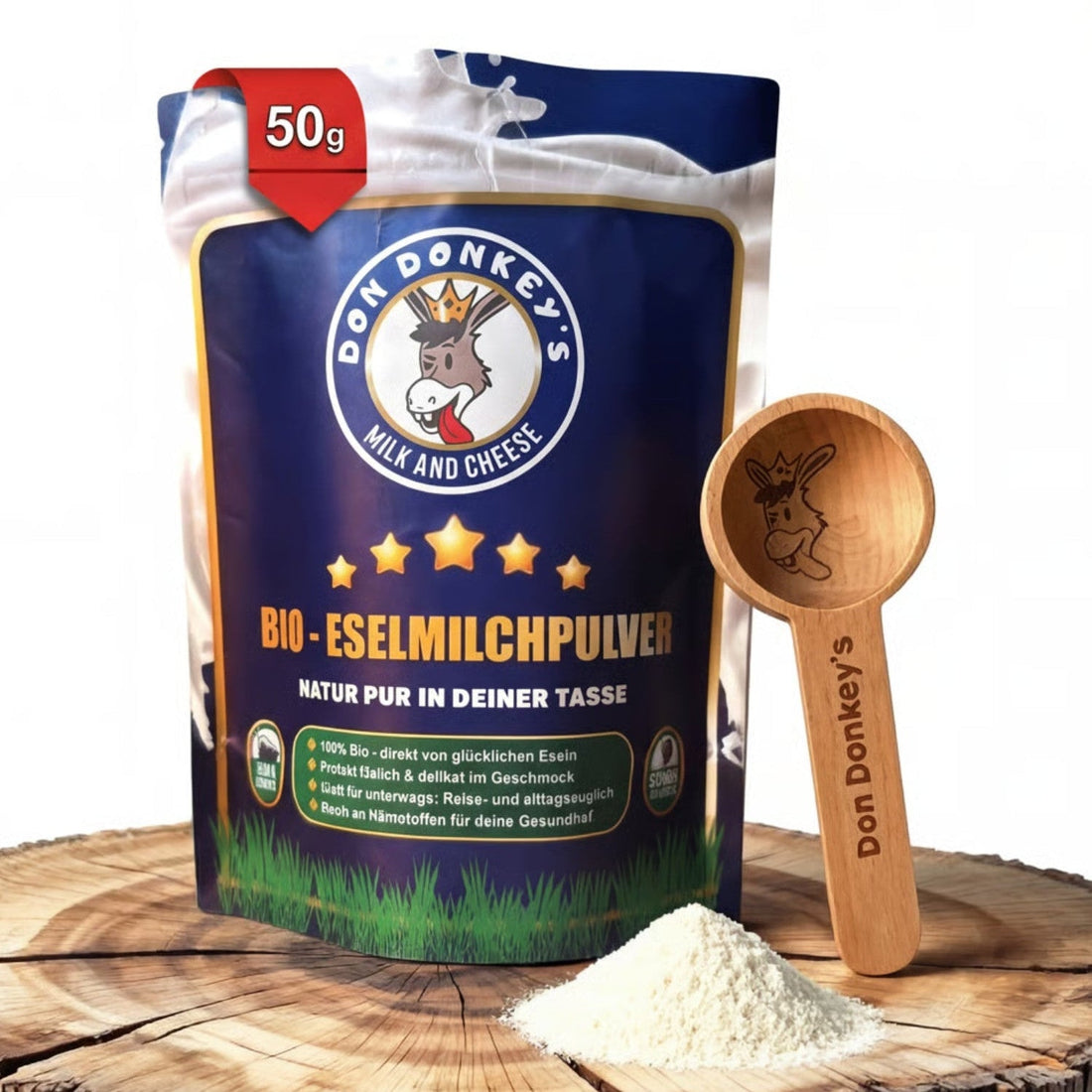
Also in our shop
Donkey Milk Powder
Donkey milk in powder form
For anyone who prefers a longer shelf life: our donkey milk in powder form – easy to store and portion.
20g · Unit price: €1.245,00 / 1 kg · incl. VAT, plus shipping