
 Buyer protection

Donkey milk research · Study 198
Mycotoxins in donkey milk: how reliable are rapid tests?
In milk samples from six jennies of a German herd, enzyme immunoassays detected neither aflatoxin M1 nor ochratoxin A or zearalenone. Detection limits were 5, 9 and 600 ng/kg. In the zearalenone test, untreated donkey milk produced falsely elevated signals – the authors suspect the abundant lysozyme as the cause.
At a glance · tap the cards
The key figures
Study design
How it was studied
Analytical method study by Justus Liebig University Giessen and LMU Munich. One milk sample (about 50 mL) each from six lactating jennies of a small herd of Poitou donkeys in Germany was examined (age 7.5 ± 2.7 years, mean body weight 350 kg). The animals received grass and hay ad libitum plus an estimated 0.2–0.3 kg pellets and 0.5 kg oats per day; pellets and oats were also analysed. Three competitive enzyme immunoassays (EIA) for aflatoxin M1, ochratoxin A and zearalenone were tested. For zearalenone, samples were first heated for 30 minutes at 78 °C and treated enzymatically to also capture phase II metabolites. To check matrix effects, samples were deliberately spiked with toxins and measured at several dilutions, with standards and samples run in four replicates for OTA and ZEN.
Interactive chart · values from the study
Detection limits of the tests compared with EU reference values
Source: results section of the study. The EU reference values (Regulation (EC) No 1881/2006) apply to other foods, including infant food and cereal-based baby food; there are no specific maximum levels for donkey milk. Zearalenone: 20 µg/kg = 20,000 ng/kg.
Results
What the study measured
All six milk samples were negative for aflatoxin M1, ochratoxin A and zearalenone. Detection limits were 5 ng/kg (AFM1), 9 ng/kg (OTA) and 600 ng/kg (ZEN).
For aflatoxin M1 and ochratoxin A, the milk could be measured directly without pretreatment. Spiked samples gave 44–77% of the nominal value for ochratoxin A, with coefficients of variation of 4.3–20%.
In the zearalenone test, all six untreated samples inhibited binding by about 30–40%, which can mimic a false-positive result. After 30 minutes at 78 °C the signal rose to about 80–85% B/B0; spiked samples gave 62 ± 7% of the nominal value.
The authors suspect the high lysozyme content of donkey milk as the cause of the interference. The mechanism remained unexplained; the effect did not occur in the AFM1 and OTA tests.
In the feed, aflatoxin B1 (< 3 µg/kg) and ochratoxin A (< 4 µg/kg) were not detectable; zearalenone was found in pellets (180 µg/kg) and oats (7 µg/kg).
Authors’ conclusion: Enzyme immunoassays are suitable tools for detecting mycotoxins in donkey milk. Because false-positive results are possible, each test should be specifically validated for donkey milk and positive results should be re-analysed after heat treatment of the sample. The study does not show how often mycotoxins occur in donkey milk – six samples from one herd are too few for that. The EU reference values mentioned partly come from infant food; donkey milk is not a substitute for breast milk or infant formula; infant feeding belongs in medical hands.
Critical appraisal
Strengths and limitations
Only six samples from one herdClear limitation
The negative results apply to these animals and this feed. No statement on donkey milk in general is possible.
Limited validationNote
The aflatoxin M1 test was not validated within the study; the authors refer to unpublished recoveries of 91–133% in mare’s milk.
Inconsistent unitsNote
Spiking levels are given in pg/kg in the text and in ng/kg in the figure legend (OTA 100, 200, 400; ZEN 2000). Which is correct cannot be determined with certainty from the paper.
Grass and hay not analysedNote
Only pellets and oats were tested. The authors assume grass and hay were not a major source of toxins.
Disclosed funding, clear methodsStrength
Funded by the Brigitte and Wolfram Gedek Foundation, no conflicts of interest. Feed was analysed too, and matrix effects were checked systematically with spiked samples.
Editorial note: The paper matters above all for its methods: tests validated for cow milk can give false signals in donkey milk. The six negative samples are a good individual result but not a market overview. For quality control, this means rapid test results on donkey milk should be backed up with control samples. To the research archive.
Research question for DON DONKEY’S®
Can aflatoxin M1 and other mycotoxins be checked regularly in batches of our donkey milk using a method validated for donkey milk, and documented together with feed analyses from our partner farms?
Original publication
Immunochemical detection of mycotoxins in donkey milk
Original title: Immunochemical detection of mycotoxins in donkey milk
Gross M., Ploetz C.P., Gottschalk C.
Mycotoxin Research · 2019 · 35(1), 83–87
Institute of Veterinary Food Science, Junior Professorship of Veterinary Food Diagnostics, Justus Liebig University Giessen; Chair of Food Safety, LMU Munich, Germany (according to the paper)
DOI: 10.1007/s12550-018-0333-2
Transparency: according to the acknowledgements, the study was funded by the Brigitte and Wolfram Gedek Foundation; the authors declare no conflicts of interest. No product-related statement for DON DONKEY’S®.
Summarised and checked by the DON DONKEY’S editorial team against the original publication · As of: November 2026
The study summarised above was carried out independently of DON DONKEY’S® and does not relate to our products. It serves solely to inform about the state of research.
DON DONKEY’S® donkey milk and donkey milk powder are foods. They are not intended to prevent, treat or cure any disease and do not replace medical advice.

From our shop
DON DONKEY’S® donkey milk
100 % donkey milk · raw milk, frozen
On this page we report the findings of a published study. Independently of that, you will find our donkey milk here: 100 % donkey milk, frozen as raw milk.
100 ml bottle / 100ml · Unit price: €249,00 / 1 l · incl. VAT, plus shipping
Also in our shop
Donkey Milk Powder
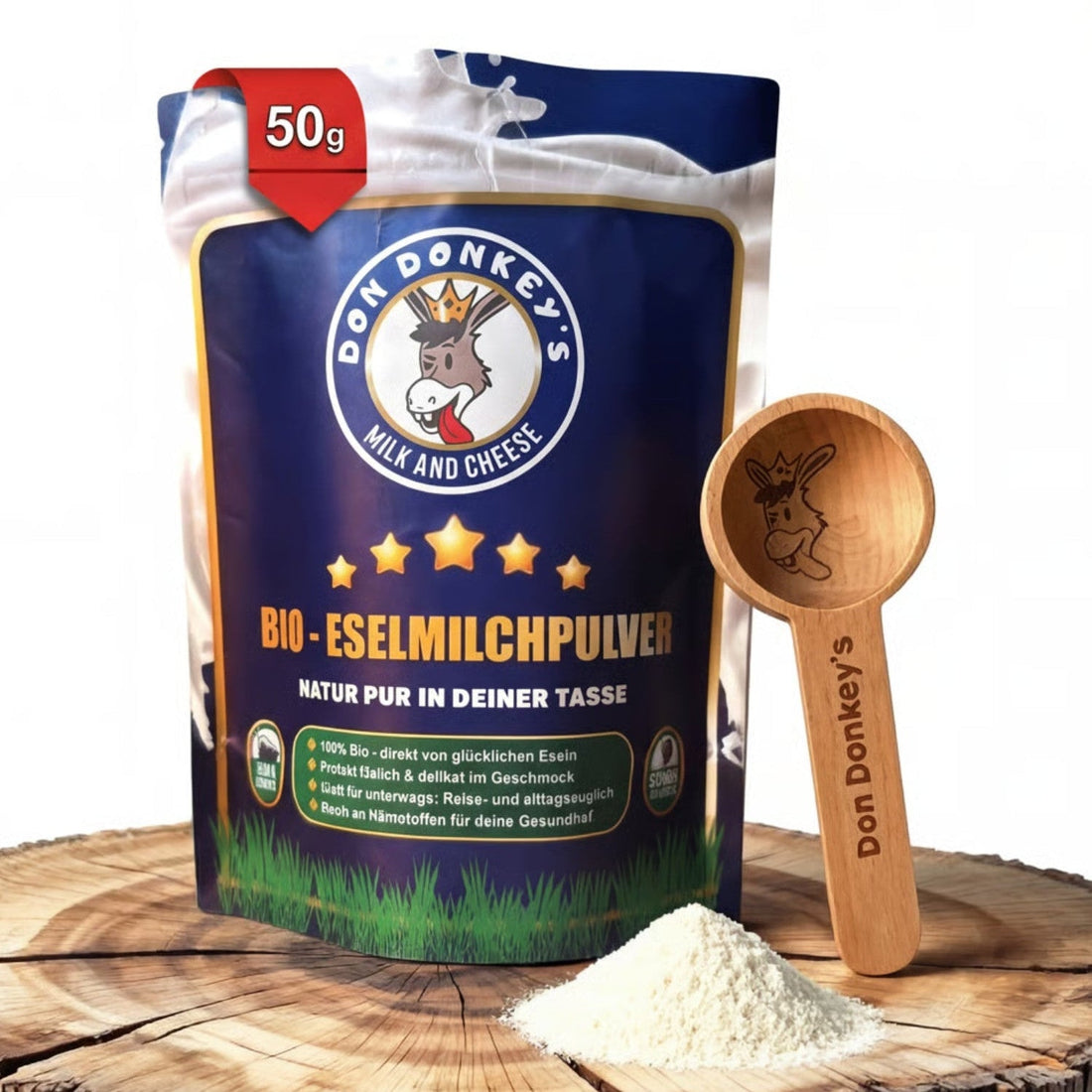
Donkey milk in powder form
For anyone who prefers a longer shelf life: our donkey milk in powder form – easy to store and portion.
20g · Unit price: €1.245,00 / 1 kg · incl. VAT, plus shipping