
 Buyer protection

Donkey milk research · Study 195
Donkey milk powder from the spray dryer: what temperature and concentration change
According to the abstract, spray-dried powder from the milk of Indian jennies contained 4.12% moisture, 22.84% protein and 5.97% fat. As the inlet air temperature rose (160 to 180 °C), solubility, density and dispersibility fell and wetting time increased. The authors rated flowability as “fair”.
At a glance · tap the cards
The key figures
Study design
How it was studied
Process engineering lab study by a group at the University of Agricultural Sciences (Raichur and Bengaluru) and the Nehru Institute of Technology (Coimbatore), India. Milk from the Indian Small Grey breed was concentrated to 20, 25 and 30% total solids and dried in a spray dryer at 160, 170 and 180 °C inlet air temperature (two-fluid nozzle 0.84 mm, 1.75 kg/cm², 0.5 L/h, blower 2100 rpm). Composition, colour (L*, a*, b*), water activity, density, flowability, solubility, dispersibility, wetting time, heat utilisation, particle structure and minerals were measured. Assessed based on the abstract; the full text was not available to the editorial team. Number of animals, number of runs and individual values per setting are therefore not known.
Results
What the study measured
According to the abstract, the powder contained 4.12% moisture (dry basis), 5.97% fat, 22.84% protein, 4.64% carbohydrate and 62.43% ash.
Colour values L*, a* and b* and water activity decreased the more concentrated the milk and the higher the inlet air temperature.
Density decreased with rising inlet air temperature and increased with rising milk concentration. Flowability was fair according to the Hausner ratio (1.25) and Carr index (20%).
Solubility fell with higher concentration and temperature; wetting time rose with both. Dispersibility fell with temperature and rose with concentration.
The dryer’s heat utilisation efficiency rose with concentration and fell with temperature. Powder particles were spherical, and according to the authors minerals were abundant.
Authors’ conclusion: Milk concentration and inlet air temperature clearly influence colour, density, solubility and wettability of donkey milk powder. The study describes technical powder properties; whether and how proteins or other components change during drying cannot be read from the abstract.
Critical appraisal
Strengths and limitations
Only the abstract assessedClear limitation
Individual values per temperature and concentration, replicates and statistics are missing. Funding and conflicts of interest could not be checked.
Unusual compositionNote
Ash (62.43%) and carbohydrate (4.64%) are given like this, although the same group measured 6.30% lactose and 0.40% ash in fresh donkey milk (Study 197). A transcription error is possible but cannot be checked without the full text.
One breed, one dryerNote
Milk from the Indian Small Grey breed was studied in a laboratory unit. Industrial spray towers operate at different throughputs.
No nutrient stability dataClear limitation
According to the abstract, heat-sensitive proteins such as lysozyme or vitamins were not compared before and after drying.
Systematic trial designStrength
Three concentrations and three temperatures were combined, and many practically relevant powder parameters were recorded.
Editorial note: The paper provides practical parameters on spray drying donkey milk, such as solubility and flowability. The stated powder composition should be read with caution. The abstract does not allow statements about the retention of specific components. To the research archive.
Research question for DON DONKEY’S®
How do solubility, wetting time and water activity of our donkey milk powder vary from batch to batch – and can these values be shown on the certificate of analysis?
Original publication
Influence of processing conditions on quality of Indian small grey donkey milk powder by spray drying
Original title: Influence of processing conditions on quality of Indian small grey donkey milk powder by spray drying
Nayak C.M., Ramachandra C.T., Nidoni U., Hiregoudar S., Ram J., Naik N.M.
Journal of Food Science and Technology · 2022 · 59(8), 3266–3273
Department of Processing and Food Engineering, University of Agricultural Sciences, Raichur and Bengaluru; Nehru Institute of Technology, Coimbatore, India (according to the paper)
DOI: 10.1007/s13197-021-05340-w
Transparency: funding and conflicts of interest could not be checked from the abstract. No product-related statement for DON DONKEY’S®.
Summarised and checked by the DON DONKEY’S editorial team against the original publication · As of: November 2026
The study summarised above was carried out independently of DON DONKEY’S® and does not relate to our products. It serves solely to inform about the state of research.
DON DONKEY’S® donkey milk and donkey milk powder are foods. They are not intended to prevent, treat or cure any disease and do not replace medical advice.

From our shop
DON DONKEY’S® donkey milk
100 % donkey milk · raw milk, frozen
On this page we report the findings of a published study. Independently of that, you will find our donkey milk here: 100 % donkey milk, frozen as raw milk.
100 ml bottle / 100ml · Unit price: €249,00 / 1 l · incl. VAT, plus shipping
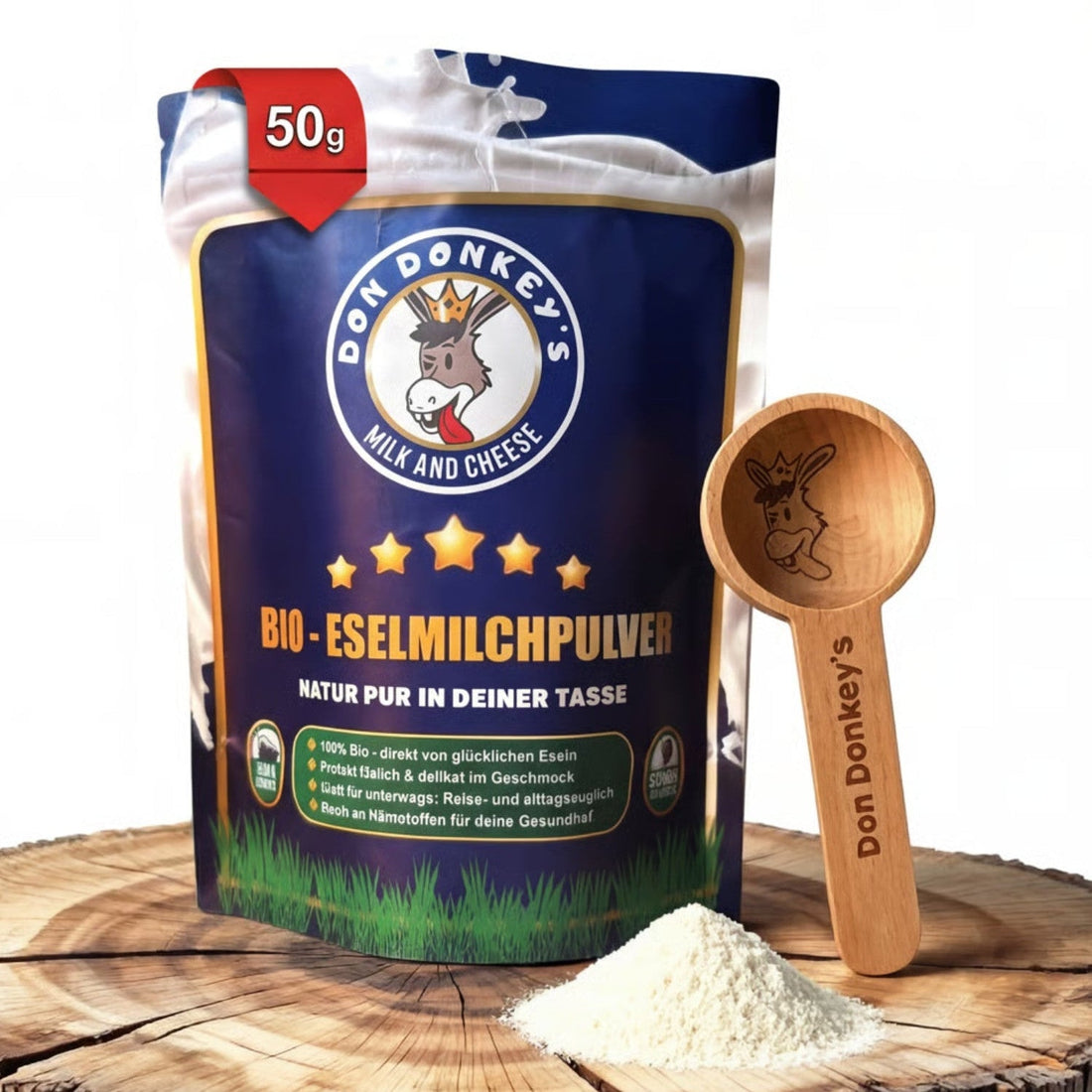
Also in our shop
Donkey Milk Powder
Donkey milk in powder form
For anyone who prefers a longer shelf life: our donkey milk in powder form – easy to store and portion.
20g · Unit price: €1.245,00 / 1 kg · incl. VAT, plus shipping