
 Buyer protection

Donkey milk research · Study 193
Italian donkey milk: microbiological quality and safety
An Italian team tested donkey milk against seven microbiological criteria. The total bacterial count met EU requirements; Salmonella, Listeria monocytogenes, coagulase-positive staphylococci and Cronobacter sakazakii were not detected. E. coli O157 and Campylobacter coli were found – the abstract does not say in how many samples.
At a glance · tap the cards
The key figures
Study design
How it was studied
Microbiological milk analysis by an Italian team, published in the Journal of Food Safety. Donkey milk from Italy was examined. Total viable count and coagulase-positive staphylococci were determined as process hygiene criteria, and Salmonella spp., Listeria monocytogenes, Cronobacter sakazakii, E. coli O157 and Campylobacter spp. as food safety criteria. Assessed based on the abstract; number of samples and farms, sampling, period, detection methods and frequency of positive findings are not stated there. The authors’ institutions are not listed in the metadata.
Results
What the study measured
According to the authors, the total viable count of the donkey milk examined met European requirements.
Salmonella spp., Listeria monocytogenes, coagulase-positive staphylococci and Cronobacter sakazakii were not detected.
E. coli O157 and Campylobacter coli were detected. The abstract states neither the number of positive samples nor the farms.
The authors consider this a relevant food safety issue and recommend a control plan with intensive, continuous monitoring.
In the practical section, they call for high hygiene standards along the entire raw milk chain, specific microbiological criteria for raw donkey milk and specific control plans for authorised dairy donkey farms.
Authors’ conclusion: The total viable count met EU requirements, but the detection of E. coli O157 and Campylobacter coli shows that an adequate control plan with continuous monitoring is needed. The study describes findings in the samples examined; how often such pathogens occur in donkey milk in general cannot be derived from it.
Critical appraisal
Strengths and limitations
Number of samples and frequency unknownClear limitation
The abstract states neither the number of samples nor how often the pathogens were found. A frequency therefore cannot be given.
Farms and period unclearNote
The regions and farms the milk came from and when it was sampled are not stated. Findings apply only to these samples.
Evaluative practical sectionNote
The practical section calls donkey milk a “pharmafood”. This classification has no connection to the measurements and is not adopted by us.
Only the abstract assessedNote
Detection methods, limits and individual results are unknown without the full text; funding and conflicts of interest could not be checked.
Testing against EU criteriaStrength
The study follows process hygiene and food safety criteria and thus provides practical pointers for farms’ own checks.
Editorial note: The paper shows what dairy donkey farms should test raw milk for regularly and gives a mixed picture: good total counts, four pathogens not detected, two others detected. Without sample numbers, it remains unclear how frequent these findings were. For producers it is mainly an argument for consistent hygiene and regular batch analyses. To the research archive.
Research question for DON DONKEY’S®
What results do regular batch tests of our frozen donkey milk for total viable count, E. coli O157 and Campylobacter deliver over a whole year – and how transparently can they be published?
Original publication
Microbiological safety and quality of Italian donkey milk
Original title: Microbiological safety and quality of Italian donkey milk
Mottola A., Alberghini L., Giaccone V., Marchetti P., Tantillo G., Di Pinto A.
Journal of Food Safety · 2018 · 38(3), e12444
Research group in Italy; institutions not stated in the metadata
DOI: 10.1111/jfs.12444
Transparency: funding and conflicts of interest could not be checked from the abstract. No product-related statement for DON DONKEY’S®.
Summarised and checked by the DON DONKEY’S editorial team against the original publication · As of: November 2026
The study summarised above was carried out independently of DON DONKEY’S® and does not relate to our products. It serves solely to inform about the state of research.
DON DONKEY’S® donkey milk and donkey milk powder are foods. They are not intended to prevent, treat or cure any disease and do not replace medical advice.

From our shop
DON DONKEY’S® donkey milk
100 % donkey milk · raw milk, frozen
On this page we report the findings of a published study. Independently of that, you will find our donkey milk here: 100 % donkey milk, frozen as raw milk.
100 ml bottle / 100ml · Unit price: €249,00 / 1 l · incl. VAT, plus shipping
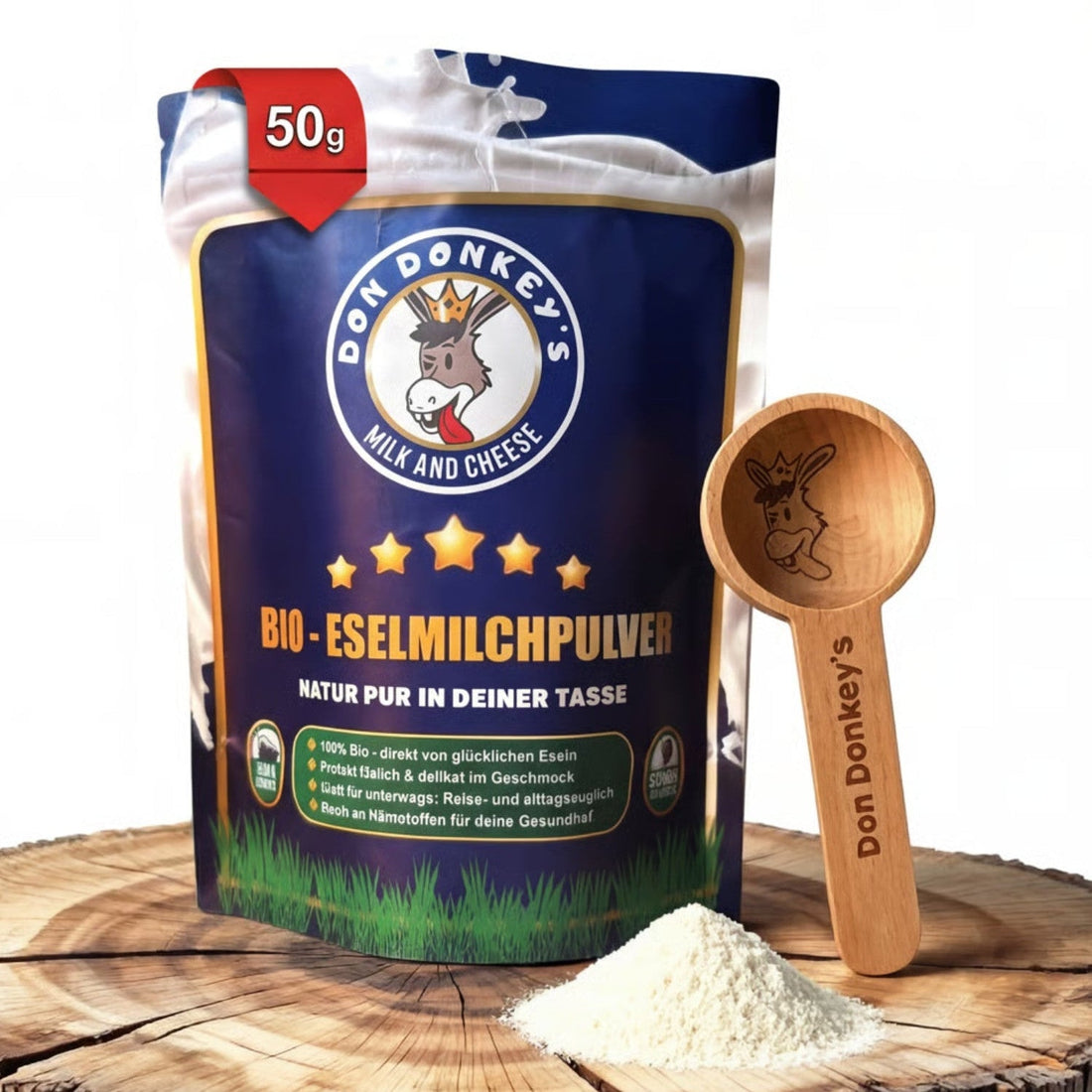
Also in our shop
Donkey Milk Powder
Donkey milk in powder form
For anyone who prefers a longer shelf life: our donkey milk in powder form – easy to store and portion.
20g · Unit price: €1.245,00 / 1 kg · incl. VAT, plus shipping