
 Buyer protection

Donkey milk research · Study 192
Human, cow and donkey milk: a comparison with a focus on metabolism
This invited review by nine authors from Naples compares the composition and metabolic effects of human, cow and donkey milk. According to the abstract, milk from different species differs considerably in nutrients and metabolic effects; in the authors’ assessment, donkey milk is closest to human milk. The abstract gives no specific values and does not name the underlying study types.
At a glance · tap the cards
The key figures
Study design
How it was studied
Invited review by nine authors from the University of Naples Federico II and the University of Campania “Luigi Vanvitelli” (Italy), published in the Journal of Dairy Science. It compares the main compositional features and metabolic effects of human, cow and donkey milk based on existing literature. There are no own measurements. Assessed based on the abstract; search strategy, studies included, study types and specific values are not stated there.
Results
What the study measured
The review compares the main compositional features and metabolic effects of three types of milk: human, cow and donkey milk.
The authors describe human milk as a newborn’s first food with an important role in growth and development.
According to the authors, cow milk is the most consumed milk worldwide. Concerns about its saturated fat content have not been confirmed in epidemiological studies.
The authors explain the interest in milk from other species by adverse reactions of some people to certain components of cow milk.
In the authors’ assessment, donkey milk is the closest to human milk among milks from other animals. They call it an “excellent substitute” – an assessment we do not adopt.
According to the abstract, milk from different species differs considerably in nutrients and metabolic effects. The abstract gives no specific values or underlying studies.
Authors’ conclusion: Milk from different species shows substantial differences in composition and metabolic effects; donkey milk is closest to human milk. The review interprets literature but measures nothing itself. Whether and how donkey milk affects human metabolism cannot be judged from the abstract, and similarity in composition does not make donkey milk a substitute for breast milk.
Critical appraisal
Strengths and limitations
Assessment goes beyond the dataClear limitation
Calling it an “excellent substitute” for human milk is a value judgement. Similar composition does not mean equal suitability, and the abstract gives no values that would make the comparison verifiable.
Study types unknownClear limitation
The abstract does not state whether the metabolic effects described come from cell, animal or human studies.
No systematic method apparentNote
The abstract does not describe a search strategy or selection criteria. It is an invited, narrative review.
Only the abstract assessedNote
Tables, values and sources are unknown without the full text; funding and conflicts of interest could not be checked.
Three types of milk side by sideStrength
The review sets human, cow and donkey milk against each other in one comparison and appeared in an established dairy science journal.
Editorial note: The abstract offers a framework for comparing three types of milk, but no verifiable values. We do not adopt the statement that donkey milk is an “excellent substitute” for human milk. Donkey milk is not a substitute for breast milk or infant formula; infant feeding belongs in medical hands. To the research archive.
Research question for DON DONKEY’S®
How does the fatty acid profile of our donkey milk change between the grazing and housing periods – and can it be stated transparently for each batch?
Original publication
Invited review: Human, cow, and donkey milk comparison: Focus on metabolic effects.
Original title: Invited review: Human, cow, and donkey milk comparison: Focus on metabolic effects.
Cimmino F., Catapano A., Villano I., Di Maio G., Petrella L., Traina G., Pizzella A., Tudisco R., Cavaliere G.
Journal of Dairy Science · 2023 · 106(5), 3072–3085
Department of Biology, University of Naples Federico II, and Department of Experimental Medicine, University of Campania “Luigi Vanvitelli”, Naples, Italy (according to the authors)
Transparency: funding and conflicts of interest could not be checked from the abstract; no funding is listed in the metadata. No product-related statement for DON DONKEY’S®.
Summarised and checked by the DON DONKEY’S editorial team against the original publication · As of: November 2026
The study summarised above was carried out independently of DON DONKEY’S® and does not relate to our products. It serves solely to inform about the state of research.
DON DONKEY’S® donkey milk and donkey milk powder are foods. They are not intended to prevent, treat or cure any disease and do not replace medical advice.

From our shop
DON DONKEY’S® donkey milk
100 % donkey milk · raw milk, frozen
On this page we report the findings of a published study. Independently of that, you will find our donkey milk here: 100 % donkey milk, frozen as raw milk.
100 ml bottle / 100ml · Unit price: €249,00 / 1 l · incl. VAT, plus shipping
Also in our shop
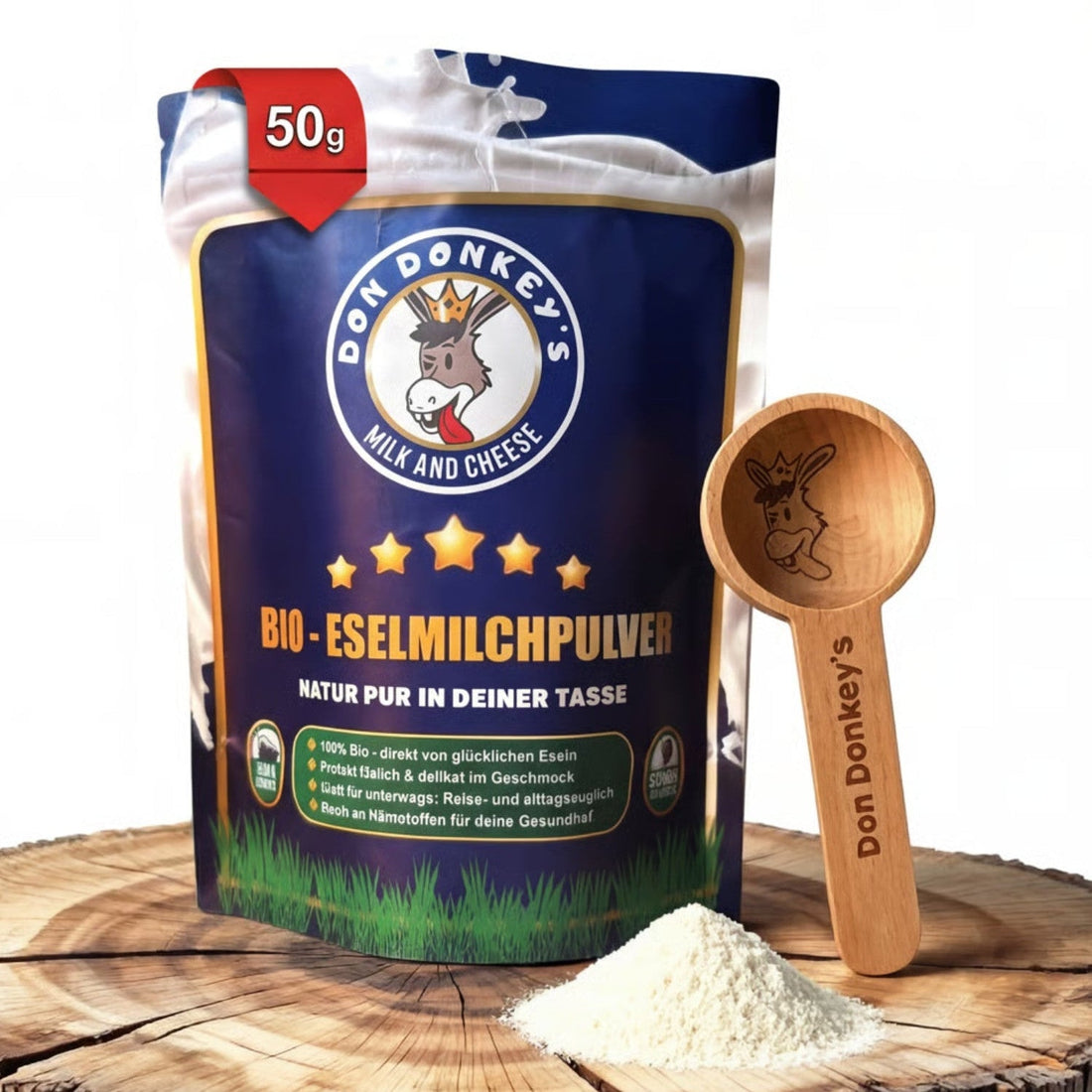
Donkey Milk Powder
Donkey milk in powder form
For anyone who prefers a longer shelf life: our donkey milk in powder form – easy to store and portion.
20g · Unit price: €1.245,00 / 1 kg · incl. VAT, plus shipping