
 Buyer protection

Donkey milk research · Study 191
Donkey milk, oxidative stress and inflammation: what models show
This review from Liaocheng (China) summarises studies on antioxidant and inflammation-related findings with donkey milk. According to the abstract, the highlighted data come from in vitro and animal models. The four authors themselves write that the underlying mechanism is poorly understood and that only few clinical studies exist.
At a glance · tap the cards
The key figures
Study design
How it was studied
Review by four authors from the College of Agronomy at Liaocheng University (China), based at the Shandong Engineering Technology Research Center for Efficient Breeding and Ecological Feeding of Black Donkey. It describes the relationship between inflammation and oxidative stress and summarises research on the nutritional value and functional properties of donkey milk, focusing on antioxidant and inflammation-related findings from in vitro and animal models. There are no own measurements. Assessed based on the abstract; studies included, search strategy, animal species and measured values are not stated there.
Results
What the study measured
The review first describes how inflammation and oxidative stress are related and then summarises research on the nutritional value and functional properties of donkey milk.
The focus is on antioxidant and inflammation-related findings from in vitro models and animal models. The abstract does not highlight studies in humans.
According to the authors, donkey milk and products made from it scavenged reactive oxygen species, activated antioxidant systems and changed immune parameters and the gut flora in these models.
The authors discuss a possible role of donkey milk in chronic, inflammation-related diseases. This is their assessment based on model findings, not a result of studies in humans.
As limitations, the authors themselves state that the mechanism is poorly understood, few clinical studies exist and further research at the molecular level is needed.
Authors’ conclusion: The review is intended to improve understanding of oxidative stress, inflammation and the biological functions of donkey milk and to provide “a certain basis” for nutritional approaches to chronic diseases; however, mechanisms and benefits in humans remain to be clarified. The paper shows model findings – it does not show that donkey milk affects inflammation or diseases in humans.
Critical appraisal
Strengths and limitations
Model findings onlyClear limitation
The highlighted data come from test tube and animal experiments. They cannot be transferred to humans.
Evaluative introductionClear limitation
The abstract describes donkey milk as a “natural nutritional and medicinal product”. This is an assessment not supported by the model data cited.
Ties to donkey breedingNote
The authors work at a research centre for donkey breeding and feeding. Conflicts of interest could not be checked from the abstract.
Only the abstract assessedNote
Which studies, animal species and measured values were included is unknown without the full text.
Names its own limitsStrength
The authors openly state that the mechanism is poorly understood and clinical studies are lacking.
Editorial note: The review collects model findings on antioxidant and inflammation-related properties and places them in a broader context. That is not enough for statements about effects in humans – as the authors themselves say. We read it as an overview of a research field, not as evidence. To the research archive.
Research question for DON DONKEY’S®
How does the laboratory-measurable antioxidant capacity of our donkey milk change over storage time in the freezer and after thawing?
Original publication
Effects of donkey milk on oxidative stress and inflammatory response.
Original title: Effects of donkey milk on oxidative stress and inflammatory response.
Li Y., Ma Q., Liu G., Wang C.
Journal of Food Biochemistry · 2022 · 46(4), e13935
College of Agronomy, Shandong Engineering Technology Research Center for Efficient Breeding and Ecological Feeding of Black Donkey, Liaocheng University, China (according to the authors)
DOI: 10.1111/jfbc.13935
Transparency: funded by non-US public sources according to the metadata; details on funding and conflicts of interest could not be checked from the abstract. No product-related statement for DON DONKEY’S®.
Summarised and checked by the DON DONKEY’S editorial team against the original publication · As of: November 2026
The study summarised above was carried out independently of DON DONKEY’S® and does not relate to our products. It serves solely to inform about the state of research.
DON DONKEY’S® donkey milk and donkey milk powder are foods. They are not intended to prevent, treat or cure any disease and do not replace medical advice.

From our shop
DON DONKEY’S® donkey milk
100 % donkey milk · raw milk, frozen
On this page we report the findings of a published study. Independently of that, you will find our donkey milk here: 100 % donkey milk, frozen as raw milk.
100 ml bottle / 100ml · Unit price: €249,00 / 1 l · incl. VAT, plus shipping
Also in our shop
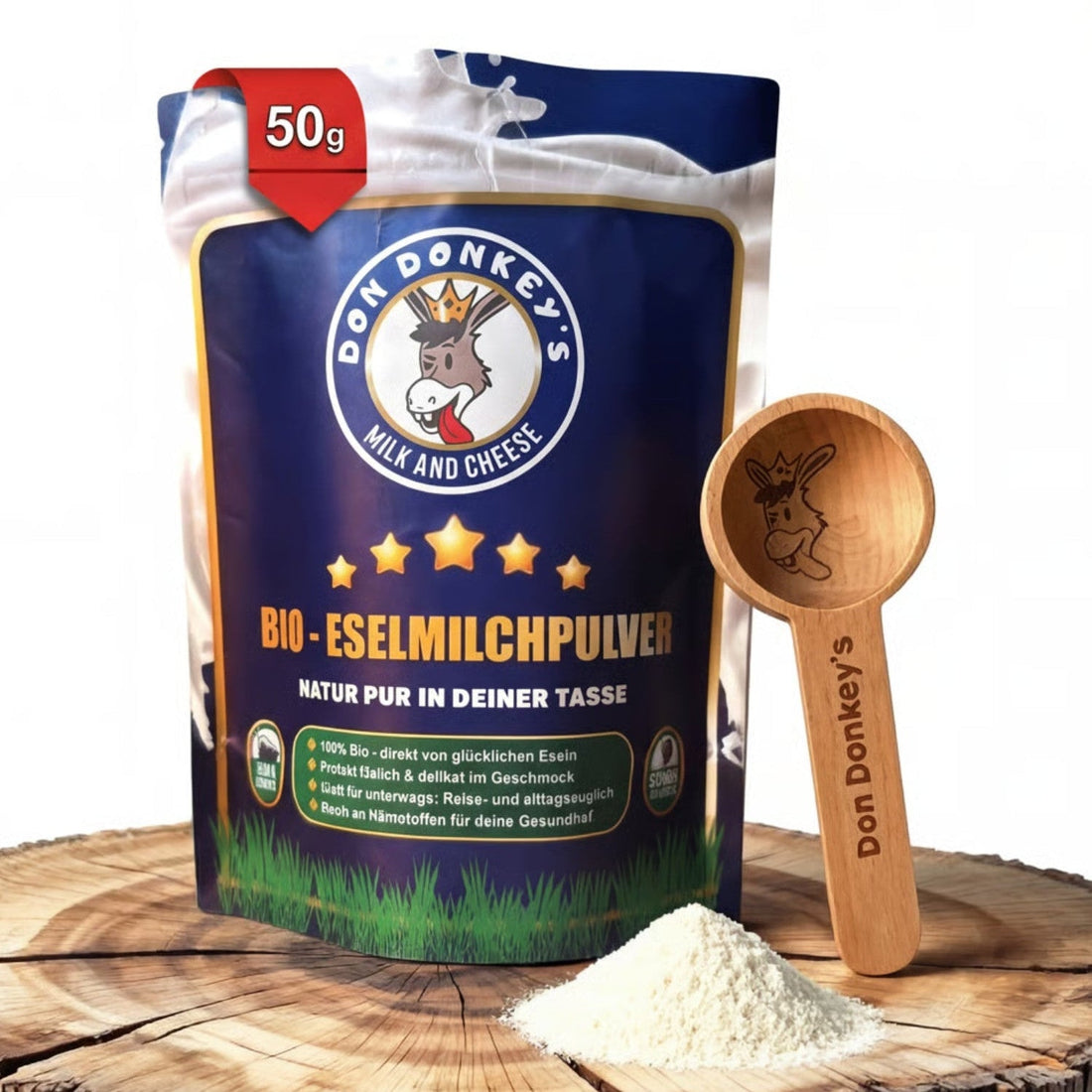
Donkey Milk Powder
Donkey milk in powder form
For anyone who prefers a longer shelf life: our donkey milk in powder form – easy to store and portion.
20g · Unit price: €1.245,00 / 1 kg · incl. VAT, plus shipping