
 Buyer protection

Donkey milk research · Study 189
Composition of donkey milk: a review from Serbia
This review from Novi Sad (Serbia) summarises what is known about the composition of donkey milk: low in fat, cholesterol, total protein and casein, but high in lactose, whey proteins, calcium, selenium and vitamin D3. According to the authors, literature values for individual components differ considerably. They consider clinical trials in humans necessary for statements on health properties.
At a glance · tap the cards
The key figures
Study design
How it was studied
Review by four authors from the Scientific Veterinary Institute “Novi Sad” (Serbia), funded according to the metadata by non-US public sources. It summarises literature on the chemical composition of donkey milk, protective proteins and biological activities described in the literature, and addresses commercialisation and research needs. The paper contains no own measurements. Assessed based on the abstract; specific contents, the studies included and how they were selected are not stated there.
Results
What the study measured
According to the authors, literature values for individual components of donkey milk differ considerably. As established basic characteristics they name low fat, cholesterol, total protein and casein, and high lactose, whey proteins, calcium, selenium and vitamin D3.
The review lists α-lactalbumin, lysozyme, lactoferrin, lactoperoxidase and immunoglobulins as protective proteins.
The authors list a range of biological activities described in the literature, such as antioxidant and antibacterial ones. The abstract does not state which types of studies these are based on; effects in humans are not demonstrated by them.
Because of the low total fat content, donkey milk must be enriched with other fat for children’s diets to provide enough energy, according to the authors.
Commercialisation of donkey milk is limited by low production, few products and a lack of product information.
The authors call for clinical trials in humans to obtain stronger evidence on the properties described.
Authors’ conclusion: Donkey milk has a valuable nutrient composition and can be considered a “functional food”; however, clinical trials in humans are needed for stronger evidence. The review describes composition – it does not show health effects in humans, and the classification as a functional food is the authors’ assessment.
Critical appraisal
Strengths and limitations
Evaluative statements without evidence in the abstractClear limitation
The abstract lists many “strong” activities without naming study types. We do not adopt such assessments.
No systematic method apparentNote
Search strategy and selection criteria are not described in the abstract. It is a narrative review.
Large variation in contentsNote
The authors themselves stress that literature values differ considerably. General statements do not apply to every milk.
Only the abstract assessedNote
Specific contents, sources and tables are unknown without the full text.
Names research needsStrength
The authors openly state that clinical trials are lacking and also name the low fat content as a limitation for children’s diets.
Editorial note: The review confirms the known basic features of donkey milk composition and names the need for human studies. The list of biological activities in the abstract, by contrast, is a compilation of literature statements, not proof of effect. Donkey milk is not a substitute for breast milk or infant formula; infant feeding belongs in medical hands. To the research archive.
Research question for DON DONKEY’S®
How much do fat and lactose content of our donkey milk vary between batches and seasons – and can the values be stated on the label as an honest range?
Original publication
Donkey Milk: An Overview of its Chemical Composition and Main Nutritional Properties or Human Health Benefit Properties.
Original title: Donkey Milk: An Overview of its Chemical Composition and Main Nutritional Properties or Human Health Benefit Properties.
Živkov Baloš M., Ljubojević Pelić D., Jakšić S., Lazić S.
Journal of Equine Veterinary Science · 2023 · 121, 104225
Scientific Veterinary Institute “Novi Sad”, Novi Sad, Serbia (according to the authors)
DOI: 10.1016/j.jevs.2023.104225
Transparency: funded by non-US public sources according to the metadata; details on funding and conflicts of interest could not be checked from the abstract. No product-related statement for DON DONKEY’S®.
Summarised and checked by the DON DONKEY’S editorial team against the original publication · As of: November 2026
The study summarised above was carried out independently of DON DONKEY’S® and does not relate to our products. It serves solely to inform about the state of research.
DON DONKEY’S® donkey milk and donkey milk powder are foods. They are not intended to prevent, treat or cure any disease and do not replace medical advice.

From our shop
DON DONKEY’S® donkey milk
100 % donkey milk · raw milk, frozen
On this page we report the findings of a published study. Independently of that, you will find our donkey milk here: 100 % donkey milk, frozen as raw milk.
100 ml bottle / 100ml · Unit price: €249,00 / 1 l · incl. VAT, plus shipping
Also in our shop
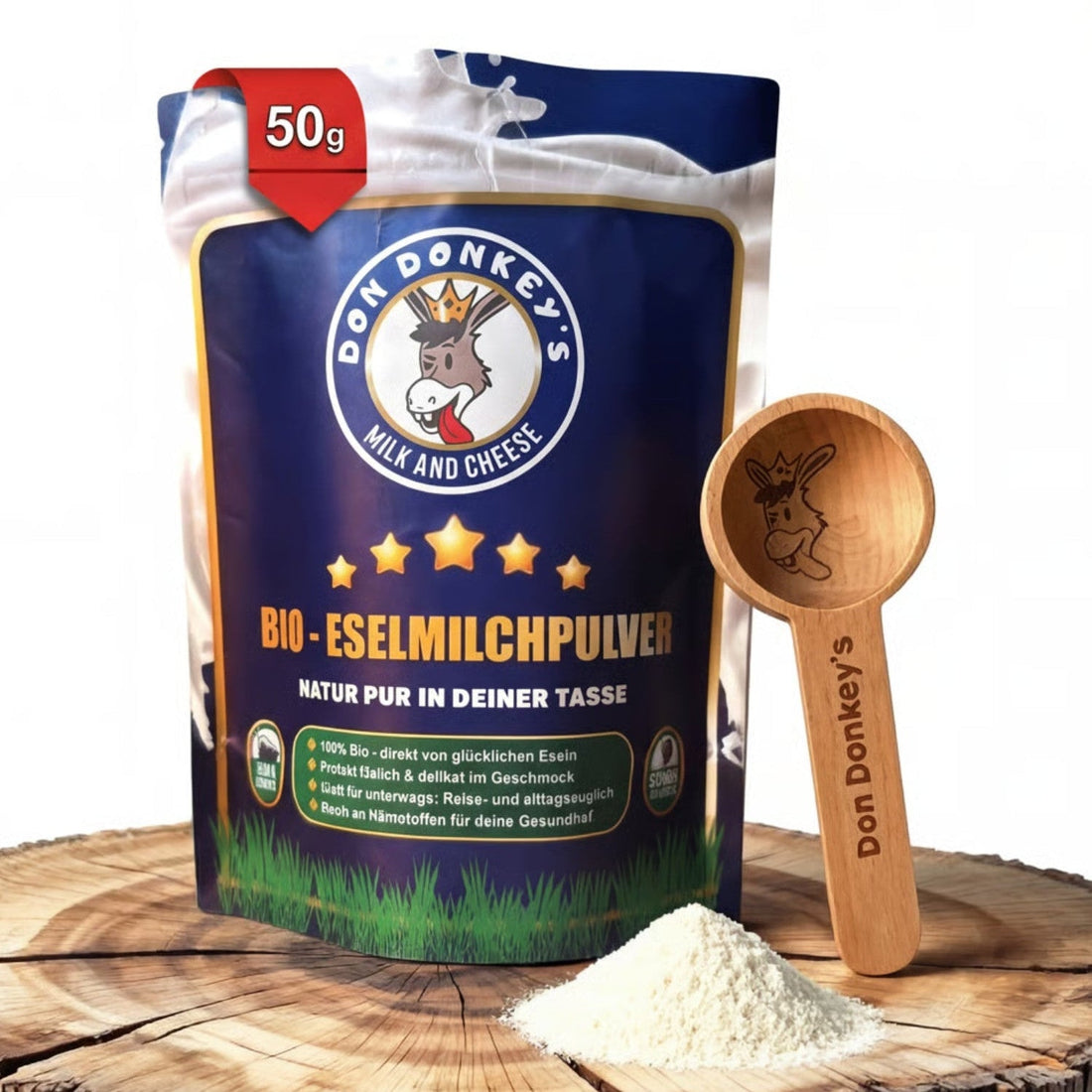
Donkey Milk Powder
Donkey milk in powder form
For anyone who prefers a longer shelf life: our donkey milk in powder form – easy to store and portion.
20g · Unit price: €1.245,00 / 1 kg · incl. VAT, plus shipping