
 Buyer protection

Donkey milk research · Study 188
Donkey milk in cow’s milk allergy: 19 of 46 reacted in testing
In a Spanish allergy department, 46 people with severe cow’s milk allergy agreed to be tested with donkey milk under supervision; 19 of them reacted positively. Of 13 people with eosinophilic oesophagitis who were tested, 6 reacted, while the others tolerated 100 mL without reaction. In Western blot, the allergen profile of donkey milk resembled that of cow milk but was weaker.
At a glance · swipe or use the arrows
The key figures
Study design
How it was studied
Clinical observational study by an allergy department in Spain, published as a preprint (not peer-reviewed). Over one year, patients with food hypersensitivity were recorded. Donkey milk came from Zamora (Spain) and was frozen at −72 °C. After informed consent, in vivo tests (prick-to-prick skin test, oral challenge) and laboratory tests (specific IgE, SDS-PAGE, Western blot, molecular analysis) were carried out in four groups: severe cow’s milk allergy, eosinophilic oesophagitis and two control groups (healthy people and people with grass pollen allergy without digestive symptoms). Assessed based on the abstract; age, challenge protocol, blinding, type of reactions and the size of the control groups are not stated there.
Results
What the study measured
Of 2032 patients with food hypersensitivity, 83 (4%) had severe symptoms after cow milk. 46 had IgE to a fraction referred to in the abstract as “alpha-lactoglobulin”, 42 to β-lactoglobulin and 47 to casein.
46 of these people agreed to a challenge with donkey milk; it was positive in 19.
Of 67 people with eosinophilic oesophagitis, 13 were challenged with donkey milk and 6 reacted positively.
According to the abstract, the others tested tolerated 100 mL of donkey milk without reaction.
In Western blot, donkey milk showed an allergen profile similar to cow milk in all patients analysed, but with clearly lower intensity.
Authors’ conclusion: The authors found lower IgE-mediated hypersensitivity to donkey milk than to cow milk and, given its accessibility, consider donkey milk a “feasible alternative”. We do not adopt this assessment: 19 of 46 people tested with severe cow’s milk allergy also reacted to donkey milk, and the allergen profile resembled that of cow milk. Whether an individual tolerates donkey milk can only be clarified medically.
Critical appraisal
Strengths and limitations
Preprint without peer reviewClear limitation
The paper was published as a preprint and has not been peer-reviewed. Results may still change before formal publication.
Many reactions to donkey milkClear limitation
19 of 46 people tested with severe cow’s milk allergy and 6 of 13 with eosinophilic oesophagitis reacted positively. The Western blot profile points to cross-reactions.
Selection and missing detailsNote
Only people who consented were tested. The abstract does not state age, challenge protocol, blinding or type of reactions; whether children were included is unclear.
Only the abstract assessedNote
Results of the control groups and skin tests are unknown without the full text. The term “alpha-lactoglobulin” in the abstract is unclear.
Real patient data with several methodsStrength
The study combines oral challenge under clinical conditions with skin tests, IgE measurement and Western blot, and includes control groups.
Editorial note: Above all, the data show one thing: a considerable proportion of people with severe cow’s milk allergy also reacted to donkey milk in this test. Donkey milk is therefore not a substitute to try out on one’s own in cow’s milk allergy. In the case of an allergy, any change in diet belongs in medical hands. To the research archive.
Research question for DON DONKEY’S®
Can protein analysis reliably rule out traces of cow milk in every batch of our donkey milk – for example from shared equipment on partner farms?
Original publication
Donkey milk as a possible alternative for cow's milk allergic patients
Original title: Donkey milk as a possible alternative for cow's milk allergic patients
Armentia A., Martin B., Galán T., Castro M., Albertos I., Jiménez J. M., Corell A., Martin-Armentia S., Pineda F.
Preprint · 2023 · Preprint, Version 1
Allergy department in Spain (according to the abstract); institution and affiliations not stated in the metadata
DOI: 10.22541/au.168136203.35094462/v1
Transparency: preprint without peer review. Funding and conflicts of interest could not be checked from the abstract. No product-related statement for DON DONKEY’S®.
Summarised and checked by the DON DONKEY’S editorial team against the original publication · As of: November 2026
The study summarised above was carried out independently of DON DONKEY’S® and does not relate to our products. It serves solely to inform about the state of research.
DON DONKEY’S® donkey milk and donkey milk powder are foods. They are not intended to prevent, treat or cure any disease and do not replace medical advice.

From our shop
DON DONKEY’S® donkey milk
100 % donkey milk · raw milk, frozen
On this page we report the findings of a published study. Independently of that, you will find our donkey milk here: 100 % donkey milk, frozen as raw milk.
100 ml bottle / 100ml · Unit price: €249,00 / 1 l · incl. VAT, plus shipping
Also in our shop
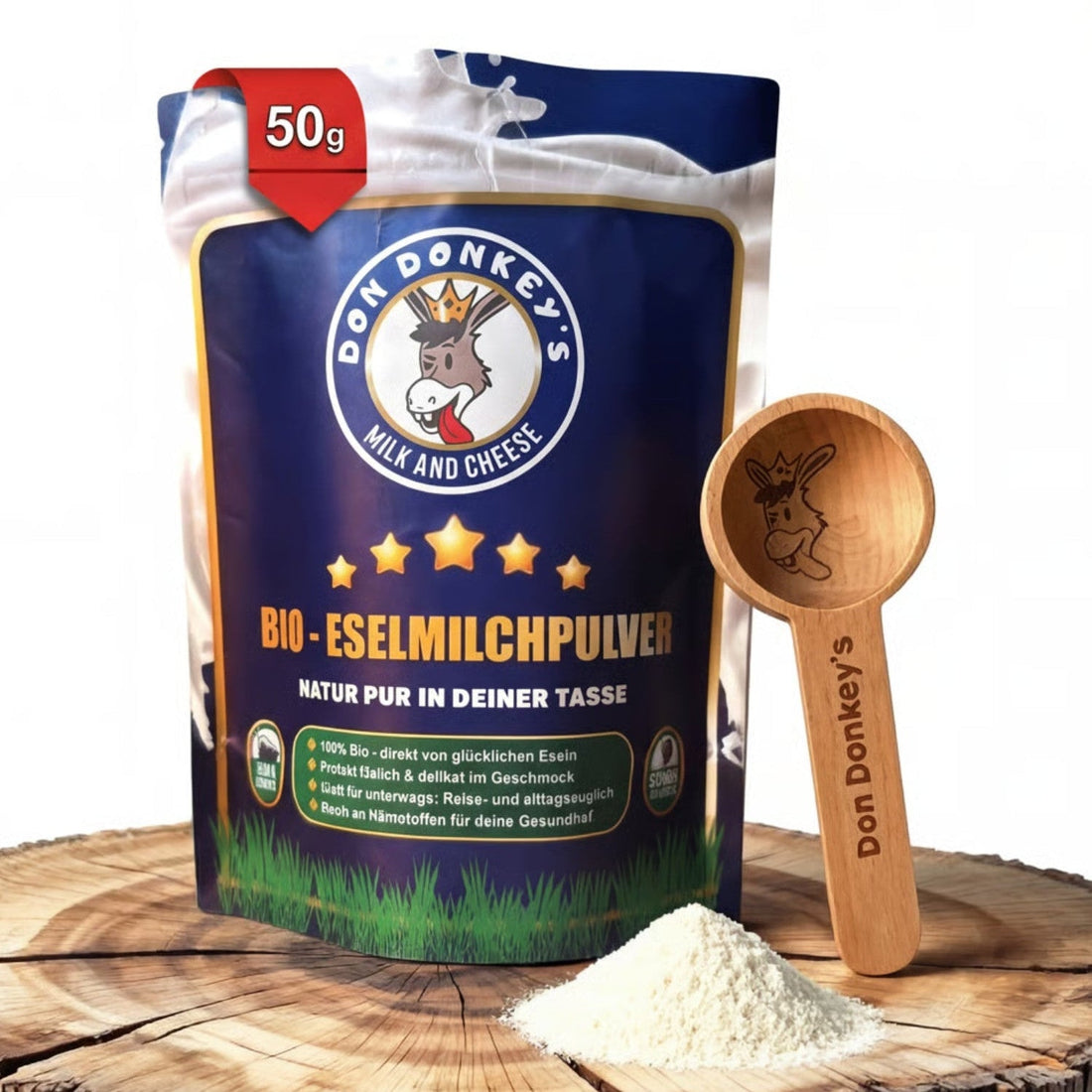
Donkey Milk Powder
Donkey milk in powder form
For anyone who prefers a longer shelf life: our donkey milk in powder form – easy to store and portion.
20g · Unit price: €1.245,00 / 1 kg · incl. VAT, plus shipping