
 Buyer protection

Donkey milk research · Study 187
Bacteria from donkey milk and pickles: experiments on fat cells in the lab
From raw donkey milk and homemade fermented pickles, a team in Vellore (India) isolated 14 bacterial strains and selected 9 that degraded oxalate, inhibited the enzyme α-glucosidase and reduced cholesterol in the test tube. Heat-killed cells of 4 strains – three Enterococcus, one Lactobacillus – reduced fat storage and the activity of genes involved in fat cell formation in a mouse fat cell line (3T3-L1). The abstract does not state which of the two sources the four strains came from.
At a glance · tap the cards
The key figures
Study design
How it was studied
Laboratory study by the School of Biosciences and Technology at Vellore Institute of Technology (Renal Research Laboratory, India). Fourteen lactic acid bacteria isolates were obtained from raw donkey milk and homemade fermented pickles. Nine strains were pre-selected in the test tube for oxalate degradation, α-glucosidase inhibition and cholesterol reduction. Heat-killed cells of these strains were tested on 3T3-L1 cells, a mouse fat cell line; fat storage and gene and protein expression of C/EBPα, PPARγ, aP2 and PLIN-1 were measured. The four most active isolates were identified by 16S rRNA sequencing and tested for survival under simulated gastric conditions and haemolysis. Assessed based on the abstract; measured values, doses, number of replicates and the origin of the individual strains are not stated there.
Results
What the study measured
Out of 14 isolates, the researchers selected 9 strains that degraded oxalate, inhibited α-glucosidase and reduced cholesterol in the test tube.
Heat-killed cells of 4 strains significantly reduced fat storage in 3T3-L1 mouse cells.
Expression of C/EBPα and PPARγ, which are involved in fat cell formation, of aP2 (fat transport) and of PLIN-1 (fat storage) decreased.
The four strains were identified by 16S rRNA sequencing as closest relatives of the genera Enterococcus (RRLA5, RRLA1, RRLD6) and Lactobacillus (RRLM2).
According to the authors, the strains survived well under simulated gastric conditions and showed no haemolysis in the test. Live cells significantly degraded oxalate in the test tube.
Authors’ conclusion: Live cells of the isolates degraded oxalate in the lab, and heat-killed cells showed “anti-adipogenic activity” according to the authors; future animal studies could clarify whether they are candidates as “biotherapeutic” agents. The study shows effects of bacterial cells on a mouse cell line – not that donkey milk or these bacteria affect weight, blood sugar or kidney stones in humans.
Critical appraisal
Strengths and limitations
Cell culture, not an organismClear limitation
3T3-L1 cells are a mouse cell line. How bacteria act in the gut and what reaches the body cannot be tested this way.
Bacteria, not donkey milkClear limitation
Isolated bacterial strains were tested, some from pickles. The abstract does not state the origin of the four active strains; donkey milk itself was not tested.
Title goes beyond the dataNote
Phrases such as “Harnessing the Power” and “antiadipogenic agents” describe cell culture findings. The introduction refers to conditions that were not studied.
Only the abstract assessedNote
Measured values, doses, controls and replicates are unknown without the full text. For Enterococcus, careful safety testing is also customary; its extent cannot be seen here.
Several levels of measurementStrength
The effect on the cells was recorded via fat storage, gene expression and protein expression, and the strains were identified genetically.
Editorial note: For donkey milk as a food, this work is only marginally relevant: it uses raw donkey milk as one of two sources of bacterial isolates and tests them on mouse cells. No statements on metabolism or weight in humans can be derived from it. It is of interest as further evidence that raw donkey milk contains a diverse bacterial flora. To the research archive.
Research question for DON DONKEY’S®
Can live lactic acid bacteria still be cultured from our frozen raw milk after thawing – and how much do batches from different partner farms differ?
Original publication
Harnessing the Power of Donkey's Milk and Homemade Pickles: Unveiling Oxalate-Degrading Probiotics and Their Heat-Killed Cells as Antiadipogenic Agents in 3T3-L1 Adipocytes.
Original title: Harnessing the Power of Donkey's Milk and Homemade Pickles: Unveiling Oxalate-Degrading Probiotics and Their Heat-Killed Cells as Antiadipogenic Agents in 3T3-L1 Adipocytes.
Hiremath S., Viswanathan P.
Current Microbiology · 2025 · 82(4), 155
School of Biosciences and Technology, Renal Research Laboratory, Vellore Institute of Technology, Vellore, Tamil Nadu, India (according to the authors)
DOI: 10.1007/s00284-025-04146-9
Transparency: funding and conflicts of interest could not be checked from the abstract; no funding is listed in the metadata. No product-related statement for DON DONKEY’S®.
Summarised and checked by the DON DONKEY’S editorial team against the original publication · As of: November 2026
The study summarised above was carried out independently of DON DONKEY’S® and does not relate to our products. It serves solely to inform about the state of research.
DON DONKEY’S® donkey milk and donkey milk powder are foods. They are not intended to prevent, treat or cure any disease and do not replace medical advice.

From our shop
DON DONKEY’S® donkey milk
100 % donkey milk · raw milk, frozen
On this page we report the findings of a published study. Independently of that, you will find our donkey milk here: 100 % donkey milk, frozen as raw milk.
100 ml bottle / 100ml · Unit price: €249,00 / 1 l · incl. VAT, plus shipping
Also in our shop
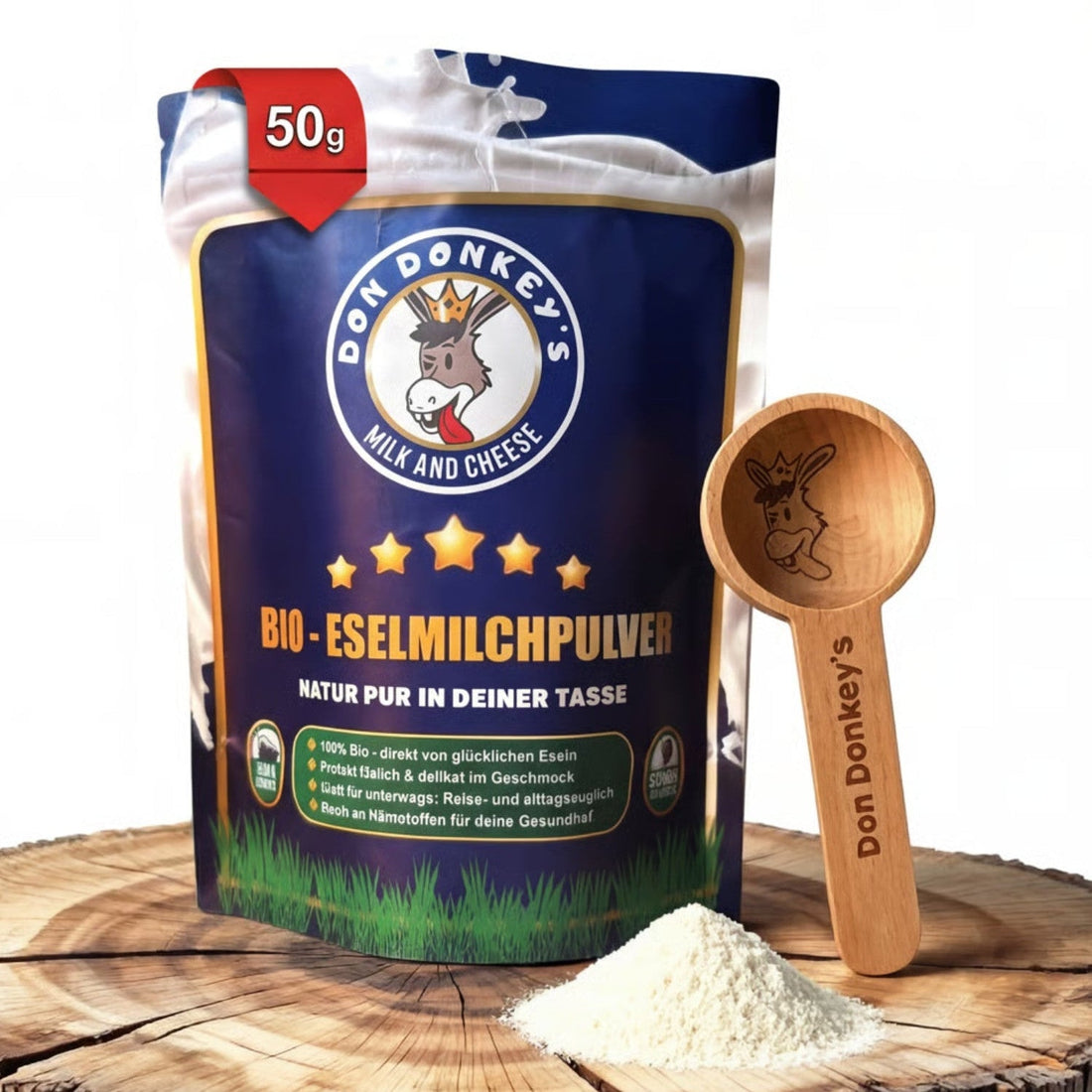
Donkey Milk Powder
Donkey milk in powder form
For anyone who prefers a longer shelf life: our donkey milk in powder form – easy to store and portion.
20g · Unit price: €1.245,00 / 1 kg · incl. VAT, plus shipping