
 Buyer protection

Donkey milk research · Study 185
Donkey milk and health: what the evidence supports – and what it does not
This review from China asks in its title whether there is sufficient evidence for health benefits of donkey milk. The findings it compiles on components such as lysozyme and lactoferrin come mostly from cell lines and animal models; the authors themselves write that “rigorous clinical trials” are needed to substantiate health claims. On composition, the review cites 57 mg/L vitamin C, among other values (human milk 60, cow milk 27 mg/L).
At a glance · tap the cards
The key figures
Study design
How it was studied
Narrative review by 13 authors, mainly from the Liaocheng Research Institute of Donkey High-Efficiency Breeding and Ecological Feeding at Liaocheng University (China), with contributors from Pakistan and Shenzhen. The paper summarises literature on donkey milk composition, antimicrobial and immunological findings, cell and animal studies in tumour and diabetes research, use in cow’s milk protein allergy, and the influence of lactation stage, feeding, breed and processing. There are no own measurements; a systematic search strategy, inclusion and exclusion criteria or an assessment of study quality are not described. The full text was assessed; the composition table (Table 1) was not fully included in the material.
Results
What the study measured
Composition: the review describes donkey milk as low in fat, cholesterol and casein and rich in whey proteins such as lysozyme, α-lactalbumin and lactoferrin. For vitamin C it gives 57 mg/L (human milk 60, cow milk 27 mg/L).
Antimicrobial and immunological findings: the review cites lab experiments in which donkey milk or its components inhibited bacteria such as Staphylococcus aureus or E. coli, and experiments with human blood cells in which messengers such as IL-6, IL-8, IL-10 and TNF-α changed. Mouse models, for example of intestinal inflammation, are also cited.
Tumour and diabetes research: the cited work is mostly based on cell lines (for example A549, MCF7) and mouse models. The authors themselves write that the underlying mechanisms still have to be clarified in further in vitro and in vivo studies.
Cow’s milk protein allergy: the review attributes the lower allergenicity mainly to the low casein content and differences in β-lactoglobulin. At the same time, it states that hypoallergenic formulas are preferred and that milk from other species should only be used under careful paediatric supervision.
Influencing factors: according to the cited literature, lactation stage, feeding, breed and processing change the composition. Examples include selenium yeast in the feed (0.3 mg/kg) or ultra-high-pressure homogenisation at 100 MPa with a 28-day minimum shelf life; pasteurisation plus high pressure at 600 MPa, by contrast, made the milk unsuitable.
Limitations according to the authors: low milk yield, lack of standardisation in production and processing, and continuing large knowledge gaps. Clinical trials are needed to substantiate health-related claims.
Authors’ conclusion: Donkey milk is an “intriguing option” for health-promoting foods; however, in-depth in vitro and in vivo studies are needed to clarify mechanisms, along with progress in production and research. The review does not answer its title question systematically – its own references to missing clinical trials show that health effects in humans are not demonstrated by it.
Critical appraisal
Strengths and limitations
Narrative, not systematic reviewClear limitation
Search strategy, selection criteria and an assessment of study quality are missing. The authors chose which papers to include.
Mostly cell and animal dataClear limitation
Most findings come from cell lines, blood cells in the test tube and mouse models. They cannot be transferred to humans.
Evaluative languageNote
The abstract calls donkey milk an “optimal alternative” in cow’s milk allergy, whereas the full text recommends hypoallergenic formulas as the preferred option and medical supervision. We do not adopt such assessments.
Ties to donkey breeding researchNote
The authors work at an institute for donkey breeding; funding included an innovation team of the Shandong donkey industry. Conflicts of interest are denied.
Names its own limitsStrength
The review openly states that mechanisms are unclear and clinical trials are lacking, and also covers feeding and processing.
Editorial note: The paper is a broad overview of donkey milk research, but not an assessment of the strength of evidence in the strict sense. Anyone asking the title question will mainly find cell and animal findings in it, together with the authors’ note that human studies are lacking. Health effects of donkey milk cannot be derived from it; in the case of allergies, diet belongs in medical hands. To the research archive.
Research question for DON DONKEY’S®
How much do lysozyme and lactoferrin vary between batches from our partner farms depending on lactation stage and season – and do they remain measurably the same after freezing and thawing?
Original publication
Is there sufficient evidence to support the health benefits of including donkey milk in the diet?
Original title: Is there sufficient evidence to support the health benefits of including donkey milk in the diet?
Khan M. Z., Chen W., Li M., Ren W., Huang B., Kou X., Ullah Q., Wei L., Wang T., Khan A., Zhang Z., Li L., Wang C.
Frontiers in Nutrition · 2024 · 11, 1404998
Liaocheng Research Institute of Donkey High-Efficiency Breeding and Ecological Feeding, Liaocheng University, China; further contributors from Bahawalpur (Pakistan) and Shenzhen (China) (according to the paper)
DOI: 10.3389/fnut.2024.1404998
Transparency: funded among others by the National Key R&D Program of China, the National Natural Science Foundation of China, a donkey industry innovation team of Shandong Province and research funds of Liaocheng University. The authors declare no conflicts of interest. No product-related statement for DON DONKEY’S®.
Summarised and checked by the DON DONKEY’S editorial team against the original publication · As of: November 2026
The study summarised above was carried out independently of DON DONKEY’S® and does not relate to our products. It serves solely to inform about the state of research.
DON DONKEY’S® donkey milk and donkey milk powder are foods. They are not intended to prevent, treat or cure any disease and do not replace medical advice.

From our shop
DON DONKEY’S® donkey milk
100 % donkey milk · raw milk, frozen
On this page we report the findings of a published study. Independently of that, you will find our donkey milk here: 100 % donkey milk, frozen as raw milk.
100 ml bottle / 100ml · Unit price: €249,00 / 1 l · incl. VAT, plus shipping
Also in our shop
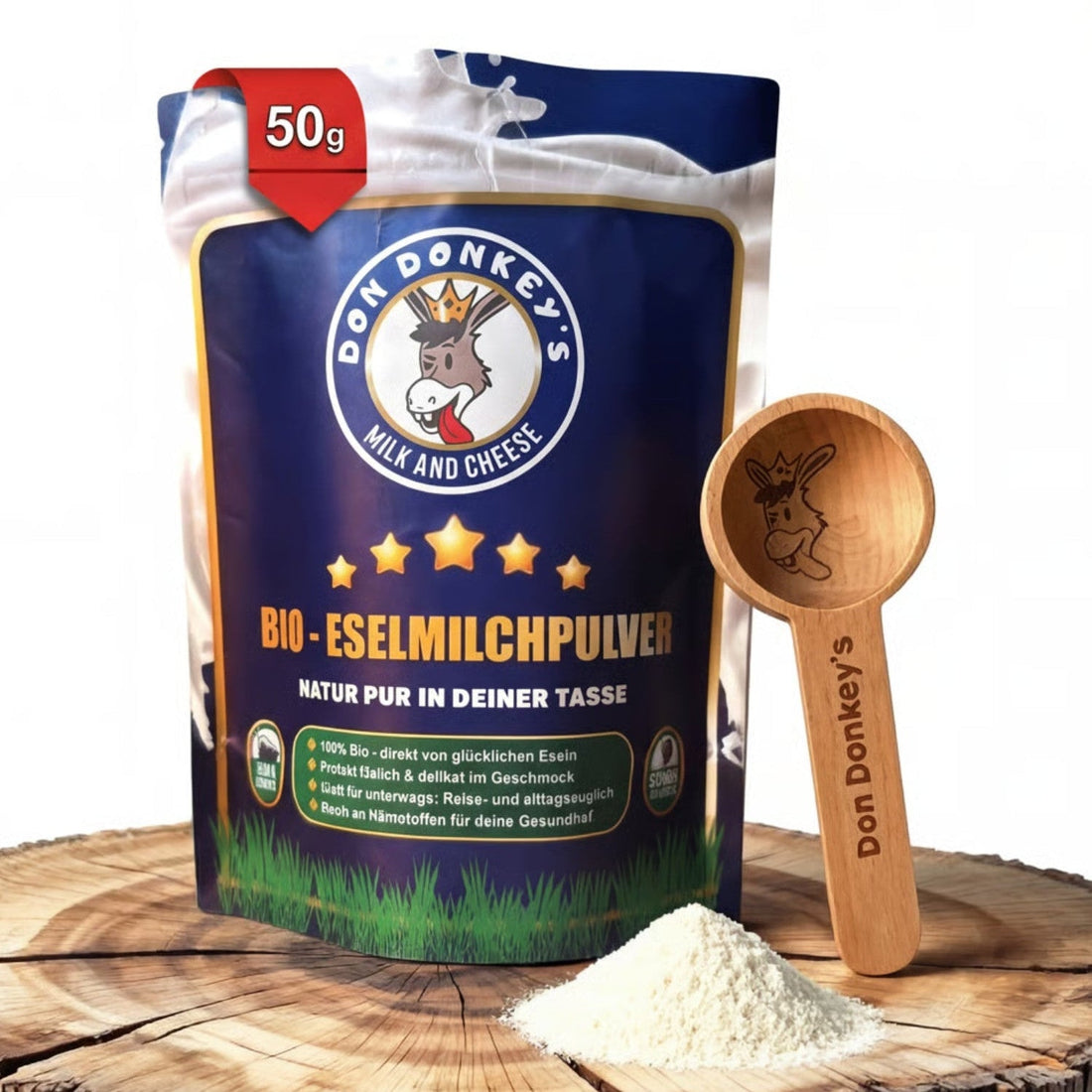
Donkey Milk Powder
Donkey milk in powder form
For anyone who prefers a longer shelf life: our donkey milk in powder form – easy to store and portion.
20g · Unit price: €1.245,00 / 1 kg · incl. VAT, plus shipping