
 Buyer protection

Donkey milk research · Study 183
Milk from Jiangyue jennies: nutrients, nitrogen fractions, amino acids
Milk from Jiangyue jennies in north-west China contained on average 1.57 % protein, 1.16 % fat, 6.33 % lactose and 0.4 % ash, with 9.53 % total solids. Casein and whey protein were in a ratio of 52:37; the 8 essential amino acids made up 38.2 % of the protein.
At a glance · tap the cards
The key figures
Study design
How it was studied
Milk analysis by the College of Food Science and Nutritional Engineering, China Agricultural University (Beijing). Milk samples from jennies of the Jiangyue breed in north-west China, taken over the course of lactation, were analysed. Total solids, protein, fat, lactose, ash, pH and density, the distribution of nitrogen fractions (casein, whey protein), the protein pattern by SDS-PAGE and the amino acid profile were determined. Evaluated based on the abstract: it does not give the number of animals or samples, sampling times, husbandry, feeding or measures of variation.
Interactive chart · values from the study
Average composition of donkey milk
Source: abstract of the study, averages over the lactation period studied.
Second analysis
Selected amino acids in the protein
Source: abstract of the study. Only the amino acids named there.
Results
What the study measured
On average, the milk contained 9.53 % total solids, 1.57 % protein, 1.16 % fat, 6.33 % lactose and 0.4 % ash. According to the authors, this is closer to mare and human milk than to the milk of other mammals.
pH and density remained constant over lactation. Protein and ash tended to decrease; lactose rose up to 120 days after foaling and fell thereafter. Fat content varied widely.
The content and share of whey protein, casein and amino acids changed only slightly. Casein and whey protein were in a ratio of 52:37.
SDS-PAGE showed marked proportions of β-lactoglobulin and lysozyme.
The 8 essential amino acids made up 38.2 % of the protein. Serine (6.2 %), glutamic acid (22.8 %), arginine (4.6 %), valine (6.5 %) and cystine (0.4 %) are also reported.
Authors’ conclusion: The authors consider the composition of donkey milk closer to mare and human milk than to the milk of other mammals and point to a higher share of essential amino acids compared with mare and cow’s milk. The study describes contents; it did not examine whether or how well these nutrients are absorbed.
Critical appraisal
Strengths and limitations
Sample size unknownClear limitation
The abstract does not give the number of animals or samples. How robust the averages are cannot be judged.
One breed, one regionNote
Jiangyue jennies from north-west China were studied. Breed, feeding and husbandry can strongly influence the values.
Comparisons from the literatureNote
Comparisons with mare, cow and human milk are probably based on literature values, not on parallel measurements.
Content is not availabilityNote
Contents were measured. How much of them the body absorbs was not studied.
Broad measurement programmeStrength
The paper combines basic composition, nitrogen fractions, protein pattern and amino acid profile over the course of lactation.
Editorial note: The paper provides concrete averages for the composition of a Chinese donkey breed. It is notable that fat content (average 1.16 %) varied widely according to the authors, while pH and density remained constant. Other herds require their own analyses. To the research archive.
Research question for DON DONKEY’S®
How do protein, fat and lactose levels in our donkey milk change over the season when each batch is documented with its stage of lactation?
Original publication
Composition, physiochemical properties, nitrogen fraction distribution, and amino acid profile of donkey milk.
Original title: Composition, physiochemical properties, nitrogen fraction distribution, and amino acid profile of donkey milk.
Guo H. Y., Pang K., Zhang X. Y., Zhao L., Chen S. W., Dong M. L., Ren F. Z.
Journal of Dairy Science · 2007 · 90(4), 1635–1643
College of Food Science and Nutritional Engineering, China Agricultural University, Beijing, China (according to the paper)
DOI: 10.3168/jds.2006-600
Transparency: funded by the Beijing Ministry of Education according to the database record; conflicts of interest could not be checked from the abstract. No product-related statement for DON DONKEY’S®.
Summarised and checked by the DON DONKEY’S editorial team against the original publication · As of: November 2026
The study summarised above was carried out independently of DON DONKEY’S® and does not relate to our products. It serves solely to inform about the state of research.
DON DONKEY’S® donkey milk and donkey milk powder are foods. They are not intended to prevent, treat or cure any disease and do not replace medical advice.

From our shop
DON DONKEY’S® donkey milk
100 % donkey milk · raw milk, frozen
On this page we report the findings of a published study. Independently of that, you will find our donkey milk here: 100 % donkey milk, frozen as raw milk.
100 ml bottle / 100ml · Unit price: €249,00 / 1 l · incl. VAT, plus shipping
Also in our shop
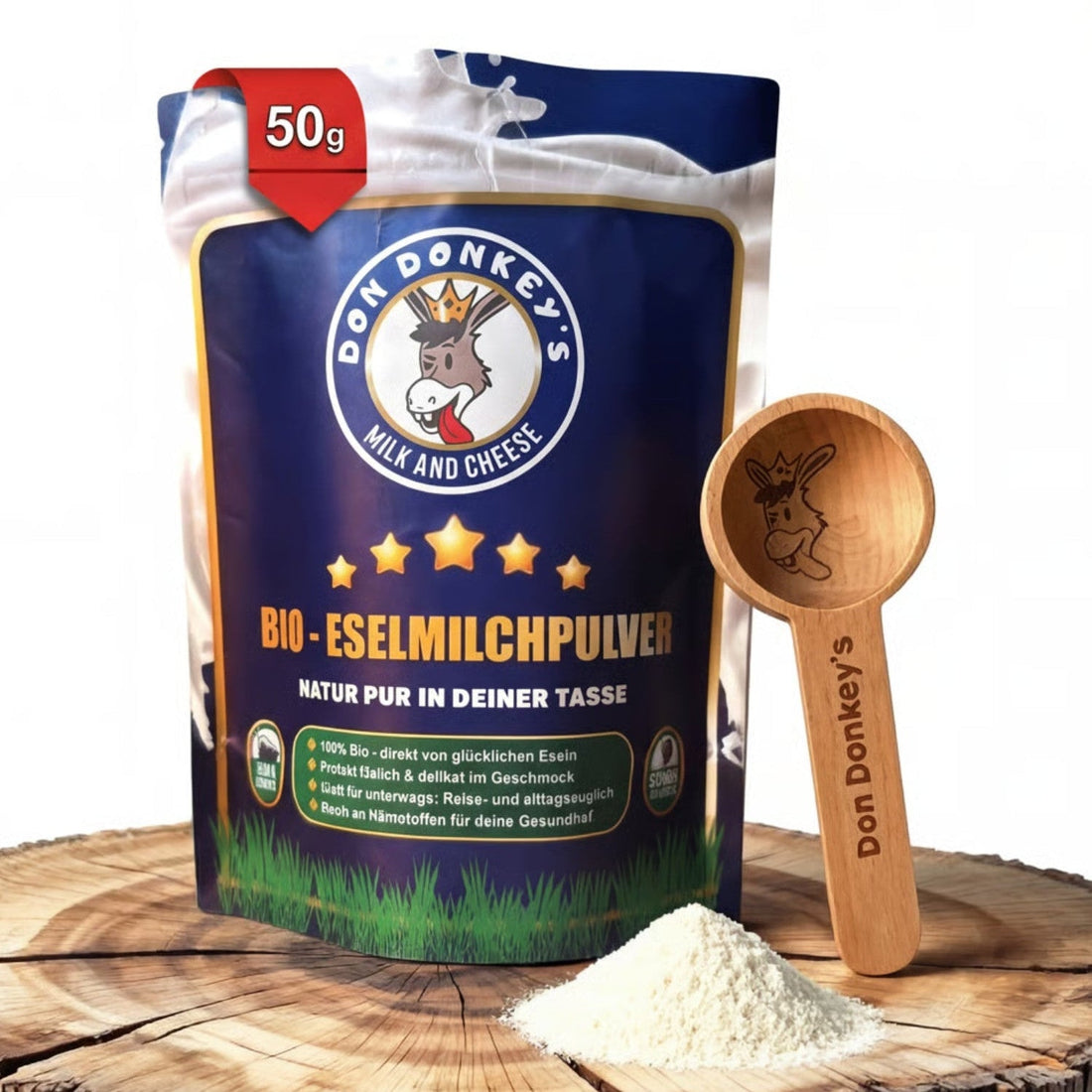
Donkey Milk Powder
Donkey milk in powder form
For anyone who prefers a longer shelf life: our donkey milk in powder form – easy to store and portion.
20g · Unit price: €1.245,00 / 1 kg · incl. VAT, plus shipping