
 Buyer protection

Donkey milk research · Study 181
The donkey milk proteome: 106 gene products in the whey
A research group from Catania identified 106 different gene products in donkey milk whey, far more than the 8 to 10 major proteins that, according to the authors, had been described until then. Only 10 % could be matched using donkey database entries, 70 % by similarity to horse proteins.
At a glance · tap the cards
The key figures
Study design
How it was studied
Proteome analysis by a research group at the Department of Chemical Sciences, University of Catania (Italy). Donkey milk was defatted and its casein removed; the remaining whey was treated in large volumes of up to 300 ml with combinatorial peptide ligand libraries (CPLL) to enrich rare proteins. The proteins were then identified and matched against databases for the donkey (Equus asinus) and the horse (Equus caballus). Evaluated based on the abstract: it does not give the number of animals, breed, stage of lactation or the full protein list.
Results
What the study measured
106 different gene products were identified in donkey milk whey.
According to the authors, only about 8 to 10 major proteins found in all milks had been described until then.
Only 10 % of the proteins could be matched directly via the donkey database, because its genome was poorly characterised at the time.
70 % were identified by similarity to horse proteins. The abstract does not say how the remaining proteins were assigned.
The abstract gives no quantities of individual proteins or information on their function.
Authors’ conclusion: The authors describe their work as the most extensive description of donkey milk proteins to date and, in the introduction, call donkey milk a suitable breast milk substitute for allergic newborns. This assessment was not part of the measurements: the study lists proteins and tests neither tolerance nor allergenicity. Donkey milk is not a substitute for breast milk or infant formula; infant feeding belongs in medical hands.
Critical appraisal
Strengths and limitations
Assessments from the introductionClear limitation
Statements on allergy, taste and nutritional value come from the introduction, not from the study’s own measurements.
Detection without quantitiesNote
The abstract gives no quantities. Many of the 106 proteins are likely present only in traces, as they first had to be enriched.
Assignment via the horseNote
70 % of the proteins were identified via homology with the horse. This is an indirect assignment.
Only the abstract assessedNote
Number of animals, breed and the full protein list were not available.
Much broader overviewStrength
By enriching rare proteins, the paper considerably extends the known protein spectrum of donkey milk whey.
Editorial note: The title alludes to Poppaea Sabina, wife of Emperor Nero, who is said to have bathed in donkey milk according to tradition. The study itself has nothing to do with this: it is a protein analysis of the whey. Its value lies in the inventory, not in statements about effects. To the research archive.
Research question for DON DONKEY’S®
Can a whey protein profile be used as proof of origin to clearly distinguish donkey milk batches from horse or cow’s milk?
Original publication
Poppea's bath liquor: the secret proteome of she-donkey's milk.
Original title: Poppea's bath liquor: the secret proteome of she-donkey's milk.
Cunsolo V., Muccilli V., Fasoli E., Saletti R., Righetti P. G., Foti S.
Journal of Proteomics · 2011 · 74(10), 2083–2099
Department of Chemical Sciences, University of Catania, Italy (according to the paper)
DOI: 10.1016/j.jprot.2011.05.036
Transparency: funded by the Italian research ministry (MURST) according to the database record; conflicts of interest could not be checked from the abstract. No product-related statement for DON DONKEY’S®.
Summarised and checked by the DON DONKEY’S editorial team against the original publication · As of: November 2026
The study summarised above was carried out independently of DON DONKEY’S® and does not relate to our products. It serves solely to inform about the state of research.
DON DONKEY’S® donkey milk and donkey milk powder are foods. They are not intended to prevent, treat or cure any disease and do not replace medical advice.

From our shop
DON DONKEY’S® donkey milk
100 % donkey milk · raw milk, frozen
On this page we report the findings of a published study. Independently of that, you will find our donkey milk here: 100 % donkey milk, frozen as raw milk.
100 ml bottle / 100ml · Unit price: €249,00 / 1 l · incl. VAT, plus shipping
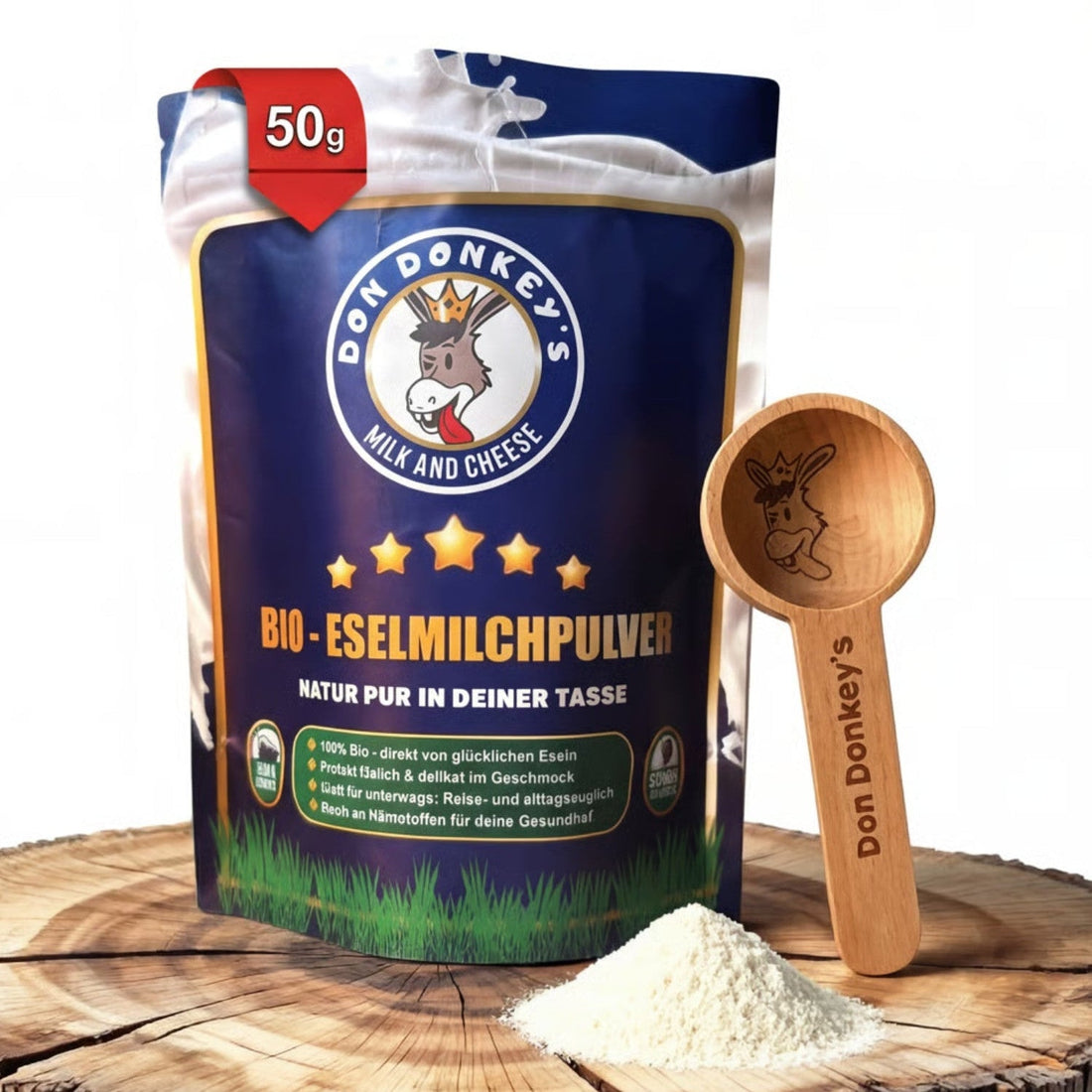
Also in our shop
Donkey Milk Powder
Donkey milk in powder form
For anyone who prefers a longer shelf life: our donkey milk in powder form – easy to store and portion.
20g · Unit price: €1.245,00 / 1 kg · incl. VAT, plus shipping