
 Buyer protection

Donkey milk research · Study 180
Donkey milk protein and echovirus 5: a laboratory finding
In a laboratory experiment, all three protein fractions tested from Ragusano donkey milk significantly inhibited the replication of echovirus 5 at 1 mg/ml. Whey protein and a low-molecular-weight whey fraction under 30,000 Da were active at all concentrations tested (1, 5 and 10 mg/ml); the authors observed the clearest effect for whey protein.
At a glance · swipe or use the arrows
The key figures
Study design
How it was studied
Laboratory study by a Norwegian-Italian research group. Three protein fractions were obtained from Ragusano donkey milk: casein (CN), whey protein (WP) and a low-molecular-weight whey fraction under 30,000 Da (LWP). WP and LWP were tested at three concentrations (1, 5 and 10 mg/ml) for their effect on the replication of echovirus type 5; casein only at 1 mg/ml. Evaluated based on the abstract: it does not give the cell system used, the number of replicates, inhibition rates or the number of animals.
Results
What the study measured
At 1 mg/ml, all three protein fractions significantly inhibited the replication of echovirus 5.
Whey protein and the low-molecular-weight whey fraction inhibited virus replication at all concentrations tested: 1, 5 and 10 mg/ml.
Casein was tested only at the lowest concentration; there are no data for higher concentrations.
The authors observed the clearest antiviral effect for the whey protein fraction.
The abstract contains no inhibition rates in per cent or other figures.
Authors’ conclusion: According to the authors, the different whey proteins in donkey milk, probably acting together, have antiviral activity against echovirus 5 and might help prevent gastrointestinal viral infections in humans. This conclusion goes beyond the data: isolated fractions were tested in the lab, not people and not digested milk.
Critical appraisal
Strengths and limitations
Laboratory test, not humansClear limitation
Isolated protein fractions were tested directly against viruses. The trial does not test whether any of this remains active after digestion in the gut.
Conclusion goes beyond the dataClear limitation
Preventing infections in humans is a hypothesis of the authors, not a measured result.
Only the abstract assessedNote
Cell system, inhibition rates and replicates were not available. The paper is also a short communication of 3 pages.
One virus, one breedNote
Only echovirus 5 was tested, with milk from one donkey breed. Other viruses or origins were not studied.
Fractions and doses tested separatelyStrength
The study compares three protein fractions and several concentrations, showing which fraction responded in the lab.
Editorial note: The paper is an early laboratory finding on the activity of donkey milk whey proteins against a virus. It allows no statement on whether drinking donkey milk protects against infections. To the research archive.
Research question for DON DONKEY’S®
How are casein and whey protein distributed in our donkey milk, and does this ratio stay the same after freezing and drying?
Original publication
Antiviral activity of donkey milk protein fractions on echovirus type 5
Original title: Antiviral activity of donkey milk protein fractions on echovirus type 5
Brumini D., Furlund C. B., Comi I., Devold T. G., Marletta D., Vegarud G. E., Jonassen C. M.
International Dairy Journal · 2013 · 28(2), 109–111
Norwegian University of Life Sciences (Ås), Norwegian Veterinary Institute and University of Catania, Italy (according to author profiles; not stated in the database record)
DOI: 10.1016/j.idairyj.2012.08.010
Transparency: funding and conflicts of interest could not be checked from the abstract. No product-related statement for DON DONKEY’S®.
Summarised and checked by the DON DONKEY’S editorial team against the original publication · As of: November 2026
The study summarised above was carried out independently of DON DONKEY’S® and does not relate to our products. It serves solely to inform about the state of research.
DON DONKEY’S® donkey milk and donkey milk powder are foods. They are not intended to prevent, treat or cure any disease and do not replace medical advice.

From our shop
DON DONKEY’S® donkey milk
100 % donkey milk · raw milk, frozen
On this page we report the findings of a published study. Independently of that, you will find our donkey milk here: 100 % donkey milk, frozen as raw milk.
100 ml bottle / 100ml · Unit price: €249,00 / 1 l · incl. VAT, plus shipping
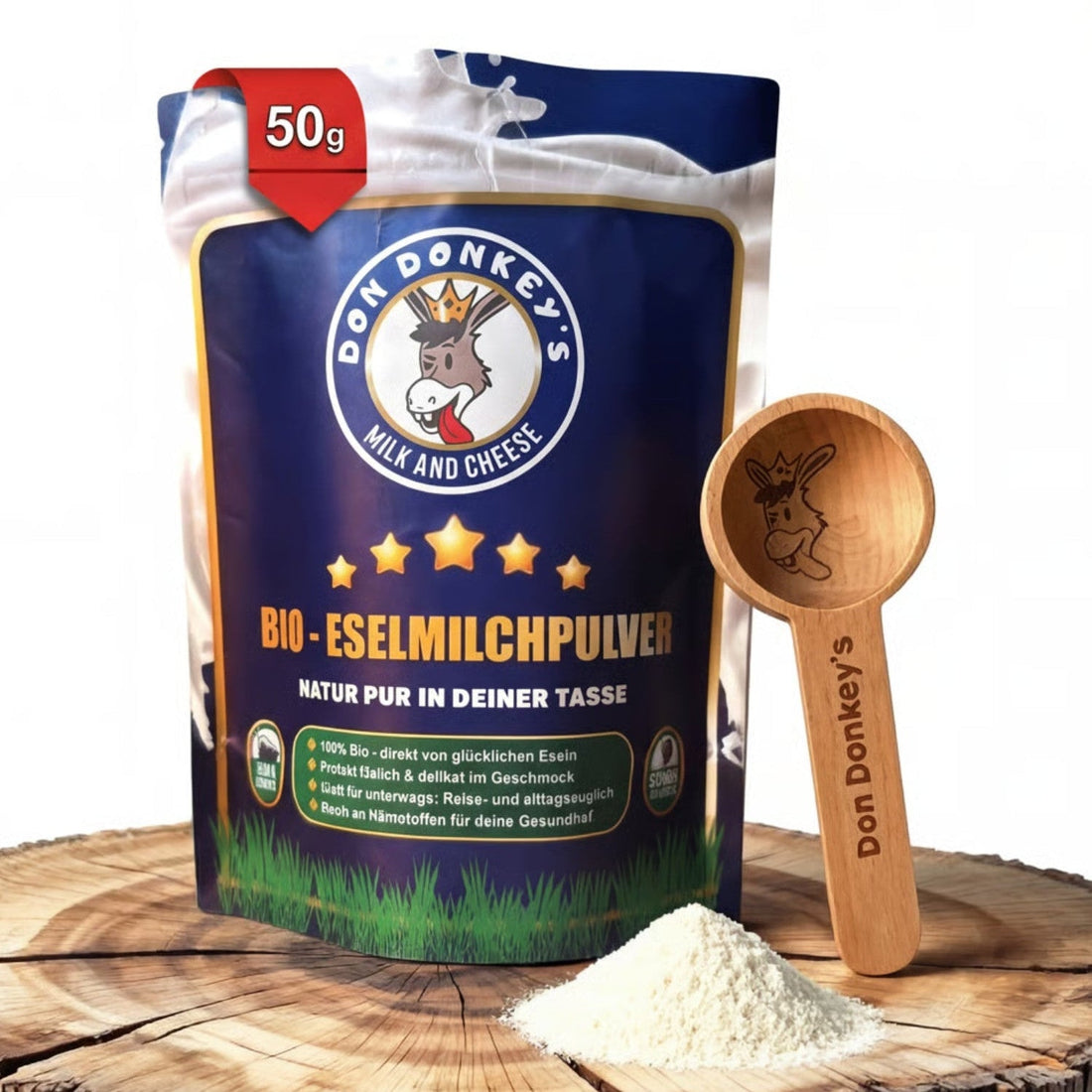
Also in our shop
Donkey Milk Powder
Donkey milk in powder form
For anyone who prefers a longer shelf life: our donkey milk in powder form – easy to store and portion.
20g · Unit price: €1.245,00 / 1 kg · incl. VAT, plus shipping