
 Buyer protection

Donkey milk research · Study 176
Donkey milk in a shelf-life test: four treatments, two temperatures
A research group from Bologna compared untreated donkey milk with pasteurised (65 °C, 30 minutes), high-pressure processed (HPP) and pasteurised plus high-pressure processed milk, stored at 4 and 12 °C for 3 to 30 days. According to the authors, only the combination of pasteurisation and HPP met the microbiological criteria for up to 30 days when kept at 4 °C until opening. Raw milk treated with HPP alone showed visible flocks.
At a glance · swipe or use the arrows
The key figures
Study design
How it was studied
Technology study by the University of Bologna and the Experimental Institute for Zooprophylaxis in Lombardy and Emilia Romagna (Italy). A farm-scale pasteurisation and packing system was simulated. Four variants were compared: untreated raw milk, pasteurisation (65 °C for 30 minutes), high-pressure processing (HPP) and pasteurisation followed by HPP after packing. Samples were stored at 4 and 12 °C for 3 to 30 days. Microbiological hygiene indicators, pH, alkaline phosphatase and furosine were measured, and Bacillus cereus was considered. Evaluated based on the abstract: it does not give sample numbers, bacterial counts, HPP pressure levels or the number of farms.
Results
What the study measured
The authors describe the microbiological quality of the raw milk studied as “not optimal”. They conclude that animal hygiene and good practice in milking and handling on donkey farms are important.
Raw milk treated with high pressure alone showed visible flocks. The authors therefore classify it as unfit for sale.
According to the authors, pasteurisation clearly reduced the microbiological risk. However, the farm-scale packing system alone did not ensure an extended shelf life.
Pasteurisation plus HPP after packing met the microbiological criteria for up to 30 days, provided the milk was kept at 4 °C until opening.
Microbial growth had little effect on pH. pH differed significantly only between raw and treated milk after 3 days at 12 °C.
According to the authors, alkaline phosphatase and furosine are suitable indicators of proper heat treatment. Growth of Bacillus cereus was observed under thermal abuse.
Authors’ conclusion: The authors recommend combining heat treatment, high pressure and storage to extend the shelf life of donkey milk, and call for further tests on Bacillus cereus. The study does not show how frozen donkey milk behaves: freezing was not one of the variants tested.
Critical appraisal
Strengths and limitations
Only the abstract assessedNote
Bacterial counts, sample numbers, HPP pressure levels and statistical details were not available.
Starting milk not optimalClear limitation
The authors themselves describe the raw milk as microbiologically not optimal. The results therefore depend heavily on this one starting milk.
Freezing not studiedClear limitation
Only cold storage at 4 °C and 12 °C was compared. No conclusions about frozen milk can be drawn.
One farm-scale systemNote
A specific packing system was simulated. Other equipment, packaging or hygiene concepts may produce different results.
Realistic storage conditionsStrength
Besides refrigeration, 12 °C was deliberately tested as thermal abuse and followed for up to 30 days.
Editorial note: The paper compares processing and storage variants for liquid donkey milk under refrigerated conditions. It underlines how strongly hygiene during milking and an unbroken cold chain determine the measurements. It makes no statement about frozen raw milk. To the research archive.
Research question for DON DONKEY’S®
How do hygiene indicators and pH of a frozen donkey milk batch develop after thawing over 1, 2 and 3 days in the fridge at 4 °C?
Original publication
Shelf life of donkey milk subjected to different treatment and storage conditions.
Original title: Shelf life of donkey milk subjected to different treatment and storage conditions.
Giacometti F., Bardasi L., Merialdi G., Morbarigazzi M., Federici S., Piva S., Serraino A.
Journal of Dairy Science · 2016 · 99(6), 4291–4299
University of Bologna, Department of Veterinary Medical Sciences, and Experimental Institute for Zooprophylaxis in Lombardy and Emilia Romagna, Bologna, Italy (according to the paper)
Transparency: funding and conflicts of interest could not be checked from the abstract. No product-related statement for DON DONKEY’S®.
Summarised and checked by the DON DONKEY’S editorial team against the original publication · As of: November 2026
The study summarised above was carried out independently of DON DONKEY’S® and does not relate to our products. It serves solely to inform about the state of research.
DON DONKEY’S® donkey milk and donkey milk powder are foods. They are not intended to prevent, treat or cure any disease and do not replace medical advice.

From our shop
DON DONKEY’S® donkey milk
100 % donkey milk · raw milk, frozen
On this page we report the findings of a published study. Independently of that, you will find our donkey milk here: 100 % donkey milk, frozen as raw milk.
100 ml bottle / 100ml · Unit price: €249,00 / 1 l · incl. VAT, plus shipping
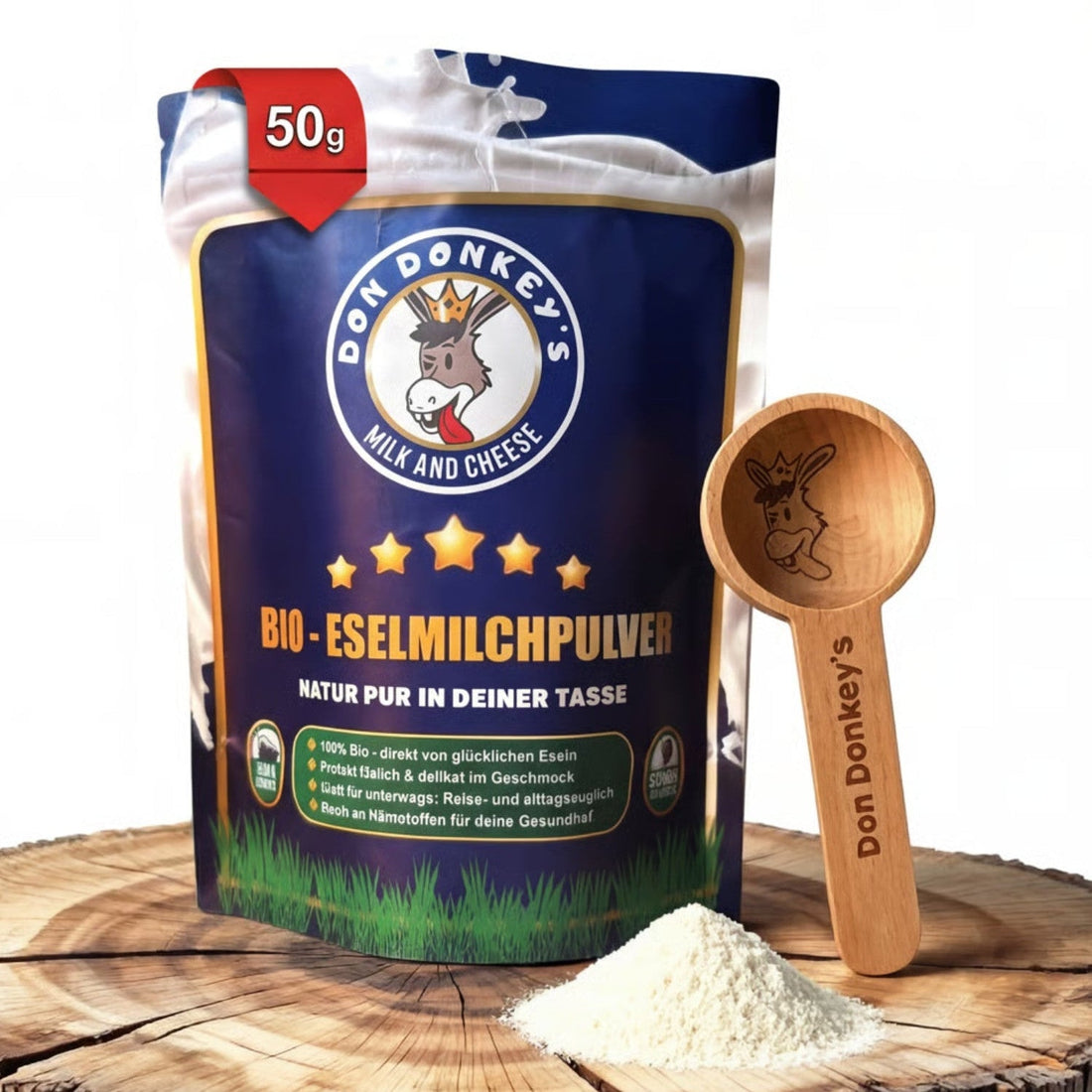
Also in our shop
Donkey Milk Powder
Donkey milk in powder form
For anyone who prefers a longer shelf life: our donkey milk in powder form – easy to store and portion.
20g · Unit price: €1.245,00 / 1 kg · incl. VAT, plus shipping