
 Buyer protection

Donkey milk research · Study 174
Short-time heating for small farms: a prototype put to the test
A new small pasteuriser that heats donkey milk to 72 °C for 15 seconds reduced the total bacterial count by more than 1 log; Enterobacteriaceae were then below the detection limit. Lysozyme activity fell by only 5.5 %, not significantly. Compared with Holder pasteurisation (63 °C, 30 minutes), the casein bands were better preserved according to the authors.
At a glance · tap the cards
The key figures
Study design
How it was studied
Technology study by a Turin-based group (research institutes CREA and CNR, one company): a small farm in Groscavallo supplied 2 L of chilled morning milk from Martina Franca jennies, which was mixed into one pool. Three 200-mL raw milk samples served as controls; two 250-mL aliquots each were pasteurised either by Holder (63 °C, 30 minutes) or in the patented HTST prototype (72 °C, 15 seconds). Total bacterial count, Enterobacteriaceae and Bacillus cereus were measured (raw and HTST milk), along with the protein profile by electrophoresis with image analysis and lysozyme activity in triplicate. Statistics: ANOVA with Tukey’s test (p ≤ 0.05). The numerical tables of the original paper were not available to the editorial team.
Results
What the study measured
According to the authors, the raw milk already had very low bacterial counts, consistent with other studies.
The HTST prototype reduced the total bacterial count by more than 1 log and brought Enterobacteriaceae below the detection limit. Bacillus cereus was reduced, but with low efficiency.
Both methods changed the protein profile. After Holder pasteurisation, bands 6 and 7 (casein fraction) were significantly lower and bands 13, 14, 16 and 17 higher.
According to the authors, HTST appeared to largely preserve the casein fraction, while Holder pasteurisation degraded it markedly.
Lysozyme activity fell slightly and not significantly by 5.5 %. The authors consider both methods suitable for preserving almost all lysozyme activity.
Authors’ conclusion: According to the authors, the new small HTST pasteuriser can be used safely even with the low milk volumes of small donkey dairies and appears to preserve caseins better. The authors themselves stress that the findings are preliminary because only one milk pool was used; shelf life and more heavily contaminated milk were not tested.
Critical appraisal
Strengths and limitations
Only one milk poolClear limitation
All results come from a single 2-L delivery. The authors themselves call their findings preliminary.
Very low starting countNote
The raw milk was barely contaminated. How the device performs with a higher starting load remains to be tested, according to the authors.
Microbiology without Holder comparisonNote
Bacterial counts were determined only for raw and HTST milk. A direct hygiene comparison of the two methods is missing.
Own, patented deviceNote
The prototype is patented by the authors, and one team member works for a company. According to the authors, there was no funding.
Paired comparison from the same milkStrength
Raw, Holder and HTST samples come from the same pool and were analysed using identical methods. Differences are therefore due to the process, not the milk.
Editorial note: The paper is a feasibility test: it shows that a continuous short-time heater works for very small milk volumes and largely preserved lysozyme and casein bands in the trial. With a single milk pool and a device patented by the authors, it is a first step, not a definitive comparison of the methods. To the research archive.
Research question for DON DONKEY’S®
How do the protein profile and lysozyme activity of our raw donkey milk change through freezing and thawing – measured with the same electrophoresis and fluorescence methods as in this study?
Original publication
A Preliminary Assessment of HTST Processing on Donkey Milk.
Original title: A Preliminary Assessment of HTST Processing on Donkey Milk.
Giribaldi M., Antoniazzi S., Gariglio G. M., Coscia A., Bertino E., Cavallarin L.
Veterinary Sciences · 2017 · 4(4), 50
CREA – Research Centre for Engineering and Agro-Food Processing, Turin; CNR – Institute of Sciences of Food Production, Grugliasco; a company in Villafranca Piemonte, Italy (according to the paper)
Transparency: according to the authors, no grants, financial support or publication contribution. The tested prototype is patented by the authors (EP 2974603B1); a declaration of conflicts of interest is not included in the assessed text. No product-related statement for DON DONKEY’S®.
Summarised and checked by the DON DONKEY’S editorial team against the original publication · As of: November 2026
The study summarised above was carried out independently of DON DONKEY’S® and does not relate to our products. It serves solely to inform about the state of research.
DON DONKEY’S® donkey milk and donkey milk powder are foods. They are not intended to prevent, treat or cure any disease and do not replace medical advice.

From our shop
DON DONKEY’S® donkey milk
100 % donkey milk · raw milk, frozen
On this page we report the findings of a published study. Independently of that, you will find our donkey milk here: 100 % donkey milk, frozen as raw milk.
100 ml bottle / 100ml · Unit price: €249,00 / 1 l · incl. VAT, plus shipping
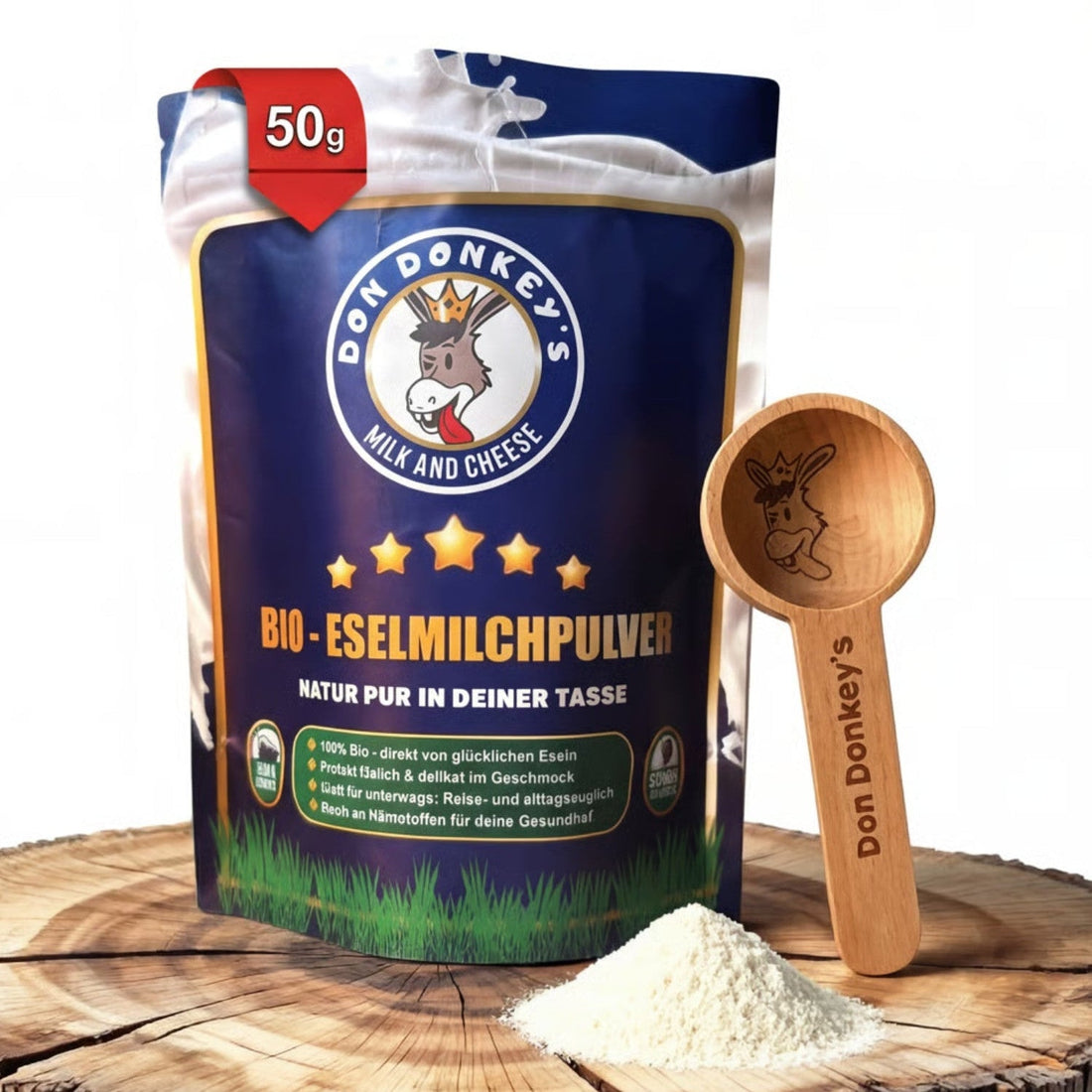
Also in our shop
Donkey Milk Powder
Donkey milk in powder form
For anyone who prefers a longer shelf life: our donkey milk in powder form – easy to store and portion.
20g · Unit price: €1.245,00 / 1 kg · incl. VAT, plus shipping