
 Buyer protection

Donkey milk research · Study 170
Vitamin D in donkey milk: raw, pasteurised, across the seasons
Raw donkey milk from an Italian farm contained on average 1.68 µg vitamin D2 and 0.60 µg vitamin D3 per 100 mL. After pasteurisation (63 °C, 30 minutes) vitamin D3 was 0.30 µg, while total vitamin D did not differ significantly. Vitamin D3 was higher in spring and summer.
At a glance · tap the cards
The key figures
Study design
How it was studied
Short communication by a research group at the University of Pisa (Italy): on a farm in central Italy producing donkey milk for human consumption, an aliquot of total bulk milk was sampled every 15 days from May to February 2017, before and after pasteurisation (63 °C for 30 minutes, without homogenisation). A total of 20 raw and 20 pasteurised samples were analysed for chemical composition and, by HPLC after saponification, for vitamin D2 and D3. Assessed based on the abstract; number of animals, breed, variability and the values for other components are not stated there.
Interactive chart · values from the study
Vitamin D in raw and pasteurised donkey milk
Source: study abstract, means of 20 samples each.
Results
What the study measured
Raw milk contained on average 1.68 µg vitamin D2 and 0.60 µg vitamin D3 per 100 mL.
In pasteurised milk the values were 1.38 µg vitamin D2 and 0.30 µg vitamin D3 per 100 mL.
For total vitamin D the authors found no significant difference between raw and pasteurised milk. Vitamin D3 was less heat-stable and significantly lower after pasteurisation.
Total content did not differ significantly between seasons; vitamin D3 was higher in spring and summer.
According to the authors, the contents were higher than the values reported in the literature for bovine and human milk.
Authors’ conclusion: According to the authors, raw and pasteurised donkey milk had a high vitamin D content, which “could be useful” in meeting deficiencies in humans; further variability factors remain to be clarified. The study only measured contents in the milk – an effect on vitamin D status in people was not studied.
Critical appraisal
Strengths and limitations
One farm, bulk milkClear limitation
All samples come from one farm. The abstract does not state breed, number of animals or feeding; other herds may differ.
Only the abstract assessedNote
Variability, values per season and the remaining composition are unknown without the full text.
Comparison with literature valuesNote
The comparison with bovine and human milk relies on values from other studies, not on own measurements in the same lab.
Content is not supplyClear limitation
The vitamin D content of the milk was measured. How much of it the body absorbs was not part of the study.
Paired samples over 10 monthsStrength
The same milk was measured before and after pasteurisation, every 15 days over 10 months. This makes the processing comparison more robust.
Editorial note: The short communication provides measured values for vitamin D2 and D3 in donkey milk and shows that vitamin D3 was more sensitive to heat than D2 in this experiment. It relates to a single farm and allows no statement on vitamin D supply in humans. To the research archive.
Research question for DON DONKEY’S®
How do vitamin D2 and D3 change in frozen raw donkey milk over storage time and after thawing – and do batches from spring and autumn differ?
Original publication
Short communication: Technological and seasonal variations of vitamin D and other nutritional components in donkey milk.
Original title: Short communication: Technological and seasonal variations of vitamin D and other nutritional components in donkey milk.
Martini M., Altomonte I., Licitra R., Salari F.
Journal of Dairy Science · 2018 · 101(10), 8721–8725
Department of Veterinary Sciences and Interdepartmental Research Centre for Nutraceuticals and Food for Health, University of Pisa, Italy (according to the authors)
Transparency: funding and conflicts of interest could not be checked from the abstract. No product-related statement for DON DONKEY’S®.
Summarised and checked by the DON DONKEY’S editorial team against the original publication · As of: November 2026
The study summarised above was carried out independently of DON DONKEY’S® and does not relate to our products. It serves solely to inform about the state of research.
DON DONKEY’S® donkey milk and donkey milk powder are foods. They are not intended to prevent, treat or cure any disease and do not replace medical advice.

From our shop
DON DONKEY’S® donkey milk
100 % donkey milk · raw milk, frozen
On this page we report the findings of a published study. Independently of that, you will find our donkey milk here: 100 % donkey milk, frozen as raw milk.
100 ml bottle / 100ml · Unit price: €249,00 / 1 l · incl. VAT, plus shipping
Also in our shop
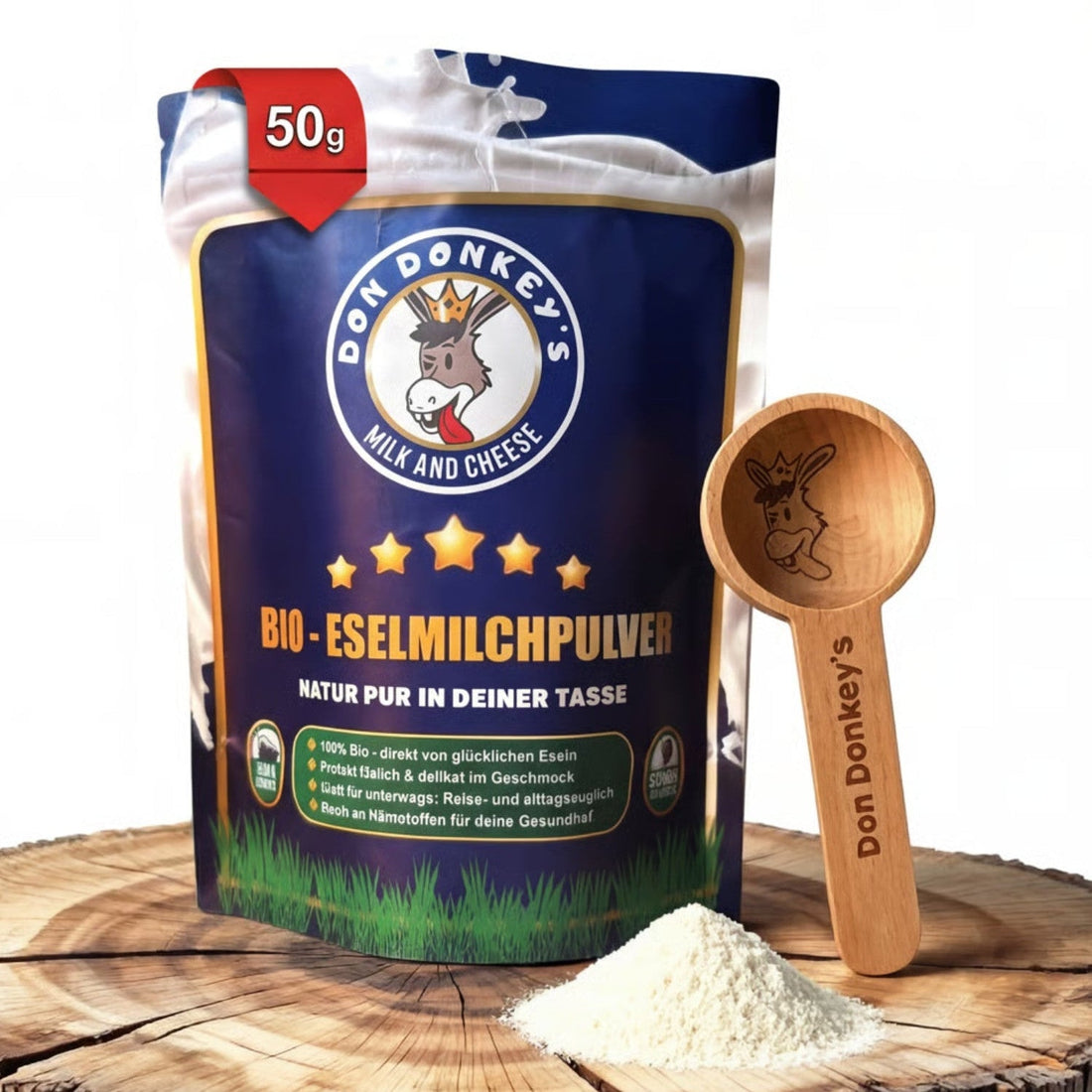
Donkey Milk Powder
Donkey milk in powder form
For anyone who prefers a longer shelf life: our donkey milk in powder form – easy to store and portion.
20g · Unit price: €1.245,00 / 1 kg · incl. VAT, plus shipping