
 Buyer protection

Donkey milk research · Study 167
Environmental residues in milk: PCBs and pesticides in donkey milk from polluted areas
In milk from grazing jennies in polluted areas of southern Italy, polychlorinated biphenyls (PCBs) were higher than organochlorine pesticides; non-dioxin-like PCBs averaged 93.13 to 263.64 ng/g per area. Higher levels of six indicator PCBs and hexachlorobenzene went along with heavier infection by intestinal strongyles.
At a glance · tap the cards
The key figures
Study design
How it was studied
Residue analysis by the University of Naples Federico II with the Experimental Zooprophylactic Institute of Southern Italy (Portici): milk from grazing jennies was examined from areas of southern Italy affected by environmental pollution with organochlorine compounds and by parasite infection. PCBs (non-dioxin-like and dioxin-like) and organochlorine pesticides were measured; regression analysis tested the relationship between infection with intestinal strongyles and pollutant levels. The authors also carried out a consumer risk assessment. Based on the abstract; full-text details such as the number of animals, samples and areas, the analytical method and the basis of the values are therefore missing.
Results
What the study measured
PCB levels, mainly of non-dioxin-like PCBs (ndl-PCBs), were higher than those of organochlorine pesticides. Mean ndl-PCBs per area ranged from 93.13 to 263.64 ng/g.
All sample units contained the six indicator PCBs, most prevalently PCB 153, followed by PCB 28 and PCB 101.
Among the dioxin-like PCBs, the non-ortho compounds PCB 169, 77 and 126 were determined in some samples, and the mono-ortho compounds PCB 118 and 105 in all areas.
Infection with intestinal strongyles correlated positively with the six indicator PCBs and with hexachlorobenzene (statistically significant at least at the 5 % level).
In some cases, the authors rated dl-PCB levels as of concern in view of the EU maximum level for dioxins and dl-PCBs. The abstract does not say how many samples were affected or which values were measured.
Authors’ conclusion: According to the authors, the findings support the hypothesis that organochlorine pollutants weaken the jennies’ defences against parasites. Their risk assessment points to a possible dl-PCB exposure for high consumers. What is shown is a statistical association in polluted areas – not cause and effect, and no statement about milk from unpolluted regions.
Critical appraisal
Strengths and limitations
Specifically polluted areasClear limitation
The jennies grazed in areas with known environmental pollution. The values describe these sites, not donkey milk in general.
Only the abstract assessedClear limitation
The number of animals, samples and areas, the analytical method and the basis of the values (whole milk or fat) are unknown. The abbreviations “WW” and “LW” are not explained.
Limit comparison without figuresNote
Without measured values and the limit, the rating of some dl-PCB values as of concern cannot be checked from the abstract.
Correlation is not causationNote
The link between parasite infection and pollutants may have other causes, such as the animals’ age, condition or grazing area.
Broad range of substancesStrength
The paper covers indicator PCBs, dioxin-like PCBs and pesticides and links them with animal health data – an approach rarely taken for donkey milk so far.
Editorial note: The study shows that environmental pollution at a site can be reflected in the milk of grazing jennies. This underlines the importance of where pastures are located and of regular residue testing; it says nothing about donkey milk from other regions. Donkey milk is not a substitute for breast milk or infant formula; infant feeding belongs in medical hands. To the research archive.
Research question for DON DONKEY’S®
Can we document for each partner farm whether its pastures lie in known pollution areas, and publish spot-check PCB analyses of batches?
Original publication
Levels of polychlorinated biphenyls and organochlorine pesticides in donkey milk: Correlation with the infection level by intestinal strongyles.
Original title: Levels of polychlorinated biphenyls and organochlorine pesticides in donkey milk: Correlation with the infection level by intestinal strongyles.
Monnolo A., Clausi M. T., Mercogliano R., Fusco G., Fiorentino M. L., Buono F., Lama A., Ferrante M. C.
Chemosphere · 2020 · 258, 127287
Department of Veterinary Medicine and Animal Productions, University of Naples Federico II; Experimental Zooprophylactic Institute of Southern Italy, Portici, Italy (according to author details)
DOI: 10.1016/j.chemosphere.2020.127287
Transparency: funding and conflicts of interest could not be checked from the abstract. No product-related statement for DON DONKEY’S®.
Summarised and checked by the DON DONKEY’S editorial team against the original publication · As of: November 2026
The study summarised above was carried out independently of DON DONKEY’S® and does not relate to our products. It serves solely to inform about the state of research.
DON DONKEY’S® donkey milk and donkey milk powder are foods. They are not intended to prevent, treat or cure any disease and do not replace medical advice.

From our shop
DON DONKEY’S® donkey milk
100 % donkey milk · raw milk, frozen
On this page we report the findings of a published study. Independently of that, you will find our donkey milk here: 100 % donkey milk, frozen as raw milk.
100 ml bottle / 100ml · Unit price: €249,00 / 1 l · incl. VAT, plus shipping
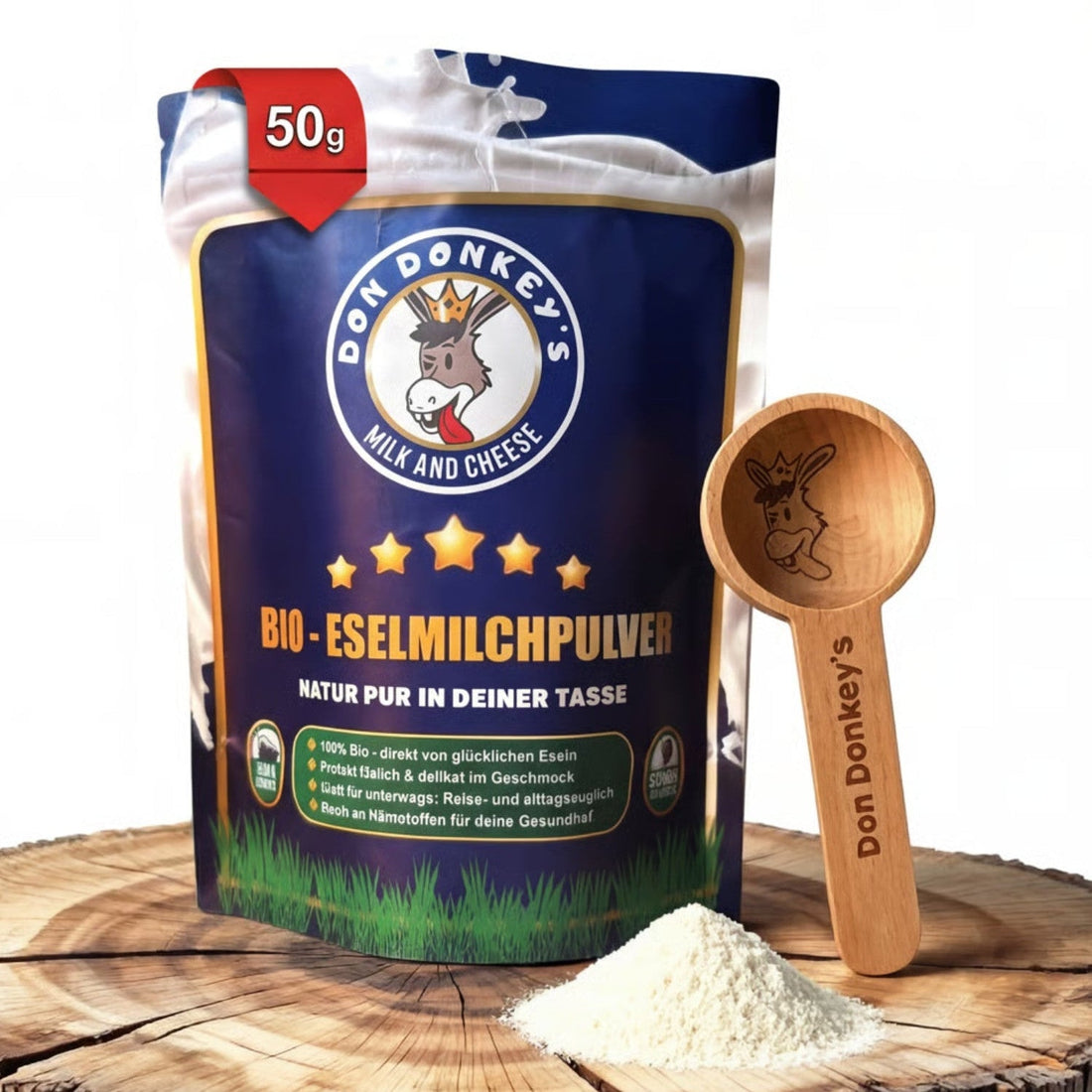
Also in our shop
Donkey Milk Powder
Donkey milk in powder form
For anyone who prefers a longer shelf life: our donkey milk in powder form – easy to store and portion.
20g · Unit price: €1.245,00 / 1 kg · incl. VAT, plus shipping