
 Buyer protection

Donkey milk research · Study 166
Mould toxin in the milk? Aflatoxin M1 in 63 donkey milk samples
In 63 samples of donkey milk from a farm in northern Italy, none exceeded the limit of quantification of 0.0125 ng/mL aflatoxin M1. Only one sample showed traces of 0.0044 ng/mL – well below the strictest EU maximum level of 0.025 ng/mL, which applies to infant and follow-on milk.
At a glance · swipe or use the arrows
The key figures
Study design
How it was studied
Residue analysis by the University of Bologna (Italy): 63 milk samples were collected between June and November 2015 on a farm in northern Italy, 52 in autumn and 11 in summer. 62 samples came from a single milking of one animal, one from the bulk tank. The jennies, of eight breeds, mostly grazed outdoors and received supplementary feed in the evening. Samples were stored at −20 °C, cleaned up with immunoaffinity columns and analysed for aflatoxin M1 by HPLC with fluorescence detection. The method had previously been optimised and validated in-house (selectivity, linearity, limits of detection and quantification, accuracy, precision, recovery, carry-over).
Interactive chart · values from the study
Aflatoxin M1: measured value, method limits and EU maximum levels
Source: sections 1, 3.2 and 3.3 of the study. The study gives the EU maximum levels in µg/kg and treats them as equal to ng/mL. 62 of 63 samples were below the detection limit.
Results
What the study measured
None of the 63 samples contained aflatoxin M1 above the limit of quantification of 0.0125 ng/mL. One sample showed traces of 0.0044 ng/mL, i.e. between the limits of detection and quantification.
As a benchmark, the authors chose the stricter EU maximum level for infant and follow-on milk of 0.025 µg/kg; for raw milk it is 0.05 µg/kg. The only measured value was well below.
The method achieved a detection limit of 0.0025 ng/mL, linearity with R² > 0.999 and a mean recovery of 89.0 % (86.6 to 92.2 %). Bias was −6 to −2.5 % and the coefficient of variation 5.1 to 12.8 %.
A shorter column and adjusted mobile phase cut the analysis time from 9 to 5 minutes; 15 blank samples showed no interfering signals.
As possible reasons for the near absence of residues, the authors cite grazing, controlled feed, the low casein content of donkey milk and low transfer into milk: in an earlier feeding study with six jennies it was 0.02 %, in dairy cows 0.1 to 5.8 % in the literature.
Authors’ conclusion: According to the authors, the data, together with other surveys, appear reassuring; they nevertheless recommend regular monitoring of milk and feed and further studies on other farms. The study shows findings from one farm in one year – not a guarantee for donkey milk in general.
Critical appraisal
Strengths and limitations
One farm, one yearClear limitation
All samples come from one farm in 2015. With different feed or warm, humid harvest years, values may differ, as the authors themselves note.
Mostly autumn samplesNote
52 of the 63 samples were taken in autumn and 11 in summer. Winter and spring, when more supplementary feed may be usual, are not covered.
Feed not analysedNote
The feed was not tested for aflatoxin B1. The explanations for the low values are the authors’ assumptions.
Assessment in the introductionNote
The paper describes donkey milk as a substitute for breast milk. We do not adopt this view; funding and conflicts of interest are not stated in the available text.
Validated, sensitive methodStrength
The detection limit of 0.0025 ng/mL was well below the strictest EU maximum level of 0.025 µg/kg; recovery, precision and carry-over were tested.
Editorial note: In 63 samples from a farm in northern Italy, the survey found traces of aflatoxin M1 in only one sample, far below the EU maximum level. This is in line with the few other surveys of donkey milk but does not replace ongoing monitoring of feed and milk. Donkey milk is not a substitute for breast milk or infant formula; infant feeding belongs in medical hands. To the research archive.
Research question for DON DONKEY’S®
Can feed batches and milk batches at our partner farms be documented so that aflatoxin M1 tests can, if needed, be clearly assigned to a batch?
Original publication
Occurrence of Aflatoxin M1 (AFM1) in Donkey Milk Collected in Northern Italy.
Original title: Occurrence of Aflatoxin M1 (AFM1) in Donkey Milk Collected in Northern Italy.
Altafini A., Tassinari M., Guerrini A., Roncada P.
Veterinary Sciences · 2020 · 7(4), 176
Department of Veterinary Medical Sciences, University of Bologna, Ozzano dell’Emilia, Italy (according to the paper)
Transparency: the available full text contains no information on funding or conflicts of interest. No product-related statement for DON DONKEY’S®.
Summarised and checked by the DON DONKEY’S editorial team against the original publication · As of: November 2026
The study summarised above was carried out independently of DON DONKEY’S® and does not relate to our products. It serves solely to inform about the state of research.
DON DONKEY’S® donkey milk and donkey milk powder are foods. They are not intended to prevent, treat or cure any disease and do not replace medical advice.

From our shop
DON DONKEY’S® donkey milk
100 % donkey milk · raw milk, frozen
On this page we report the findings of a published study. Independently of that, you will find our donkey milk here: 100 % donkey milk, frozen as raw milk.
100 ml bottle / 100ml · Unit price: €249,00 / 1 l · incl. VAT, plus shipping
Also in our shop
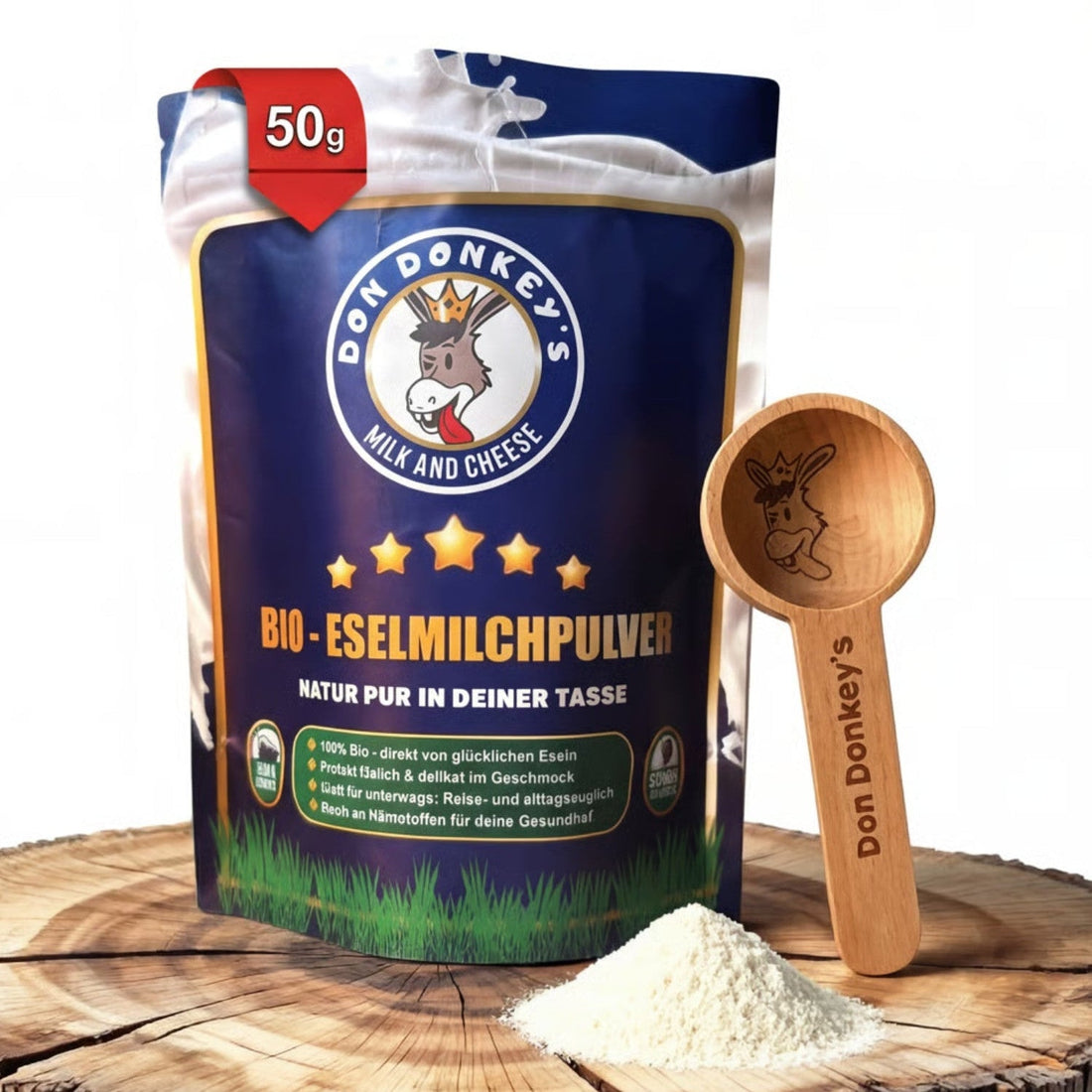
Donkey Milk Powder
Donkey milk in powder form
For anyone who prefers a longer shelf life: our donkey milk in powder form – easy to store and portion.
20g · Unit price: €1.245,00 / 1 kg · incl. VAT, plus shipping