
 Buyer protection

Donkey milk research · Study 165
Light instead of heat? UV-C treatment of raw donkey milk in a pilot trial
In raw donkey milk deliberately spiked with six bacterial strains, none of the strains was detectable after a UV-C dose of 1100 J/L. Listeria innocua was the most resistant, while Staphylococcus aureus was no longer detectable at 459 J/L.
At a glance · tap the cards
The key figures
Study design
How it was studied
Technological laboratory study by the Cyprus University of Technology (Limassol): raw donkey milk from a farm in the Larnaca district was spiked in three batches of 7 L with a mixture of six bacterial strains (about 5 log CFU/mL each) and treated with UV-C light in a pilot flow-through unit with turbulent flow. Doses from 0 to 1300 J/L were tested; after each dose step, 50 mL was taken and counted. A heat treatment of 500 mL at 62.5 °C for 30 minutes served as comparison. Inactivation curves were described with linear, Weibull and biphasic models. In addition, raw milk quality was recorded weekly for 33 weeks.
Results
What the study measured
Before inoculation, none of the six test strains was detectable in the raw milk; the mean total viable count was 2.7 log CFU/mL.
Counts of all strains fell as the UV-C dose increased. Sensitivity differed markedly between genera.
Listeria innocua was the most resistant and only undetectable at 1100 J/L. Staphylococcus aureus was undetectable at 459 J/L; Salmonella, B. cereus, E. coli and Cronobacter reacted similarly to each other.
From 1100 J/L none of the test strains grew. Heat treatment at 62.5 °C for 30 minutes also reduced all strains below the detection limit.
Inactivation did not follow simple first-order kinetics: a biphasic model fitted L. innocua and Cronobacter most closely, a double Weibull model the other strains.
Authors’ conclusion: The authors see UV-C as a possible alternative to pasteurisation for reducing bacterial counts in donkey milk to acceptable levels and describe their work as a first study. It remains open how the treatment affects immunoglobulins, lactoferrin, lysozyme and vitamins – the authors plan to examine this.
Critical appraisal
Strengths and limitations
Artificially added strainsNote
The bacteria were added at high concentrations as a mixture of reference strains, for Listeria for example Listeria innocua rather than Listeria monocytogenes. Naturally occurring strains may behave differently.
Components not testedClear limitation
Whether UV-C changes proteins, enzymes, vitamins or flavour was not measured. That would be decisive for a comparison with pasteurisation.
Three batches, one farm, one unitNote
The trials used three 7 L batches from one farm in one specific pilot unit. According to the authors, results from other equipment are hard to compare.
Gaps in the materialNote
The tables on raw milk quality and 4D doses were not available. Funding and conflicts of interest are not stated in the full text.
With a comparison treatmentStrength
UV-C and a mild heat treatment were tested on the same spiked milk, with three replicates and modelling of the inactivation curves.
Editorial note: The pilot trial shows that UV-C light in a flow-through unit was able to reduce added bacteria in donkey milk below the detection limit. Whether the process preserves the composition of the milk better than heat has not yet been answered. Donkey milk is not a substitute for breast milk or infant formula; infant feeding belongs in medical hands. To the research archive.
Research question for DON DONKEY’S®
How do the lysozyme and lactoferrin contents of our donkey milk change during freezing and thawing – and how do gentle processes such as UV-C compare?
Original publication
Optimization of UV-C Processing of Donkey Milk: An Alternative to Pasteurization?
Original title: Optimization of UV-C Processing of Donkey Milk: An Alternative to Pasteurization?
Papademas P., Mousikos P., Aspri M.
Animals · 2020 · 11(1), 42
Dairy Science and Technology, Department of Agricultural Sciences, Biotechnology and Food Science, Cyprus University of Technology, Limassol (according to the paper)
DOI: 10.3390/ani11010042
Transparency: the full text available contains no information on funding or conflicts of interest. No product-related statement for DON DONKEY’S®.
Summarised and checked by the DON DONKEY’S editorial team against the original publication · As of: November 2026
The study summarised above was carried out independently of DON DONKEY’S® and does not relate to our products. It serves solely to inform about the state of research.
DON DONKEY’S® donkey milk and donkey milk powder are foods. They are not intended to prevent, treat or cure any disease and do not replace medical advice.

From our shop
DON DONKEY’S® donkey milk
100 % donkey milk · raw milk, frozen
On this page we report the findings of a published study. Independently of that, you will find our donkey milk here: 100 % donkey milk, frozen as raw milk.
100 ml bottle / 100ml · Unit price: €249,00 / 1 l · incl. VAT, plus shipping
Also in our shop
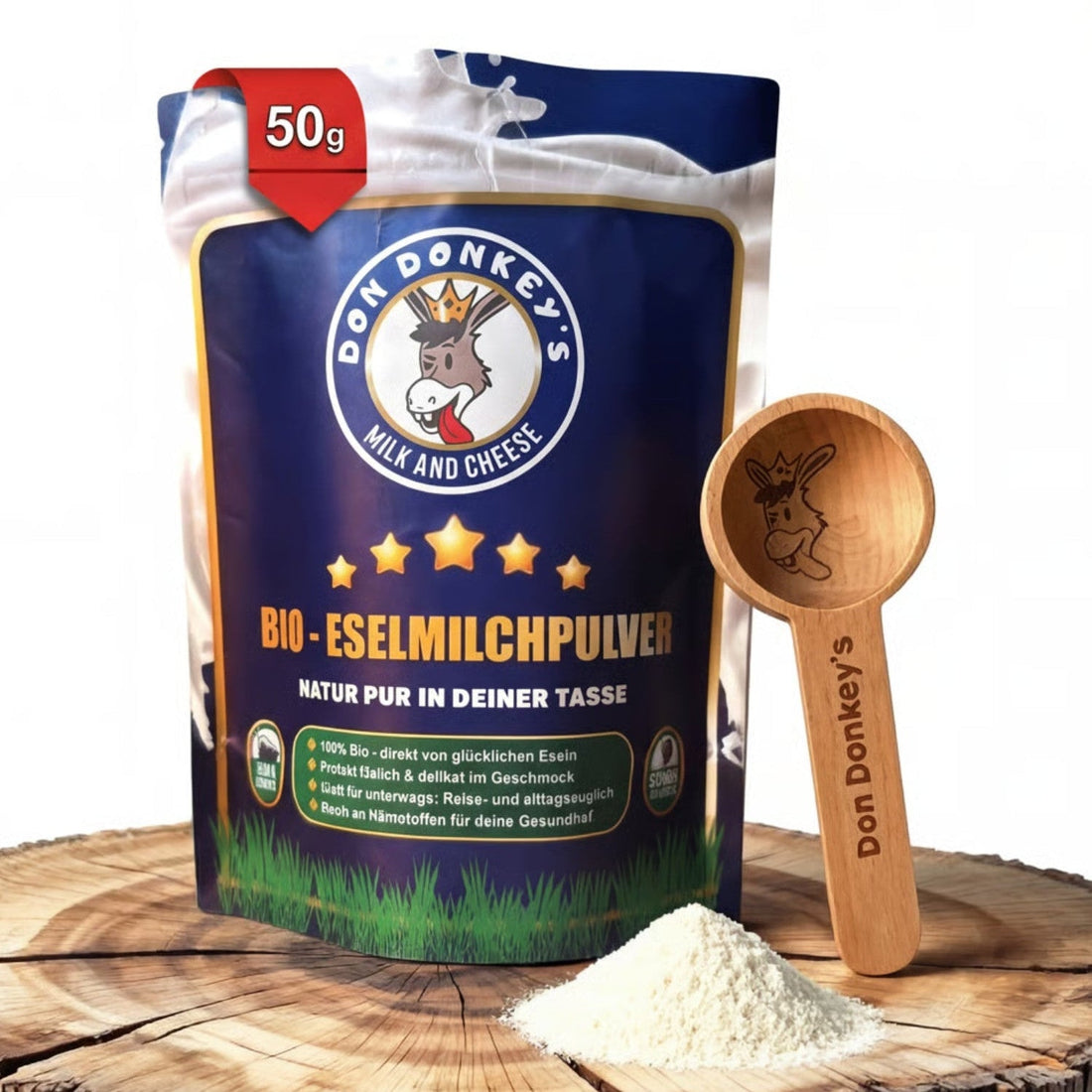
Donkey Milk Powder
Donkey milk in powder form
For anyone who prefers a longer shelf life: our donkey milk in powder form – easy to store and portion.
20g · Unit price: €1.245,00 / 1 kg · incl. VAT, plus shipping