
 Buyer protection

Donkey milk research · Study 164
Where does the milk come from? Tracing Italian donkey milk by its anions
Using five inorganic anions, the researchers assigned 45 donkey milk samples from three Italian regions to their origin – correctly in 91 to 98 % of cases. Phosphate (569.4 to 1304.4 mg/kg) and chloride (545.9 to 1757.9 mg/kg) were the most abundant anions.
At a glance · swipe or use the arrows
The key figures
Study design
How it was studied
Analytical study by the University of Messina (Italy): 45 donkey milk samples from different Italian regions were analysed for chloride, nitrite, nitrate, phosphate and sulphate by ion exchange chromatography with conductivity detection and chemical suppression. The data were divided into three groups by region of origin and compared by analysis of variance (ANOVA). Classification used a discriminant analysis of log-transformed concentrations and, alternatively, a three-step procedure. Based on the abstract; full-text details such as the names of the regions, number of farms and samples per region and the validation are therefore missing.
Results
What the study measured
Phosphate (569.4 to 1304.4 mg/kg) and chloride (545.9 to 1757.9 mg/kg) were the most abundant anions, followed by sulphate (109.5 to 200.7 mg/kg).
For nitrite and nitrate the abstract gives much lower values of 5.6 and 5.5 mg/kg respectively; it does not state whether these are means or maxima.
Chloride and nitrite differed significantly between farms (p < 0.001).
A discriminant analysis based on the log-transformed anion contents and an alternative three-step procedure were tested.
Overall, 91 to 98 % of samples were assigned to the correct region on the basis of their anion content.
Authors’ conclusion: According to the authors, the procedure is simple and could serve to trace donkey milk and protect it against fraud or commercial disputes. This was shown for 45 samples from three regions – the paper does not show whether the classification works for other regions, seasons or feeding.
Critical appraisal
Strengths and limitations
Only the abstract assessedClear limitation
The full text was not available. Which regions, how many farms and how many samples per region were included is unknown.
Small data set, three regionsClear limitation
45 samples from three regions are a narrow basis. A model developed and tested on the same data may turn out too optimistic.
Region or farm?Note
The abstract reports differences “among farms”. Whether the patterns reflect the region or rather the feed, water and husbandry of individual farms remains open.
Unclear nitrite and nitrate figuresNote
Only single values without a range are given for nitrite and nitrate; their meaning is not clear from the abstract.
Simple, widely used techniqueStrength
Ion chromatography is available in many food laboratories. This makes the approach practical in principle for origin checks.
Editorial note: The paper shows that donkey milk from three Italian regions could be distinguished well by its anion pattern. Reliable origin testing in trade would need larger sample numbers, several years and validation on independent samples. To the research archive.
Research question for DON DONKEY’S®
Can an anion or mineral profile be created for the donkey milk of each of our EU partner farms, making the origin of individual batches verifiable?
Original publication
Classification of the geographical origin of Italian donkey's milk based on differences in inorganic anions.
Original title: Classification of the geographical origin of Italian donkey's milk based on differences in inorganic anions.
Di Bella G., Lo Turco V., Potortì A. G., Luppino R. R., Fotia V., Conte F., Dugo G.
Food Additives and Contaminants: Part A · 2012 · 29(7), 1021–1029
Department of Food and Environment Sciences, University of Messina, Italy (according to author details)
DOI: 10.1080/19440049.2012.674979
Transparency: funding and conflicts of interest could not be checked from the abstract. No product-related statement for DON DONKEY’S®.
Summarised and checked by the DON DONKEY’S editorial team against the original publication · As of: November 2026
The study summarised above was carried out independently of DON DONKEY’S® and does not relate to our products. It serves solely to inform about the state of research.
DON DONKEY’S® donkey milk and donkey milk powder are foods. They are not intended to prevent, treat or cure any disease and do not replace medical advice.

From our shop
DON DONKEY’S® donkey milk
100 % donkey milk · raw milk, frozen
On this page we report the findings of a published study. Independently of that, you will find our donkey milk here: 100 % donkey milk, frozen as raw milk.
100 ml bottle / 100ml · Unit price: €249,00 / 1 l · incl. VAT, plus shipping
Also in our shop
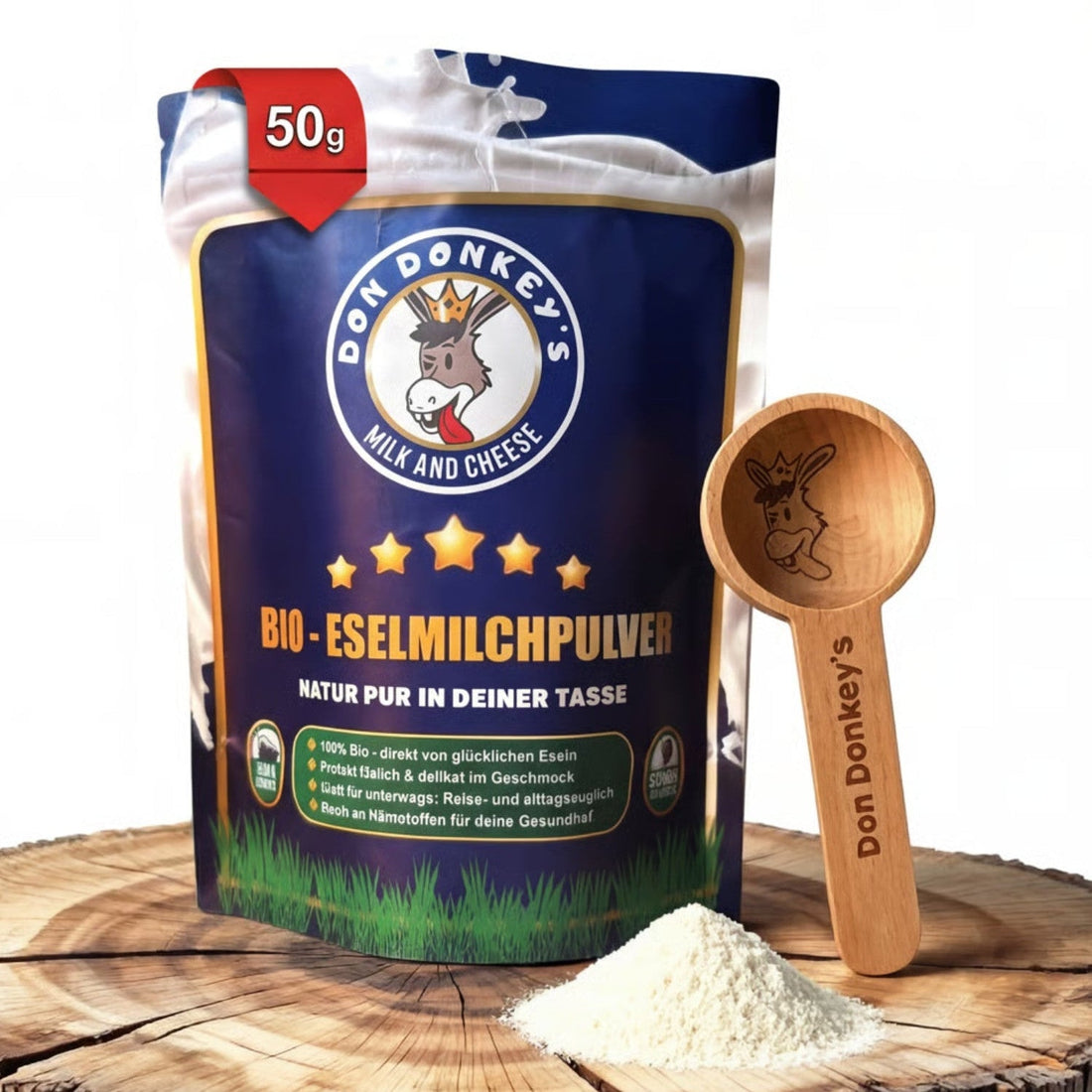
Donkey Milk Powder
Donkey milk in powder form
For anyone who prefers a longer shelf life: our donkey milk in powder form – easy to store and portion.
20g · Unit price: €1.245,00 / 1 kg · incl. VAT, plus shipping