
 Buyer protection

Donkey milk research · Study 162
What is in the unsaponifiable fat fraction? Sterols and tocopherols in donkey milk
In the milk fat of jennies, cholesterol was the most abundant sterol at a mean of 0.97 g per 100 g fat; lanosterol (0.003 g) and β-sitosterol (0.005 g) occurred in much smaller amounts. Neither sterols nor tocopherols changed significantly during the first two months of lactation.
At a glance · swipe or use the arrows
The key figures
Study design
How it was studied
Milk analysis by a research group at the University of Pisa (Italy): the unsaponifiable fraction of jennies’ milk fat was examined during the first two months of lactation. Sterols of animal origin (cholesterol, lanosterol, desmosterol), plant sterols (β-sitosterol, campesterol, brassicasterol, stigmasterol) and α- and γ-tocopherol were measured, each per 100 g of fat. The authors describe the work as a preliminary investigation. Based on the abstract; full-text details such as the number of animals and samples, breed, feeding and analytical method are therefore missing.
Results
What the study measured
Cholesterol was the main sterol in the milk fat: a mean of 0.97 ± 0.443 g per 100 g fat.
Among the minor sterols of animal origin, lanosterol came first (0.003 ± 0.001 g/100 g fat), followed by desmosterol (0.001 ± 0.001 g/100 g fat).
β-sitosterol was the main plant sterol (0.005 ± 0.002 g/100 g fat). Campesterol, brassicasterol and stigmasterol were found at lower levels; the abstract gives no individual values.
α-tocopherol averaged 0.01 ± 0.007 g and γ-tocopherol 0.003 ± 0.001 g per 100 g fat.
Sterol and tocopherol contents did not change significantly during the first two months of lactation.
Authors’ conclusion: The authors consider the presence of lanosterol of particular interest and see the plant sterols as adding to the nutritional quality of the milk fat. However, only contents were measured; whether these amounts matter when the milk is consumed was not examined.
Critical appraisal
Strengths and limitations
Only the abstract assessedClear limitation
The full text was not available. The number of jennies and samples, breed, feeding and analytical method are therefore unknown.
Values per 100 g of fatNote
All figures refer to the milk fat. As donkey milk is low in fat, the amounts per glass of milk are much smaller; the abstract does not convert them.
Assessment goes beyond the dataClear limitation
References to lanosterol as a potential drug and to plant sterols as nutritionally valuable are the authors’ views, not results measured in this paper.
Short period, wide spreadNote
Only the first two months of lactation were covered. Some standard deviations are almost as large as the means, for example for α-tocopherol.
Little-studied fractionStrength
The paper provides measured values for sterols and tocopherols in donkey milk, for which little data exist so far, and checks their course over early lactation.
Editorial note: This pilot study describes which sterols and tocopherols occur in donkey milk fat and in what order of magnitude. It adds to research on composition but says nothing about whether these components have any effect when the milk is drunk. To the research archive.
Research question for DON DONKEY’S®
How much do cholesterol and tocopherols in the fat of our donkey milk vary between batches and stages of lactation – and do tocopherol levels stay stable during frozen storage?
Original publication
A preliminary investigation into the unsaponifiable fraction of donkey milk: Sterols of animal origin, phytosterols, and tocopherols.
Original title: A preliminary investigation into the unsaponifiable fraction of donkey milk: Sterols of animal origin, phytosterols, and tocopherols.
Martini M., Altomonte I., Licitra R., Bartaloni F. V., Salari F.
Journal of Dairy Science · 2021 · 104(2), 1378–1383
Department of Veterinary Science and “E. Avanzi” research centre, University of Pisa, Italy (according to author details)
Transparency: according to the database record, the work was funded by the University of Pisa. Conflicts of interest could not be checked from the abstract. No product-related statement for DON DONKEY’S®.
Summarised and checked by the DON DONKEY’S editorial team against the original publication · As of: November 2026
The study summarised above was carried out independently of DON DONKEY’S® and does not relate to our products. It serves solely to inform about the state of research.
DON DONKEY’S® donkey milk and donkey milk powder are foods. They are not intended to prevent, treat or cure any disease and do not replace medical advice.

From our shop
DON DONKEY’S® donkey milk
100 % donkey milk · raw milk, frozen
On this page we report the findings of a published study. Independently of that, you will find our donkey milk here: 100 % donkey milk, frozen as raw milk.
100 ml bottle / 100ml · Unit price: €249,00 / 1 l · incl. VAT, plus shipping
Also in our shop
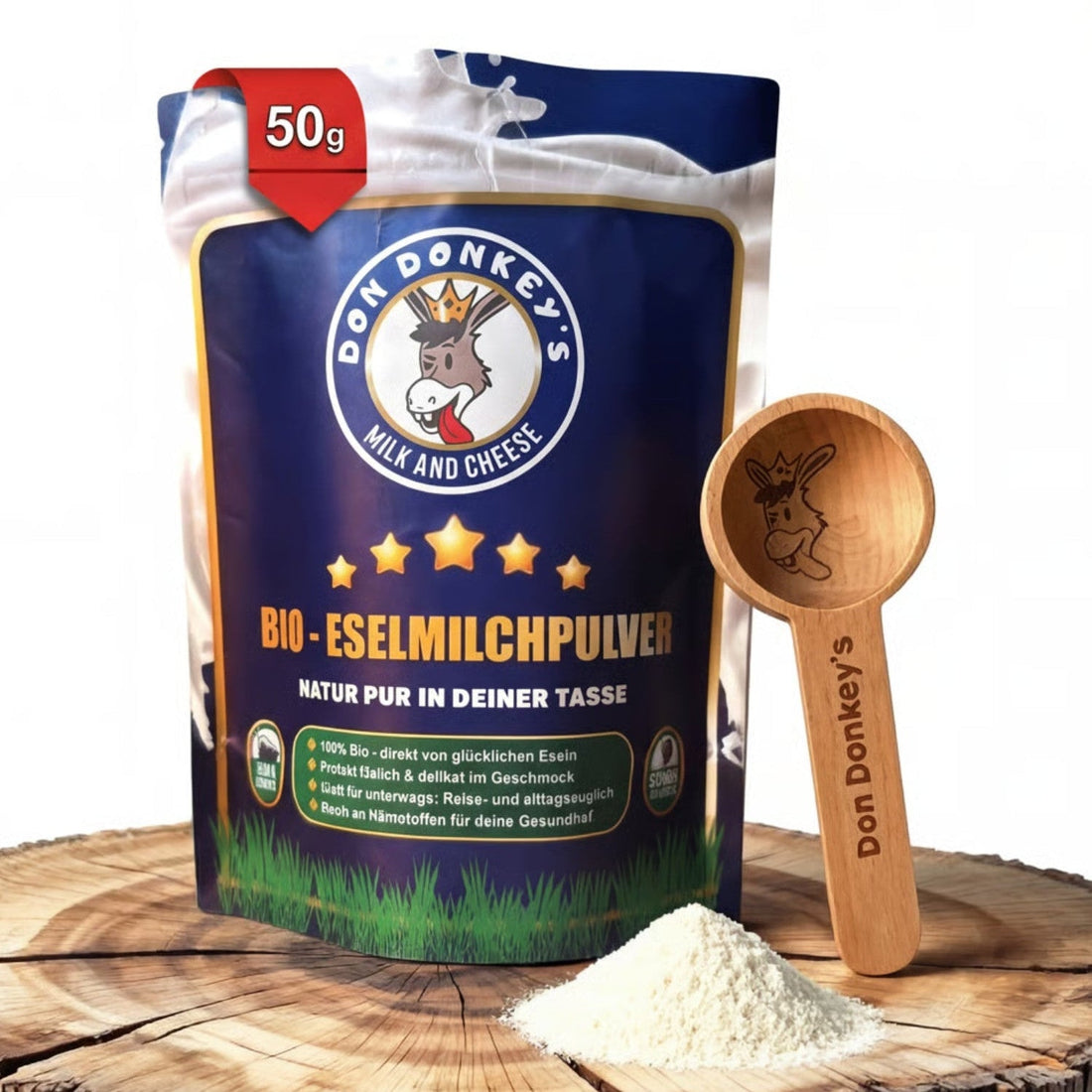
Donkey Milk Powder
Donkey milk in powder form
For anyone who prefers a longer shelf life: our donkey milk in powder form – easy to store and portion.
20g · Unit price: €1.245,00 / 1 kg · incl. VAT, plus shipping