
 Buyer protection

Donkey milk research · Study 161
Fresh or fermented: what changes in donkey milk through acidification and cold storage
Fermented donkey milk had a lower pH and contained less lactose, fewer amino acids and lower levels of 5 minerals than fresh donkey milk; the share of saturated fatty acids was lower. During 21 days of storage at 4 °C, lactose fell further while mineral contents stayed the same.
At a glance · swipe or use the arrows
The key figures
Study design
How it was studied
Food comparison in the lab, from Brazil according to the funding information. Fresh donkey milk and fermented donkey milk made from it were compared for acidity (pH, titratable acidity), lactose, minerals (calcium, phosphorus, magnesium, sodium, zinc), amino acids and fatty acid profile. The fermented milk was also stored for 21 days at 4 °C and analysed again. This summary is based on the abstract; the full text was not available to the editorial team. Origin of the milk, sample numbers, starter cultures used and figures are therefore not known.
Results
What the study measured
The fermented milk was more acidic than the fresh milk: lower pH values and higher titratable acidity.
It contained less lactose, lower levels of minerals (calcium, phosphorus, magnesium, sodium and zinc) and fewer amino acids, mainly essential amino acids.
The fatty acid profile of the fermented milk showed fewer saturated and more monounsaturated and polyunsaturated fatty acids; the authors rate it as better.
During 21 days of storage at 4 °C, lactose content fell further while mineral contents were maintained. According to the authors, the amino acid profile changed positively and the fatty acid profile negatively.
The abstract gives no figures for the individual contents.
Authors’ conclusion: Both donkey milk and fermented donkey milk have important nutritional value, and the fermented milk could be stored refrigerated for up to 21 days. The study compares the contents of two products; it does not show any health effect, and rating the fatty acid and amino acid profiles as favourable or unfavourable is the authors’ assessment.
Critical appraisal
Strengths and limitations
Only the abstract assessedClear limitation
Without the full text, sample numbers, origin of the milk, starter cultures and all figures are unknown. How large the differences were cannot be judged.
Evaluative termsNote
A “better” fatty acid profile and “improvements” in the amino acid profile are the authors’ assessments, not measured quantities.
Shelf life viewed chemically onlyNote
Whether microbiological or sensory tests support the 21-day storage recommendation is not clear from the abstract.
Funding only partly knownNote
The record names the Brazilian funding agency CAPES. Conflicts of interest could not be checked from the abstract.
Broad measurement programmeStrength
The study covers acidity, lactose, five minerals, amino acids and fatty acids and also looks at changes over storage.
Editorial note: The paper describes how the composition of donkey milk shifts through fermentation and cold storage: less lactose, lower minerals, a changed fatty acid profile. Without figures, the size of these differences remains open. We do not adopt the positive ratings of individual profiles. To the research archive.
Research question for DON DONKEY’S®
How do pH and lactose content of our donkey milk change over several days of cold storage after thawing, measured in the same batches?
Original publication
Donkey milk and fermented donkey milk: are there differences in the nutritional value and physicochemical characteristics?
Original title: Donkey milk and fermented donkey milk: are there differences in the nutritional value and physicochemical characteristics?
Cavalcanti N. S. H., Pimentel T. C., Magnani M., Pacheco M. T. B., Alves S. P., Branquinho Bessa R. J., Marília da Silva Sant’ana A., de Cássia Ramos do Egypto Queiroga R.
LWT – Food Science and Technology · 2021 · 144, 111239
Research group from Brazil, including the Universidade Federal da Paraíba (according to funding information and author profiles; institutions not stated in the available data)
DOI: 10.1016/j.lwt.2021.111239
Transparency: according to the record, funded by the Coordenação de Aperfeiçoamento de Pessoal de Nível Superior (CAPES, Brazil). Conflicts of interest could not be checked from the abstract. No product-related statement for DON DONKEY’S®.
Summarised and checked by the DON DONKEY’S editorial team against the original publication · As of: November 2026
The study summarised above was carried out independently of DON DONKEY’S® and does not relate to our products. It serves solely to inform about the state of research.
DON DONKEY’S® donkey milk and donkey milk powder are foods. They are not intended to prevent, treat or cure any disease and do not replace medical advice.

From our shop
DON DONKEY’S® donkey milk
100 % donkey milk · raw milk, frozen
On this page we report the findings of a published study. Independently of that, you will find our donkey milk here: 100 % donkey milk, frozen as raw milk.
100 ml bottle / 100ml · Unit price: €249,00 / 1 l · incl. VAT, plus shipping
Also in our shop
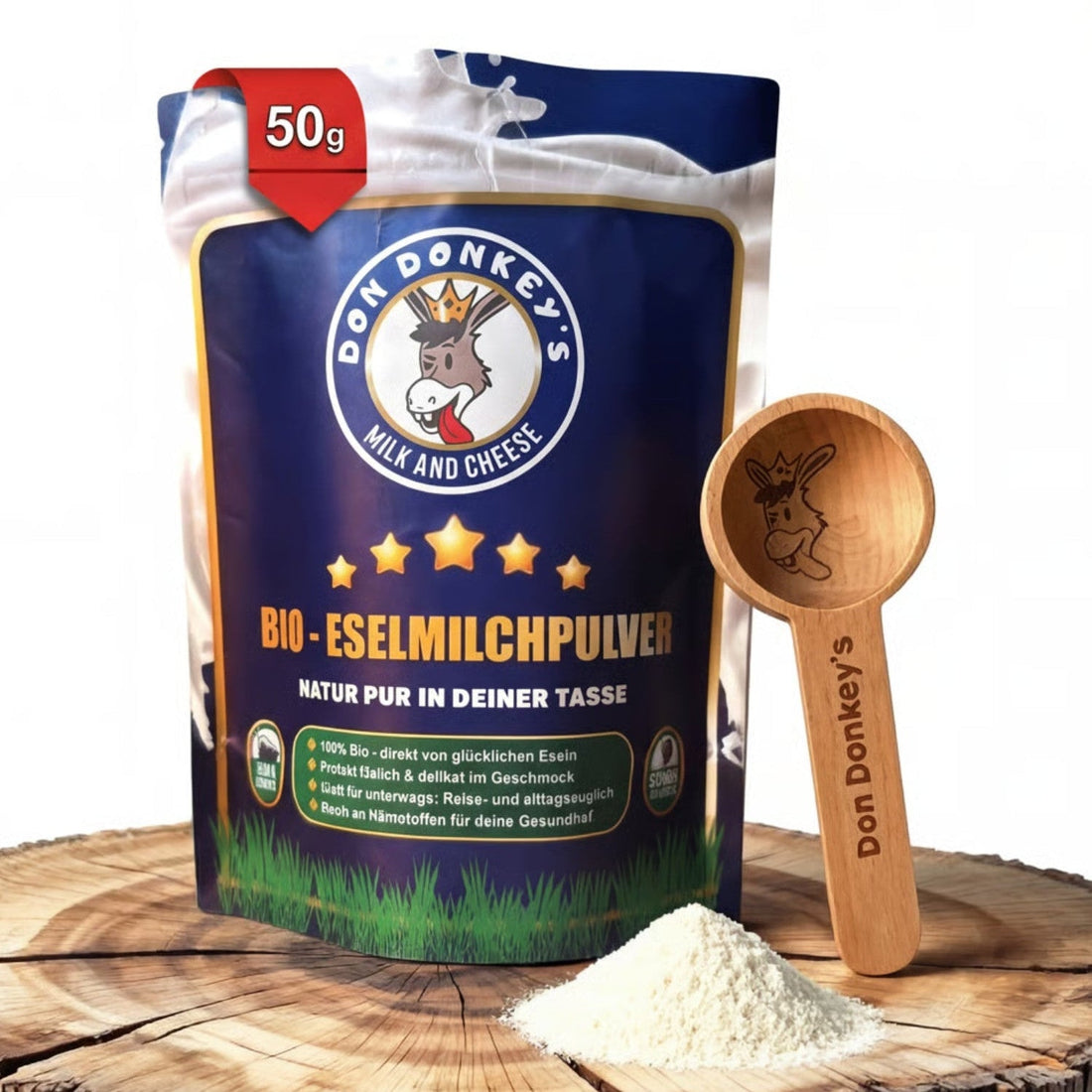
Donkey Milk Powder
Donkey milk in powder form
For anyone who prefers a longer shelf life: our donkey milk in powder form – easy to store and portion.
20g · Unit price: €1.245,00 / 1 kg · incl. VAT, plus shipping