
 Buyer protection

Donkey milk research · Study 160
Is there cow milk in it? Two lab methods test the authenticity of donkey milk
Using isoelectric focusing, an admixture of cow milk to donkey milk could be estimated from a share of 5% (v/v). An ELISA with antibodies against a segment of cow β-casein detected cow milk in laboratory mixtures at levels as low as 0.5%.
At a glance · tap the cards
The key figures
Study design
How it was studied
Analytical lab study from Italy (Institute of Food Science of the CNR, Avellino). Mixtures of donkey and cow milk with known cow milk shares were prepared in the laboratory. Two rapid methods were tested: isoelectric focusing (IEF), looking for bands of cow αs1-casein in the protein profile, and an ELISA using antibodies against the 1–28 segment of cow β-casein. This summary is based on the abstract; the full text was not available to the editorial team. The number of mixtures, replicates, origin of the milk and validation data are therefore not known.
Results
What the study measured
The authors describe blending cow milk into donkey milk as a fraudulent practice and developed two rapid detection methods.
Using isoelectric focusing, the cow milk share could be estimated from the bands of cow αs1-casein from 5% (v/v).
According to the authors, an ELISA with antibodies against the 1–28 segment of cow β-casein allowed an accurate definition of the composition of donkey-cow milk mixtures.
In mixtures prepared in the laboratory, the ELISA detected cow milk at a share as low as 0.5% (v/v).
Authors’ conclusion: IEF and ELISA are suitable as rapid methods for detecting cow milk in donkey milk, the ELISA down to 0.5%. The results come from laboratory mixtures; the abstract does not show whether the methods work as reliably on commercial products, heated milk or powder. Donkey milk is not a substitute for breast milk or infant formula; infant feeding belongs in medical hands.
Critical appraisal
Strengths and limitations
Only the abstract assessedClear limitation
Without the full text, the number of mixtures, repeatability, cross-reactions and validation data are unknown. Funding and conflicts of interest could not be checked.
Lab mixtures, not commercial productsNote
Self-prepared mixtures were tested. Whether the detection limits also apply to heated, frozen or dried products remains open.
Only cow milk as adulterantNote
Both methods target cow caseins. Admixtures of other milks such as goat or sheep milk are not covered.
Allergy context only in backgroundNote
The authors mention donkey milk as a proposed alternative in cow milk allergy. The study itself does not examine tolerability.
Two complementary methodsStrength
A simple separation method for higher shares and a sensitive antibody test for low shares down to 0.5% were developed side by side.
Editorial note: The paper provides tools for testing the authenticity of donkey milk, a topic of practical relevance for transparency of origin. The low detection limits refer to laboratory mixtures. For use in quality control, data on commercial samples and processed milk would be needed. To the research archive.
Research question for DON DONKEY’S®
Can batches of our donkey milk and donkey milk powder be spot-checked regularly by ELISA for cow milk content, with the results published as proof of authenticity?
Original publication
Isoelectric focusing and ELISA for detecting adulteration of donkey milk with cow milk
Original title: Isoelectric focusing and ELISA for detecting adulteration of donkey milk with cow milk
Pizzano R., Salimei E.
Journal of Agricultural and Food Chemistry · 2014 · 62(25), 5853–5858
Consiglio Nazionale delle Ricerche (CNR), Istituto di Scienze dell’Alimentazione, Avellino, Italy (according to the paper; no affiliation given for the second author)
DOI: 10.1021/jf5025533
Transparency: funding and conflicts of interest could not be checked from the abstract. No product-related statement for DON DONKEY’S®.
Summarised and checked by the DON DONKEY’S editorial team against the original publication · As of: November 2026
The study summarised above was carried out independently of DON DONKEY’S® and does not relate to our products. It serves solely to inform about the state of research.
DON DONKEY’S® donkey milk and donkey milk powder are foods. They are not intended to prevent, treat or cure any disease and do not replace medical advice.

From our shop
DON DONKEY’S® donkey milk
100 % donkey milk · raw milk, frozen
On this page we report the findings of a published study. Independently of that, you will find our donkey milk here: 100 % donkey milk, frozen as raw milk.
100 ml bottle / 100ml · Unit price: €249,00 / 1 l · incl. VAT, plus shipping
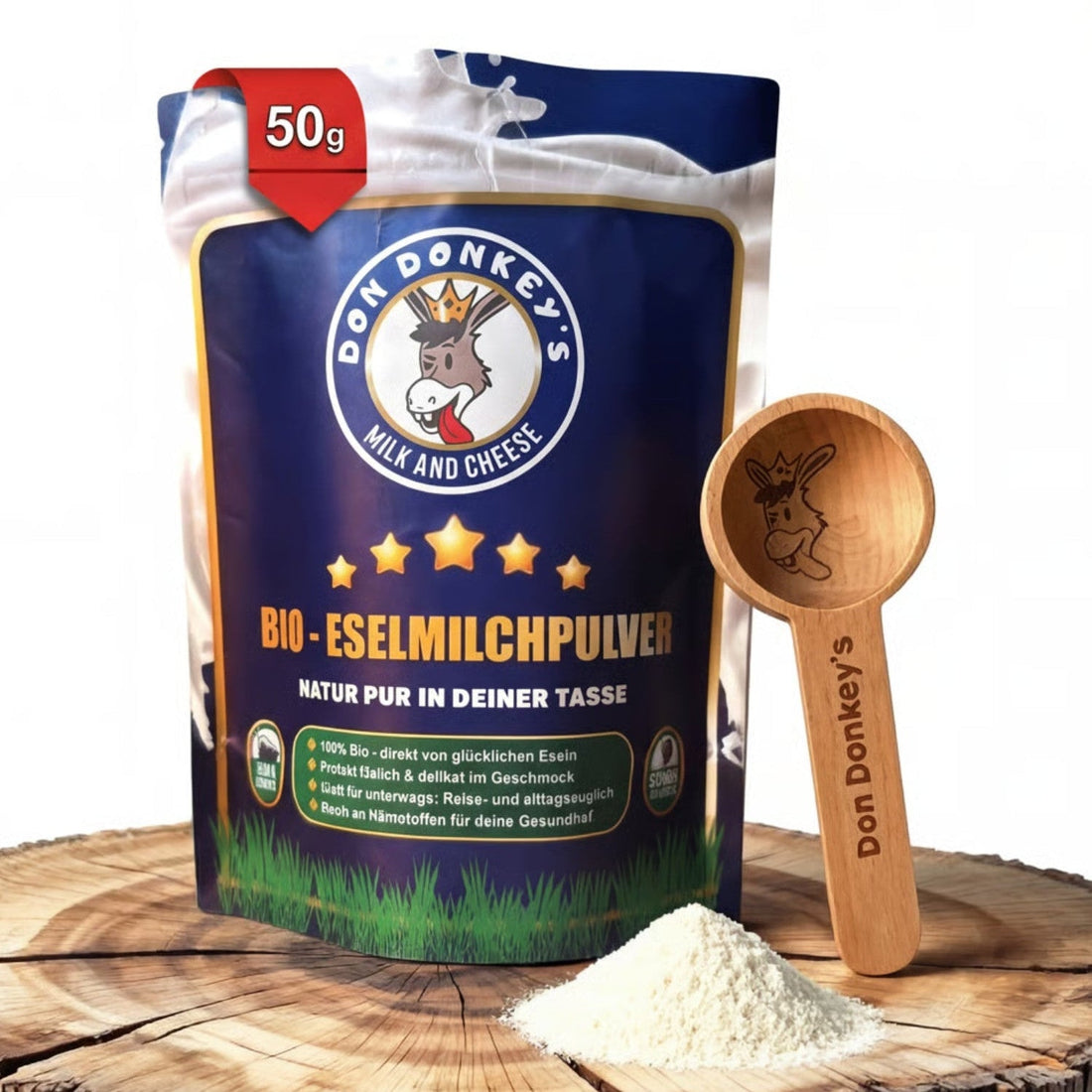
Also in our shop
Donkey Milk Powder
Donkey milk in powder form
For anyone who prefers a longer shelf life: our donkey milk in powder form – easy to store and portion.
20g · Unit price: €1.245,00 / 1 kg · incl. VAT, plus shipping