
 Buyer protection

Donkey milk research · Study 159
Fat, casein, whey, aqueous phase: where trace elements sit in donkey milk
In milk from 16 jennies, zinc was almost entirely bound to casein, as was most of the copper and manganese; 20 to 36% of selenium, cobalt and chromium were also associated with casein. Lithium and boron were found entirely in the aqueous phase, and fat carried 4.5 to 13.5% of individual elements.
At a glance · swipe or use the arrows
The key figures
Study design
How it was studied
Milk analysis by the University of Camerino (Italy). 16 clinically healthy lactating jennies provided individual milk samples. Fat, casein and whey proteins were removed step by step by centrifugation, ultracentrifugation and ultrafiltration, yielding skim milk, a whey fraction and the aqueous phase of milk. Concentrations of Zn, Cu, Mn, Se, Mo, Co, Li, B, Ti, Cr, Rb, Sr, Cd and Pb were measured by ICP-MS in whole milk and fractions; the proportions associated with fat, casein and whey proteins were calculated and tested by repeated-measures analysis of variance. This summary is based on the abstract; the full text was not available to the editorial team. Absolute concentrations, breed, lactation stage and feeding of the animals are therefore not known.
Results
What the study measured
Milk fat carried a small but significant proportion of about 4.5 to 13.5% of molybdenum, cobalt, titanium, chromium and strontium.
The casein fraction contained almost all of the milk’s zinc, most of the copper and manganese, and the greater part of molybdenum, titanium and strontium. Between 20 and 36% of selenium, cobalt and chromium were also bound to casein.
Most of the selenium, cobalt, lithium, boron, chromium and rubidium was present in soluble form. Whey proteins carried the majority of selenium and cobalt.
Lithium and boron were found entirely in the aqueous phase, as were most of the rubidium and chromium and 17 to 42% of manganese, selenium, molybdenum, cobalt, titanium and strontium.
Cadmium and lead were also measured; the abstract reports no results for these two elements.
Authors’ conclusion: The trace elements studied are distributed very differently across fat, casein, whey proteins and the aqueous phase of donkey milk. The study describes this distribution; how well the elements from donkey milk are absorbed in the body was not examined.
Critical appraisal
Strengths and limitations
Only the abstract assessedClear limitation
Absolute concentrations, spread of values and information on breed, feeding and lactation stage are missing. Funding and conflicts of interest could not be checked.
Content is not availabilityNote
Binding to casein or whey describes the state in the milk. How much of it the body can absorb was not part of the study.
16 animalsNote
The samples come from 16 jennies. Whether the distribution is the same in other herds, breeds or feeding systems remains open.
Cadmium and lead without resultsNote
According to the abstract, both elements were measured but are not reported there. No statements on residues are therefore possible.
Individual samples, stepwise fractionationStrength
Individual samples were separated into four fractions and measured with a sensitive method (ICP-MS); the analysis accounts for repeated measurements on the same animal.
Editorial note: The paper provides basic knowledge on which milk components bind the trace elements in donkey milk. This is relevant, for example, to processing steps that remove fat or protein. Quantities cannot be taken from the abstract. To the research archive.
Research question for DON DONKEY’S®
What are the zinc, copper and selenium levels in batches from our partner farms, and do they match in donkey milk and the donkey milk powder made from it, on a dry-matter basis?
Original publication
Distribution of selected trace elements in the major fractions of donkey milk
Original title: Distribution of selected trace elements in the major fractions of donkey milk
Fantuz F., Ferraro S., Todini L., Spurio R., Fatica A., Marcantoni F., Salimei E.
Journal of Dairy Science · 2022 · 105(8), 6422–6430
Scuola di Bioscienze e Medicina Veterinaria and Scuola di Scienze e Tecnologie, University of Camerino, Italy (according to the paper)
Transparency: funding and conflicts of interest could not be checked from the abstract. No product-related statement for DON DONKEY’S®.
Summarised and checked by the DON DONKEY’S editorial team against the original publication · As of: November 2026
The study summarised above was carried out independently of DON DONKEY’S® and does not relate to our products. It serves solely to inform about the state of research.
DON DONKEY’S® donkey milk and donkey milk powder are foods. They are not intended to prevent, treat or cure any disease and do not replace medical advice.

From our shop
DON DONKEY’S® donkey milk
100 % donkey milk · raw milk, frozen
On this page we report the findings of a published study. Independently of that, you will find our donkey milk here: 100 % donkey milk, frozen as raw milk.
100 ml bottle / 100ml · Unit price: €249,00 / 1 l · incl. VAT, plus shipping
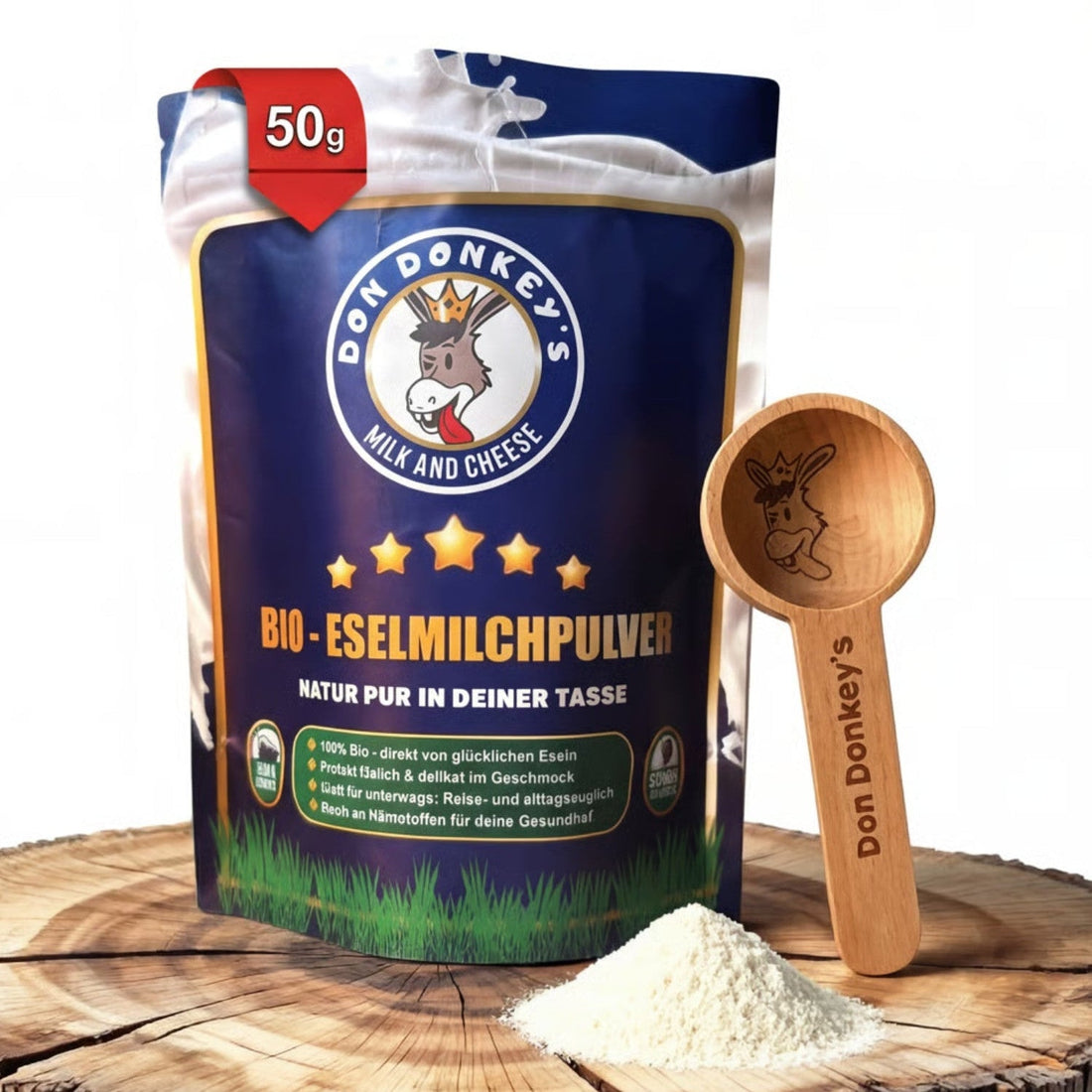
Also in our shop
Donkey Milk Powder
Donkey milk in powder form
For anyone who prefers a longer shelf life: our donkey milk in powder form – easy to store and portion.
20g · Unit price: €1.245,00 / 1 kg · incl. VAT, plus shipping