
 Buyer protection

Donkey milk research · Study 156
What jennies eat shows up in the milk: lipids and volatile compounds by roughage
Depending on whether jennies received corn straw, wheat hulls or wheat straw as roughage, 153 of 1,842 lipids detected in their milk differed significantly. Of 45 volatile compounds, 31 varied; triacylglycerols were higher in the corn straw group, phospholipids and sphingolipids in the wheat straw group.
At a glance · tap the cards
The key figures
Study design
How it was studied
Feeding trial by a research group at Liaocheng University (Shandong Province, China). 36 healthy multiparous jennies (5 years old, mean 286 ± 25 kg, 60 ± 15 days in lactation) from one farm were randomly allocated to three groups of 12. As roughage they received corn straw (G1), wheat hulls (G2) or wheat straw (G3), fed twice daily with free access to water. After a two-week preliminary phase and a four-week main phase, a 100 mL milk sample was taken from 9 randomly selected animals per group and stored at −80 °C. Lipids were determined by UPLC-ESI-MS/MS (untargeted lipidomics), volatile organic compounds by headspace solid-phase microextraction and GC-MS. Ethical approval from Liaocheng University is reported (2023022706).
Interactive chart · values from the study
Lipid categories in donkey milk (share of detected lipids)
Source: section 3.1 and Figure 1 of the study (Ren et al., 2023).
Second analysis
Composition of the three roughages
Source: section 2.1 of the study. Values for each roughage, not for the whole ration.
Results
What the study measured
1,842 lipids were detected in the milk (results section: 1,841 from 29 subclasses). 64.86% were glycerolipids, 17.71% glycerophospholipids and 8.47% sphingolipids; triacylglycerols were the largest subclass at 55.19%.
153 lipids differed significantly between groups, including 126 triacylglycerols, 6 diacylglycerols, 6 ceramides and 9 phospholipids. They were assigned to 17 metabolic pathways, most often glycerolipid metabolism.
In the corn straw group (G1), relative levels of triacylglycerols and monoacylglycerols were significantly higher than in the wheat straw group (G3). In G3, phosphatidylcholine, phosphatidylethanolamine, ceramides and sphingomyelin, among others, were higher.
Of 45 volatile organic compounds from 10 classes, 31 differed significantly between groups. According to the results section, nitrogen compounds, phenols, ketones and hydrocarbons were higher in G1, esters and alcohols in G2 and G3.
The most abundant volatile compound in G1 was 4-amino-2(1H)-pyridinone at 298.40 ± 7.82 ng/g; in G2 and G3 it was 4,6-dimethyl-isothiazolo[5,4-b]pyridin-3-one at 341.38 ± 19.97 and 379.18 ± 40.94 ng/g respectively.
Authors’ conclusion: Roughage changes the lipid and volatile compound profile of donkey milk; corn straw mainly increased glycerolipids, wheat straw glycerophospholipids and sphingolipids. The study does not show whether these differences are noticeable in taste or smell and does not rate any of the rations as nutritionally advantageous.
Critical appraisal
Strengths and limitations
Contradictory statements in the textClear limitation
The abstract and conclusion describe volatile compounds as increased in G2 and G3, while the results section reports nitrogen compounds and phenols as higher in G1. The lipid count (1,841 or 1,842) and the number of compounds lower in G1 also differ.
Relative profiles, no fat contentsNote
Relative proportions of lipid species are reported. Milk yield, total fat and fatty acid contents per 100 g are not given in the text.
Volatiles not tested by sensory panelNote
Volatile compounds were measured from samples heated to 100 °C and identified via a spectral library. No tasting took place.
Short duration, one farmNote
Four-week main phase, 9 sampled animals per group, one farm in Shandong. Conflicts of interest are not stated in the available text.
Randomised groups, broad analyticsStrength
Animals were randomly allocated and kept under the same conditions, and feed composition is documented. Lipidomics and GC-MS capture many individual compounds.
Editorial note: The paper shows that the choice of roughage alone leaves measurable traces in the lipid and volatile compound profile of donkey milk. Given the contradictory statements on volatile compounds, the direction of individual differences should be read with caution. No statement on the taste or value of the milk can be derived from it. To the research archive.
Research question for DON DONKEY’S®
Can differences in the fat and volatile compound profile between batches from our partner farms be traced to the documented type of roughage when feed and milk are analysed in parallel?
Original publication
Effects of Roughage on the Lipid and Volatile-Organic-Compound Profiles of Donkey Milk
Original title: Effects of Roughage on the Lipid and Volatile-Organic-Compound Profiles of Donkey Milk
Ren W., Sun M., Shi X., Wang T., Wang Y., Wang X., Huang B., Kou X., Liang H., Chen Y., Wang C., Li M.
Foods · 2023 · 12(11), 2231
School of Agricultural Science and Engineering, Liaocheng Research Institute of Donkey High-Efficiency Breeding and Ecological Feeding, Liaocheng University, China (according to the paper)
Transparency: funded by, among others, the National Key R&D Program of China, the Shandong Provincial Natural Science Foundation, the Shandong Province Modern Agricultural Technology System Donkey Industrial Innovation Team and the Key Technology Research and Development Program of Shandong. The available text contains no statement on conflicts of interest. No product-related statement for DON DONKEY’S®.
Summarised and checked by the DON DONKEY’S editorial team against the original publication · As of: November 2026
The study summarised above was carried out independently of DON DONKEY’S® and does not relate to our products. It serves solely to inform about the state of research.
DON DONKEY’S® donkey milk and donkey milk powder are foods. They are not intended to prevent, treat or cure any disease and do not replace medical advice.

From our shop
DON DONKEY’S® donkey milk
100 % donkey milk · raw milk, frozen
On this page we report the findings of a published study. Independently of that, you will find our donkey milk here: 100 % donkey milk, frozen as raw milk.
100 ml bottle / 100ml · Unit price: €249,00 / 1 l · incl. VAT, plus shipping
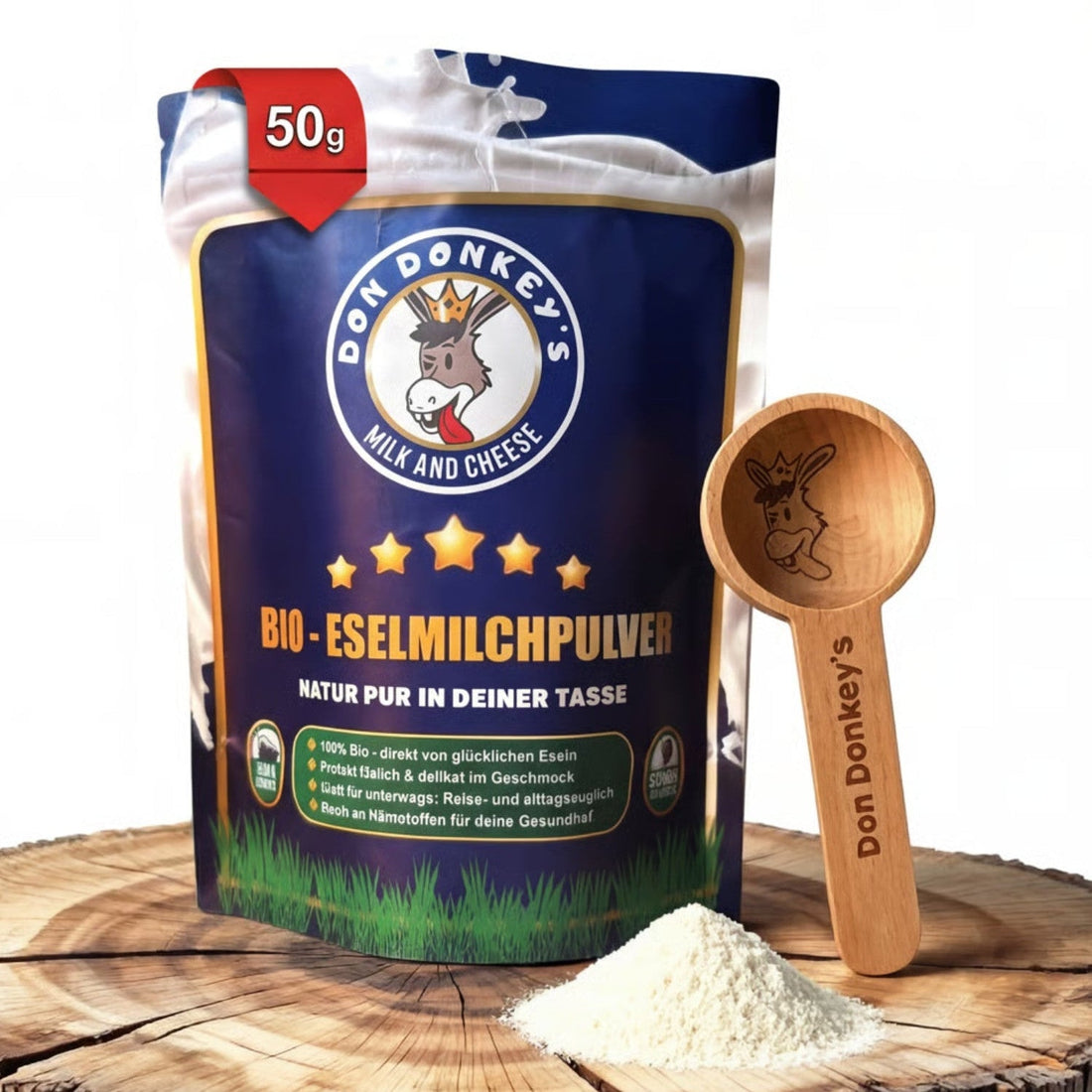
Also in our shop
Donkey Milk Powder
Donkey milk in powder form
For anyone who prefers a longer shelf life: our donkey milk in powder form – easy to store and portion.
20g · Unit price: €1.245,00 / 1 kg · incl. VAT, plus shipping