
 Buyer protection

Donkey milk research · Study 155
Bacteria in donkey milk: how the composition shifts over lactation
In 35 milk samples from Dezhou jennies, an average of 60% of bacterial gene sequences came from Proteobacteria and 22% from Firmicutes; the most common genus was Ralstonia at 39%. The composition differed by lactation stage: Escherichia-Shigella (10%) and Staphylococcus (8%) were more frequent in colostrum, Streptococcus (7%) in mature milk.
At a glance · swipe or use the arrows
The key figures
Study design
How it was studied
Milk analysis by a research group at Liaocheng University (Shandong Province, China). One sample was taken during morning machine milking from each of 35 healthy Dezhou jennies on one farm: 5 animals each on day 1 after foaling (colostrum) and on days 30, 60, 90, 120, 150 and 180. These were therefore different animals at each stage, not the same jennies followed over time. All animals received hay ad libitum and 2 kg of concentrate per day. Samples were frozen in liquid nitrogen and stored at −80 °C. Bacterial DNA was analysed by 16S rRNA high-throughput sequencing; diversity, relative abundances of phyla and genera, and metabolic functions predicted with the PICRUSt2 software were evaluated. Ethical approval from Liaocheng University is reported (2023022706).
Interactive chart · values from the study
Bacterial phyla in donkey milk (mean of all 35 samples)
Source: section 3.1 of the study (Zhou et al., 2023). Relative DNA abundances from 16S sequencing, not bacterial counts; remaining phyla not listed individually.
Second analysis
OTUs shared by colostrum (day 1) and later milk
Source: section 3.2 and Figure 4 of the study (Venn analysis).
Results
What the study measured
Across all 35 samples, bacterial sequences belonged mainly to Proteobacteria (60%), Firmicutes (22%), Bacteroidota (7%), Actinobacteriota (5%), Cyanobacteria (3%) and Deinococcota (2%).
The genera Ralstonia (39%), Pseudomonas (4%) and Acinetobacter (2%) were common in all samples.
Diversity (observed OTUs and Shannon index) was significantly higher in milk from days 30, 90, 150 and 180 than in colostrum; for days 60 and 120 the difference was not significant.
In colostrum, Escherichia-Shigella (10%), Salinicoccus (9%), Staphylococcus (8%) and Corynebacterium (4%) were more frequent than in mature milk. The heat-tolerant genera Arthrobacter and Microbacterium were also detected. Whether these were live or disease-causing strains was not examined.
Streptococcus was more frequent in mature milk (7%), Rothia (3%) and chloroplast DNA (5%) in samples from days 90 to 180. According to the authors, Streptococcus and Lactobacillus predominated among the lactic acid bacteria.
Depending on the stage, later milk shared 257 to 365 OTUs with colostrum, corresponding to 7.9 to 14.8% of all OTUs. The bacterial metabolic functions predicted by software also differed between stages.
Authors’ conclusion: The composition and predicted functions of the bacterial community in donkey milk change with lactation stage; according to the authors, the milk contains bacteria they classify as beneficial as well as potential pathogens and heat-tolerant bacteria. The study does not show how many live bacteria were present and allows no statement about effects in humans.
Critical appraisal
Strengths and limitations
DNA proportions, not bacterial countsClear limitation
16S sequencing provides relative proportions of bacterial DNA. How many bacteria per millilitre were present and whether they were alive was not determined. Genera such as Escherichia-Shigella include harmless as well as disease-causing members.
Five animals per stageClear limitation
Five different jennies were sampled at each lactation stage. Differences between stages may therefore also reflect differences between individual animals.
One farm, controls not describedNote
All animals came from one farm in Shandong. The methods section does not describe whether blank samples were run to check for contamination from reagents; for samples low in bacteria this matters for interpretation.
Functions only predictedNote
Metabolic functions were inferred from the DNA data with PICRUSt2, not measured. Conflicts of interest are not stated in the available text.
Seven time points, open-access full textStrength
The study covers the first 180 days of lactation, describes housing, feeding and laboratory methods in detail and is freely accessible.
Editorial note: The paper describes which bacterial DNA was found in donkey milk at different times after foaling. For the hygienic quality of milk, bacterial counts are more informative; these were not measured here. The description as rich in “beneficial bacteria” is the authors’ and cannot be derived from DNA proportions alone. To the research archive.
Research question for DON DONKEY’S®
How do total bacterial count and bacterial composition of our frozen donkey milk differ between early and late lactation, when batches are tested in parallel by classical microbiology and by 16S sequencing?
Original publication
Microbial Quality of Donkey Milk during Lactation Stages
Original title: Microbial Quality of Donkey Milk during Lactation Stages
Zhou M., Huang F., Du X., Wang C., Liu G.
Foods · 2023 · 12(23), 4272
School of Agricultural Science and Engineering, Liaocheng Research Institute of Donkey High-Efficiency Breeding and Ecological Feeding, Liaocheng University, China (according to the paper)
Transparency: funded by the Key Technology Research and Development Program of Shandong, the Shandong Provincial Natural Science Foundation, the National Key R&D Program of China and a Liaocheng University project. The available text contains no statement on conflicts of interest. No product-related statement for DON DONKEY’S®.
Summarised and checked by the DON DONKEY’S editorial team against the original publication · As of: November 2026
The study summarised above was carried out independently of DON DONKEY’S® and does not relate to our products. It serves solely to inform about the state of research.
DON DONKEY’S® donkey milk and donkey milk powder are foods. They are not intended to prevent, treat or cure any disease and do not replace medical advice.

From our shop
DON DONKEY’S® donkey milk
100 % donkey milk · raw milk, frozen
On this page we report the findings of a published study. Independently of that, you will find our donkey milk here: 100 % donkey milk, frozen as raw milk.
100 ml bottle / 100ml · Unit price: €249,00 / 1 l · incl. VAT, plus shipping
Also in our shop
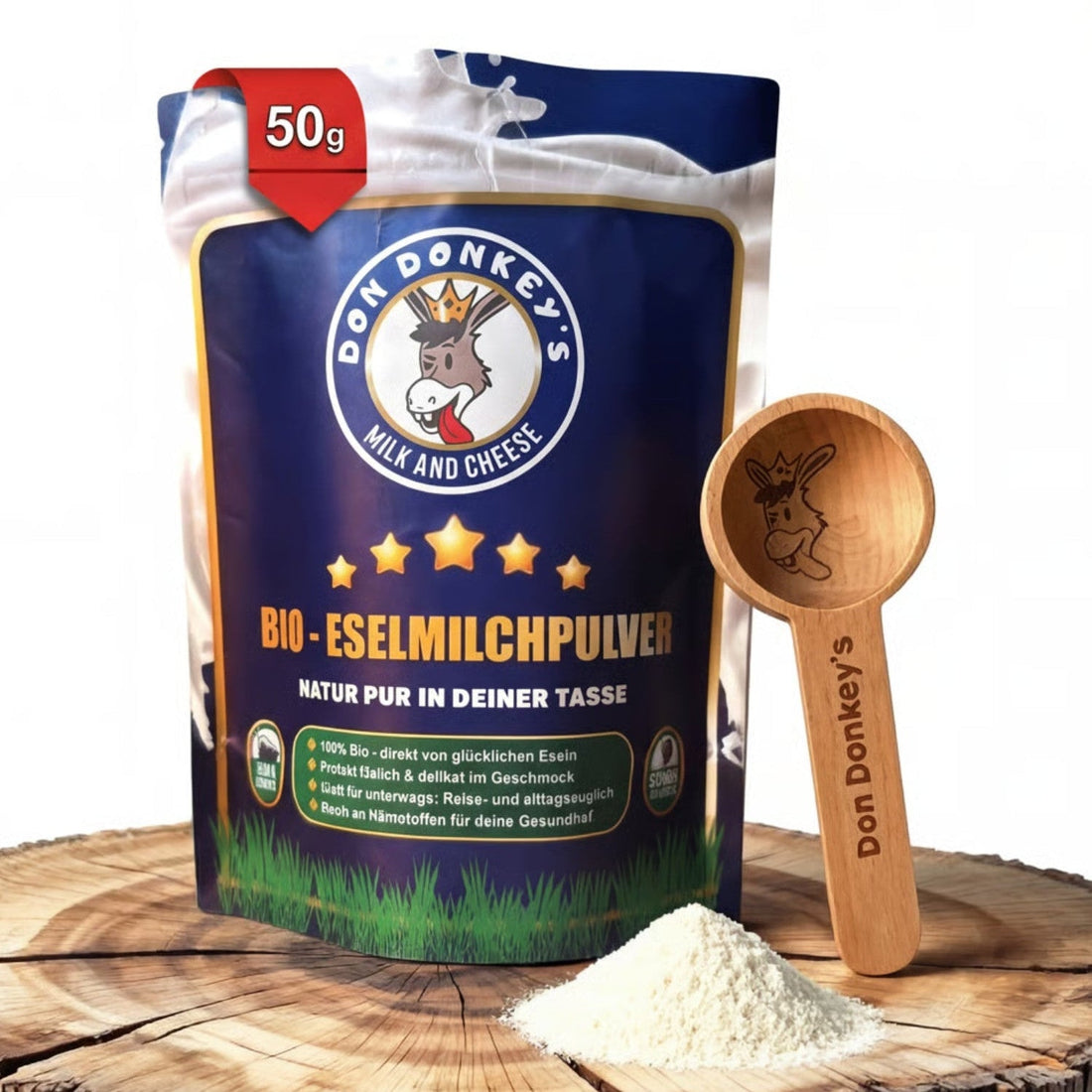
Donkey Milk Powder
Donkey milk in powder form
For anyone who prefers a longer shelf life: our donkey milk in powder form – easy to store and portion.
20g · Unit price: €1.245,00 / 1 kg · incl. VAT, plus shipping