
 Buyer protection

Donkey milk research · Study 154
Selenium yeast in the diet of jennies: milk yield, blood values and milk selenium
In an eight-week feeding trial with 28 Dezhou jennies, supplements of 0.3 and 0.5 mg selenium per kg feed dry matter from selenium yeast significantly increased estimated milk yield, selenium content in plasma and milk, and several antioxidant markers in blood. Fat, protein and lactose contents of the milk did not change; the authors recommend 0.3 mg/kg.
At a glance · swipe or use the arrows
The key figures
Study design
How it was studied
Feeding trial by Inner Mongolia Agricultural University (China) at an animal husbandry company near Hohhot: 28 healthy lactating Dezhou jennies (mean 6.01 years, 247.24 kg, day of lactation 39.93, 2.82 foalings) were randomly assigned to 4 groups of 7 animals. On top of the basal diet (0.04 mg selenium/kg dry matter, forage to concentrate 70:30) they received 0, 0.15, 0.3 or 0.5 mg selenium/kg dry matter from commercial selenium yeast. After 2 weeks of adaptation, the trial ran for 8 weeks. The foals stayed with their dams and were separated twice daily for 3 hours; the jennies were milked twice daily, and daily milk was estimated as milking yield times 4. Milk yield and composition, somatic cell count, blood count, antioxidant and immune markers in serum and selenium in plasma and milk in week 8 were measured. The university’s ethics committee approved the trial (NND2021050). The results tables with individual values were not included in the material assessed.
Results
What the study measured
Estimated milk yield, solids- and energy-corrected milk and daily yields of protein, lactose and total solids rose significantly in the 0.3 and 0.5 mg/kg groups compared with the control; the highest values were at 0.3 mg/kg.
Contents of fat, protein, lactose, solids-not-fat and urea in the milk and feed intake were not changed by the selenium supplement. The somatic cell count of the milk fell linearly with increasing dose.
In serum, the activities of glutathione peroxidase and catalase and the total antioxidant capacity rose; malondialdehyde and reactive oxygen species fell in the 0.3 and 0.5 mg/kg groups. Superoxide dismutase remained unchanged.
In serum, iNOS activity, nitric oxide, IL-1β, IL-6 and IFN-γ fell; IL-10 rose, most strongly at 0.3 mg/kg. IL-2, IL-4 and TNF-α did not change.
White blood cells and lymphocytes were highest at 0.3 mg/kg, and red blood cells and haematocrit also rose. According to the authors, all blood values remained within the normal range.
Selenium in plasma and milk rose with the dose, highest at 0.5 mg/kg. The ratio of milk to plasma selenium no longer differed between 0.3 and 0.5 mg/kg.
Authors’ conclusion: According to the authors, selenium yeast in the diet improves milk performance, milk protein synthesis efficiency and the antioxidant and immune status of lactating jennies and raises selenium in plasma and milk; a supplement of 0.3 mg/kg is recommended. What the study does not show: it concerns the feeding of jennies, not the effect of donkey milk or selenium in humans, and is based on 7 animals per group on one farm.
Critical appraisal
Strengths and limitations
Small groups, one farmClear limitation
7 jennies per group on one farm in Inner Mongolia. Whether the results transfer to other breeds, diets and baseline selenium levels is open.
Milk yield extrapolatedNote
Daily milk was estimated as milking yield times 4, because the foals drank the rest. The amount actually milked is considerably lower than the stated 3.60 kg per day.
Blood markers, not healthNote
Antioxidant and inflammation markers were measured once, in week 8. Words such as “improved” describe the animals’ lab values, not diseases.
Individual values not in the materialNote
The tables with means were not available to the editorial team, so directions and significance are reported. Funding is stated; a conflict of interest statement is missing from the material.
Randomised dose trialStrength
Random assignment, a control group, four dose levels, the pre-trial period as covariate and an approved ethics review make the trial methodologically transparent.
Editorial note: The study is a feeding trial on selenium supply in dairy jennies and shows dose-dependent changes in estimated milk yield, blood values and selenium content of the milk. This is relevant for animal husbandry, but the groups are small. The paper says nothing about any effect of donkey milk in humans. To the research archive.
Research question for DON DONKEY’S®
How high is the selenium content of the donkey milk from our partner farms, and does it differ between farms with different diets and mineral supply?
Original publication
Effects of Dietary Selenium Yeast Supplementation on Lactation Performance, Antioxidant Status, and Immune Responses in Lactating Donkeys
Original title: Effects of Dietary Selenium Yeast Supplementation on Lactation Performance, Antioxidant Status, and Immune Responses in Lactating Donkeys
Tong M., Li S., Hui F., Meng F., Li L., Shi B., Zhao Y., Guo X., Guo Y., Yan S.
Antioxidants · 2024 · 13(3), 275
Inner Mongolia Key Laboratory of Animal Nutrition and Feed Science, College of Animal Science, Inner Mongolia Agricultural University, Hohhot, China (according to the paper)
Transparency: according to the paper, funded by the National Natural Science Foundation of China (project 32160794). The trial took place at an animal husbandry company; a conflict of interest statement is not included in the available material. No product-related statement for DON DONKEY’S®.
Summarised and checked by the DON DONKEY’S editorial team against the original publication · As of: November 2026
The study summarised above was carried out independently of DON DONKEY’S® and does not relate to our products. It serves solely to inform about the state of research.
DON DONKEY’S® donkey milk and donkey milk powder are foods. They are not intended to prevent, treat or cure any disease and do not replace medical advice.

From our shop
DON DONKEY’S® donkey milk
100 % donkey milk · raw milk, frozen
On this page we report the findings of a published study. Independently of that, you will find our donkey milk here: 100 % donkey milk, frozen as raw milk.
100 ml bottle / 100ml · Unit price: €249,00 / 1 l · incl. VAT, plus shipping
Also in our shop
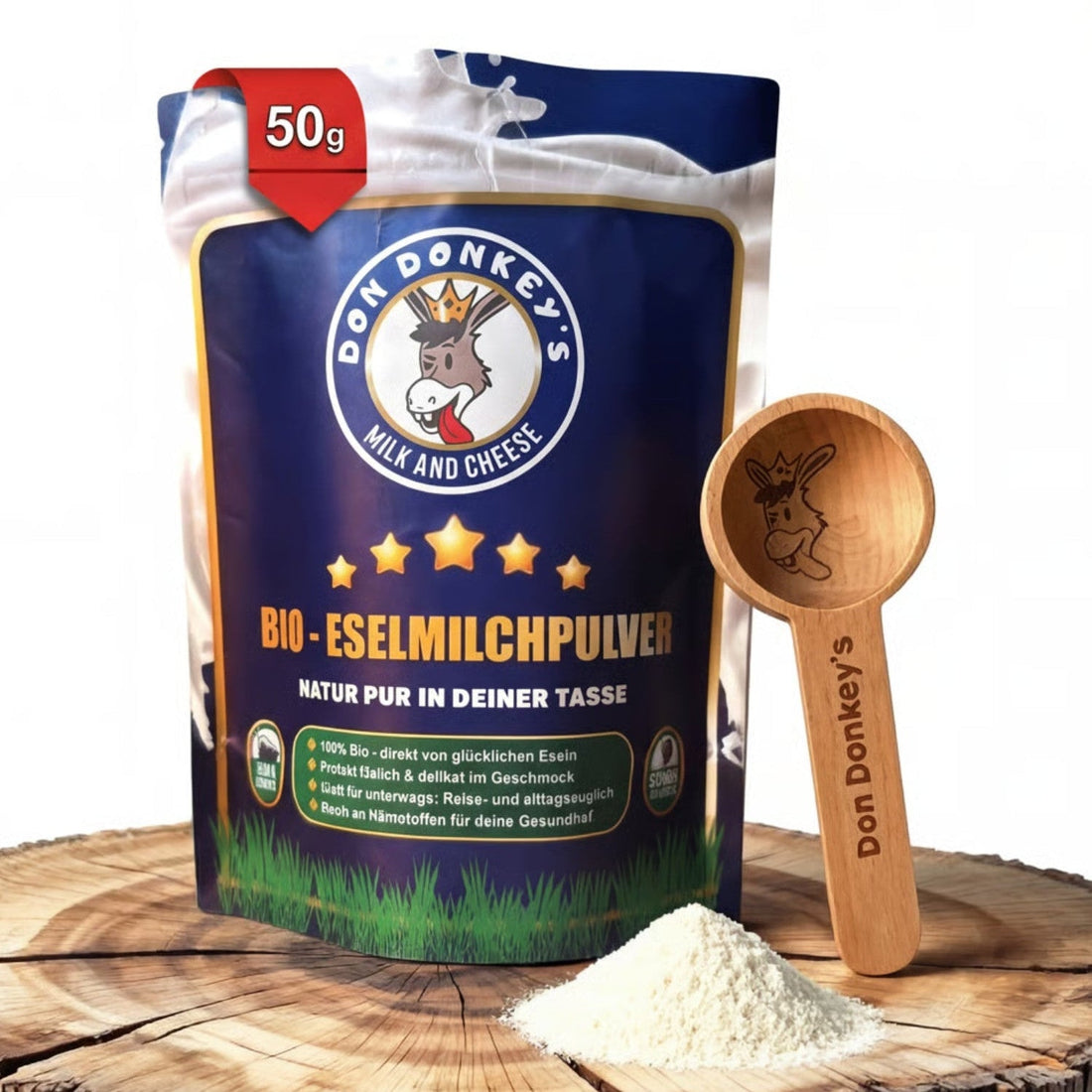
Donkey Milk Powder
Donkey milk in powder form
For anyone who prefers a longer shelf life: our donkey milk in powder form – easy to store and portion.
20g · Unit price: €1.245,00 / 1 kg · incl. VAT, plus shipping