
 Buyer protection

Donkey milk research · Study 152
Nordestino jennies in Brazil: milk yield and composition
According to the abstract, 14 jennies of the Nordestino ecotype from north-eastern Brazil produced an average of 5.0 kg of milk per day; the highest mean yield was around day 40 of lactation. There were no differences between first-time and multiparous animals in milk yield, pH, lactose, protein and fat; protein content fell over the course of lactation.
At a glance · swipe or use the arrows
The key figures
Study design
How it was studied
Observational study by research groups at the Federal University of Pernambuco Agreste and the Federal Rural University of Pernambuco (Brazil) on 14 jennies of the Nordestino ecotype in the semi-arid north-east. Design: split-split-plot with two groups (primiparous and multiparous), nine evaluation periods and measurements every two hours over the day. Milk yield was determined by weighing the foals before and after suckling; pH, lactose, protein and fat were also measured. Analysis used analysis of variance and principal component analysis over the first six months of lactation. Assessment based on the abstract: the full text was not available to the editorial team, so husbandry, feeding, analytical methods and individual composition values are missing.
Results
What the study measured
Colostrum: lactose differed significantly between evaluation days; the lowest concentration was found in colostrum.
From day 15: the pH of the milk was close to neutral.
Around day 40: this was when the highest mean milk yield occurred. Over the whole period, the jennies produced an average of 5.0 kg of milk per day.
Course of lactation: protein content fell progressively, and fat content behaved similarly. There was a negative correlation between pH and protein content (r = −56.92; P < 0.0001; notation as in the abstract).
Group comparison: primiparous and multiparous jennies did not differ in milk yield, time of day, pH, lactose, protein and fat (P > 0.05).
Authors’ conclusion: Jennies of the Nordestino ecotype produce an average of 5.0 kg of milk per day, and milk composition changes over the first six months of lactation. What the study does not show: it describes a single group in one region using foal weighing; the yield cannot be transferred to machine-milked milk from other breeds or husbandry systems.
Critical appraisal
Strengths and limitations
Small sampleClear limitation
14 jennies split into two groups. For the comparison of primiparous and multiparous animals, the number per group is small.
Foal weighing, not milkingNote
Milk yield was determined from the foals’ weight gain during suckling. This is not directly comparable with milking yields from dairy farms.
Unusual figureNote
The correlation coefficient is given as r = −56.92. The usual range is between −1 and 1; the notation cannot be clarified without the full text.
Only the abstract assessedNote
Concrete contents of lactose, protein and fat, feeding and husbandry are unknown.
Close-meshed measurementsStrength
Nine evaluation periods and measurements every two hours capture both the daily and lactation course in a population that has been little studied.
Editorial note: The paper provides baseline data on milk yield and composition in a regionally adapted donkey population in Brazil. It is a factual observation without any health angle. The daily yield refers to milk drunk by foals and should not be equated with milking yields on dairy farms. To the research archive.
Research question for DON DONKEY’S®
How much do protein and fat contents of our donkey milk vary between batches from different stages of lactation, and can the lactation stage be documented transparently for each batch?
Original publication
Production and composition of milk from female donkeys of the Nordestino Ecotype
Original title: Production and composition of milk from female donkeys of the Nordestino Ecotype
da Silva Dias W., Santiago J. M., da Silva A. H., de Souza Araujo Pinto D., da Silva A. R., de Melo Júnior E. F., da Silva K. M. L., Oliveira J. T. C., Bispo S. V., Lucena J. E. C.
Tropical Animal Health and Production · 2025 · 57(3), 143
Federal University of Pernambuco Agreste, Garanhuns, and Federal Rural University of Pernambuco, Serra Talhada, Brazil (according to author information)
DOI: 10.1007/s11250-025-04361-3
Transparency: according to the database entry, funded by the Coordenação de Aperfeiçoamento de Pessoal de Nível Superior (CAPES). Conflicts of interest could not be checked from the abstract. No product-related statement for DON DONKEY’S®.
Summarised and checked by the DON DONKEY’S editorial team against the original publication · As of: November 2026
The study summarised above was carried out independently of DON DONKEY’S® and does not relate to our products. It serves solely to inform about the state of research.
DON DONKEY’S® donkey milk and donkey milk powder are foods. They are not intended to prevent, treat or cure any disease and do not replace medical advice.

From our shop
DON DONKEY’S® donkey milk
100 % donkey milk · raw milk, frozen
On this page we report the findings of a published study. Independently of that, you will find our donkey milk here: 100 % donkey milk, frozen as raw milk.
100 ml bottle / 100ml · Unit price: €249,00 / 1 l · incl. VAT, plus shipping
Also in our shop
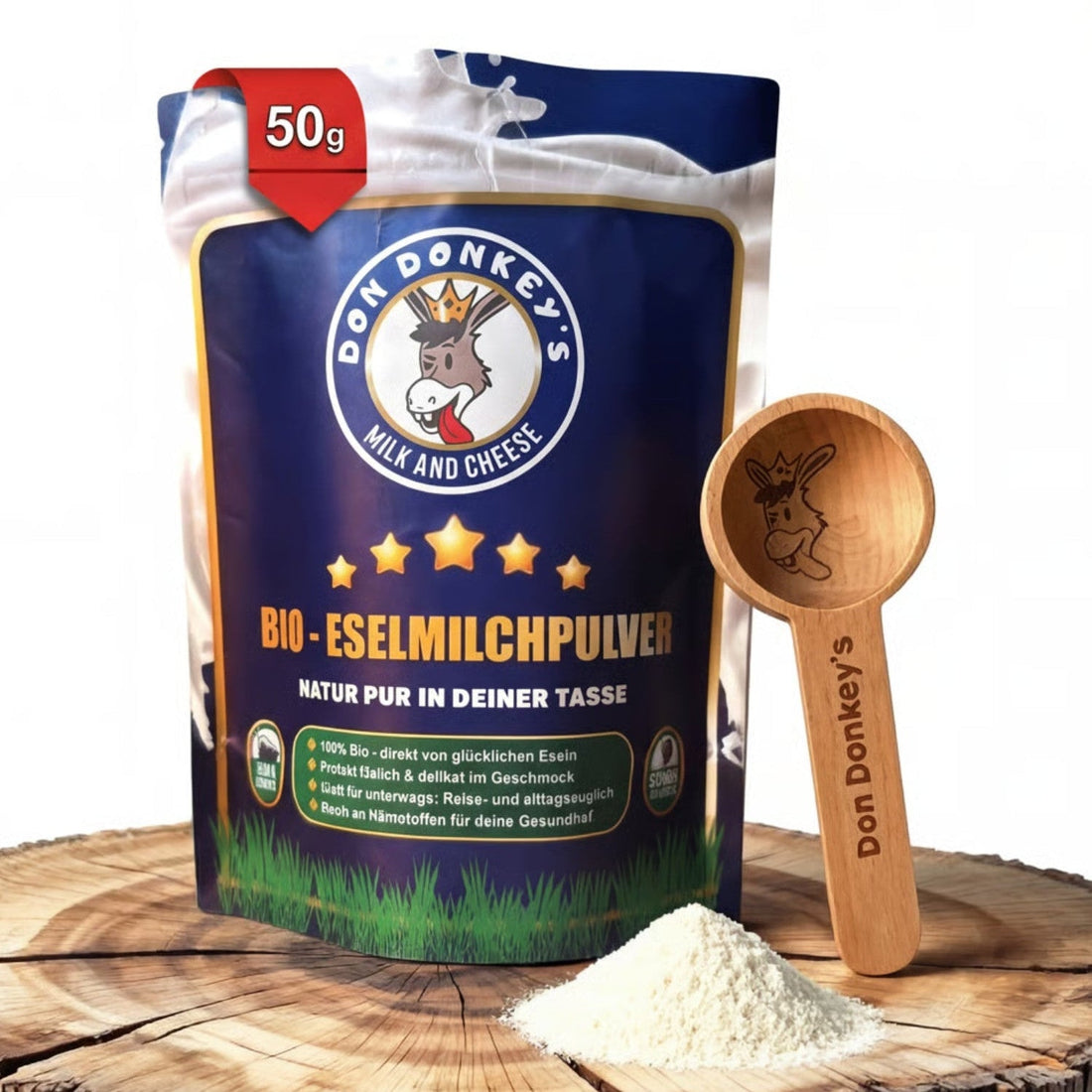
Donkey Milk Powder
Donkey milk in powder form
For anyone who prefers a longer shelf life: our donkey milk in powder form – easy to store and portion.
20g · Unit price: €1.245,00 / 1 kg · incl. VAT, plus shipping