
 Buyer protection

Donkey milk research · Study 151
Vitamins in human milk and donkey milk: a review
According to this review from Camerino, donkey milk contains 57 mg/L vitamin C, close to human milk (60 mg/L); thiamine, riboflavin, niacin, vitamin B6 and folic acid are above the values for human milk, for example niacin at 18.75 versus 4.64 µM. Vitamin E, at 5.2 µg/100 mL, is markedly lower than in human milk (237 µg/100 mL), and vitamins B12 and K were not detected in donkey milk.
At a glance · tap the cards
The key figures
Study design
How it was studied
Review by a research group at the School of Biosciences and Veterinary Medicine, University of Camerino (Italy). The authors compile published values for water- and fat-soluble vitamins in donkey, cow and human milk in tables and discuss them nutritionally. They also summarise clinical studies on the use of donkey milk in cow’s milk protein allergy and cite case reports of allergic reactions to donkey milk. There are no measurements of their own; a systematic literature search with defined criteria is not described. The full text was assessed; the table of clinical studies (Table 6) was not included in the material.
Interactive chart · values from the study
B vitamins in donkey, cow and human milk
Source: Table 4 of the review (compiled literature values, µM). Vitamin B12 not shown: listed as not detected in donkey and human milk.
Second analysis
Vitamin C in donkey, cow and human milk
Source: Table 4 of the review (literature value, mg/L).
Results
What the study measured
Vitamin C: for fresh donkey milk, the review gives 57 mg/L, for human milk 60 mg/L and for cow milk 27 mg/L.
B vitamins: according to Table 4, donkey milk is above the values for human milk for thiamine (0.66 µM), riboflavin (0.17 µM), niacin (18.75 µM), vitamin B6 (5.38 µM) and folic acid (0.83 µM). For riboflavin, cow milk is markedly higher at 2.12 µM.
Vitamin B12 was not detected in donkey milk. The authors explain this by the donkey’s digestion in the hindgut, whereas ruminants produce B12 in the rumen.
Fat-soluble vitamins: vitamin A, at 58 µg/100 mL, is close to human milk (60 µg). Vitamin D is given as 2.23 µg/100 mL, human milk as 0.06 µg; vitamin E, by contrast, as 5.2 versus 237 µg/100 mL. Vitamin K has never been detected in donkey milk.
The review cites two case reports of allergic reactions to donkey milk in adult women (aged 25 and 35) with known allergies, including one severe immediate reaction.
As a limit to wider use, the authors name the low production volume and high market price of donkey milk.
Authors’ conclusion: Donkey milk has nutritional properties comparable to human milk, and its vitamin content confirms a remarkable nutritional value; the authors consider it suitable for children with cow’s milk protein allergy and for older people and call for interdisciplinary clinical trials. What this review does not show: it compiles literature values and does not test suitability or any effect, and for several vitamins donkey milk is markedly below human milk.
Critical appraisal
Strengths and limitations
Narrative reviewClear limitation
A systematic search with inclusion and exclusion criteria is not described. The authors selected the included studies themselves.
Single values from few sourcesNote
The table values each come from individual cited papers, without ranges. According to the authors, feeding, breed and lactation stage strongly affect vitamin contents.
Inconsistencies in the tablesNote
In the text, fat-soluble vitamins are assigned partly to Table 4, partly to Table 5. Vitamin B12 is also listed as not detected for human milk, which needs explanation.
Assessments go beyond the dataClear limitation
Statements on suitability in allergies and for older people are the authors’ assessments. Content in milk says nothing about uptake or effect in the body.
Compact vitamin comparisonStrength
The paper sets out water- and fat-soluble vitamins of donkey, cow and human milk side by side and also names values where donkey milk is low.
Editorial note: The review is a useful reference for vitamin values in donkey milk but relies on single values from few sources without systematic selection. It shows a mixed picture: higher values for several B vitamins, similar ones for vitamins C and A, markedly lower ones for vitamin E. No conclusions on suitability for children or on health can be drawn from it. To the research archive.
Research question for DON DONKEY’S®
How high is the vitamin C content of our donkey milk straight after thawing and after several days of chilled storage – and how much of it is retained in donkey milk powder?
Original publication
Vitamins in Human and Donkey Milk: Functional and Nutritional Role
Original title: Vitamins in Human and Donkey Milk: Functional and Nutritional Role
Vincenzetti S., Santini G., Polzonetti V., Pucciarelli S., Klimanova Y., Polidori P.
Nutrients · 2021 · 13(5), 1509
School of Biosciences and Veterinary Medicine, University of Camerino, Italy (according to the paper)
DOI: 10.3390/nu13051509
Transparency: funding and conflicts of interest are not included in the available material. No product-related statement for DON DONKEY’S®.
Summarised and checked by the DON DONKEY’S editorial team against the original publication · As of: November 2026
The study summarised above was carried out independently of DON DONKEY’S® and does not relate to our products. It serves solely to inform about the state of research.
DON DONKEY’S® donkey milk and donkey milk powder are foods. They are not intended to prevent, treat or cure any disease and do not replace medical advice.

From our shop
DON DONKEY’S® donkey milk
100 % donkey milk · raw milk, frozen
On this page we report the findings of a published study. Independently of that, you will find our donkey milk here: 100 % donkey milk, frozen as raw milk.
100 ml bottle / 100ml · Unit price: €249,00 / 1 l · incl. VAT, plus shipping
Also in our shop
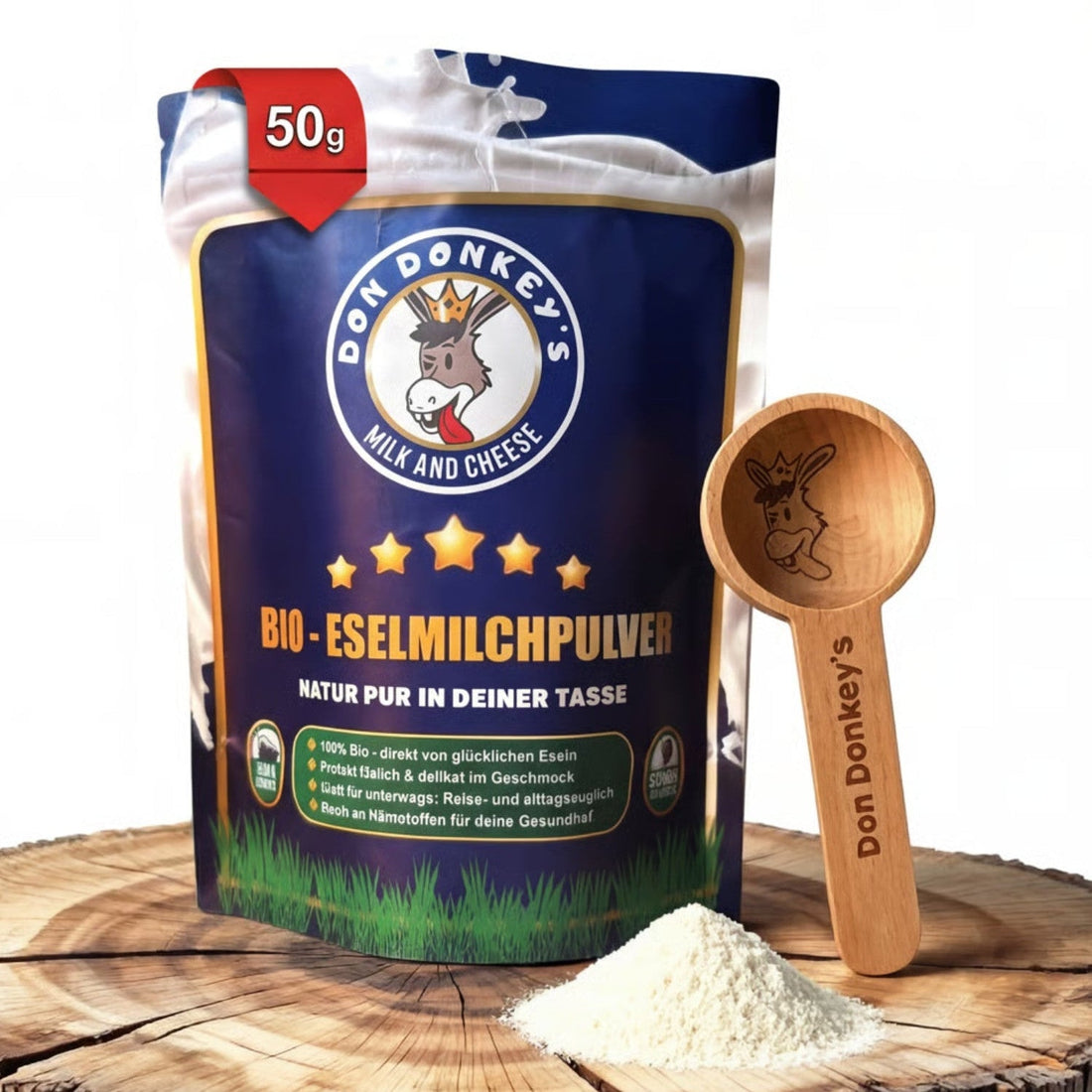
Donkey Milk Powder
Donkey milk in powder form
For anyone who prefers a longer shelf life: our donkey milk in powder form – easy to store and portion.
20g · Unit price: €1.245,00 / 1 kg · incl. VAT, plus shipping