
 Buyer protection

Donkey milk research · Study 149
Cow milk and donkey milk: polar lipids compared
Using lipidomics, a research group from Shanghai and Shenyang identified 206 polar lipid species from 11 subclasses in cow and donkey milk. 150 of them differed significantly between the two milks; they were mapped to 6 metabolic pathways, including linoleic acid and sphingolipid metabolism.
At a glance · tap the cards
The key figures
Study design
How it was studied
Milk analysis by a research group at the State Key Laboratory of Dairy Biotechnology (Shanghai) and Shenyang Agricultural University (China): polar lipids in cow and donkey milk were profiled and compared using lipidomics (according to the keywords, UHPLC-QTRAP-MS). Significantly different lipids were selected and mapped to metabolic pathways. Assessment based on the abstract: the full text was not available to the editorial team, so sample numbers, origin, breed, lactation stage and concentrations are missing.
Results
What the study measured
In cow and donkey milk combined, 206 polar lipid species from 11 subclasses were identified.
150 of these lipids differed significantly between cow and donkey milk. The abstract does not state which lipids were higher in which milk.
The differing lipids were mapped to 6 metabolic pathways: linoleic acid, sphingolipid, α-linolenic acid, glycerophospholipid and arachidonic acid metabolism, and GPI anchor biosynthesis.
According to the authors’ introduction, donkey milk has a relatively low lipid content and differs markedly from cow milk in lipid composition. The abstract gives no concrete contents.
Authors’ conclusion: The findings offer a theoretical foundation for future optimisation of lipid composition in infant formula and for evaluating the nutritional value of dairy products. What the study does not show: it measured which lipids occur; it says nothing about their uptake or significance for children.
Critical appraisal
Strengths and limitations
Only composition measuredClear limitation
The study describes differences in the lipid profile. No effect or nutritional benefit was studied.
Pathways are a mappingNote
The 6 pathways come from a database comparison. They show where such lipids occur biochemically, not what they do in the body.
Only the abstract assessedNote
Numbers of animals and samples, origin, feeding and concentrations are unknown. Whether the samples are representative cannot be judged.
Outlook on infant formulaClear limitation
The reference to infant formula is the authors’ perspective and goes beyond the measurements.
Broad lipidomics analysisStrength
With 206 lipid species from 11 subclasses, the study covers the polar lipid profile very broadly and compares both milks with the same method.
Editorial note: The paper provides a detailed inventory of polar lipids in cow and donkey milk. It shows differences in composition without giving amounts or sample size in the abstract. No conclusions on health or suitability for particular groups can be drawn from it. To the research archive.
Research question for DON DONKEY’S®
How stable is the polar lipid profile of our donkey milk across several batches, and does it change measurably through freezing or drying to powder?
Original publication
Comprehensive characterization and comparison of polar lipids in bovine and donkey Milk based on Lipidomics
Original title: Comprehensive characterization and comparison of polar lipids in bovine and donkey Milk based on Lipidomics
Chen J., Zhang Y., Liu Z., Wang J., Zhang S., Shao J., Yue X., Li M.
Food Chemistry · 2025 · 496(Pt 2), 146801
State Key Laboratory of Dairy Biotechnology, Shanghai, and College of Food Science, Shenyang Agricultural University, China (according to author information)
DOI: 10.1016/j.foodchem.2025.146801
Transparency: according to the database entry, funded among others by Shenyang Agricultural University and the Liaoning Provincial Natural Science Foundation. Conflicts of interest could not be checked from the abstract. No product-related statement for DON DONKEY’S®.
Summarised and checked by the DON DONKEY’S editorial team against the original publication · As of: November 2026
The study summarised above was carried out independently of DON DONKEY’S® and does not relate to our products. It serves solely to inform about the state of research.
DON DONKEY’S® donkey milk and donkey milk powder are foods. They are not intended to prevent, treat or cure any disease and do not replace medical advice.

From our shop
DON DONKEY’S® donkey milk
100 % donkey milk · raw milk, frozen
On this page we report the findings of a published study. Independently of that, you will find our donkey milk here: 100 % donkey milk, frozen as raw milk.
100 ml bottle / 100ml · Unit price: €249,00 / 1 l · incl. VAT, plus shipping
Also in our shop
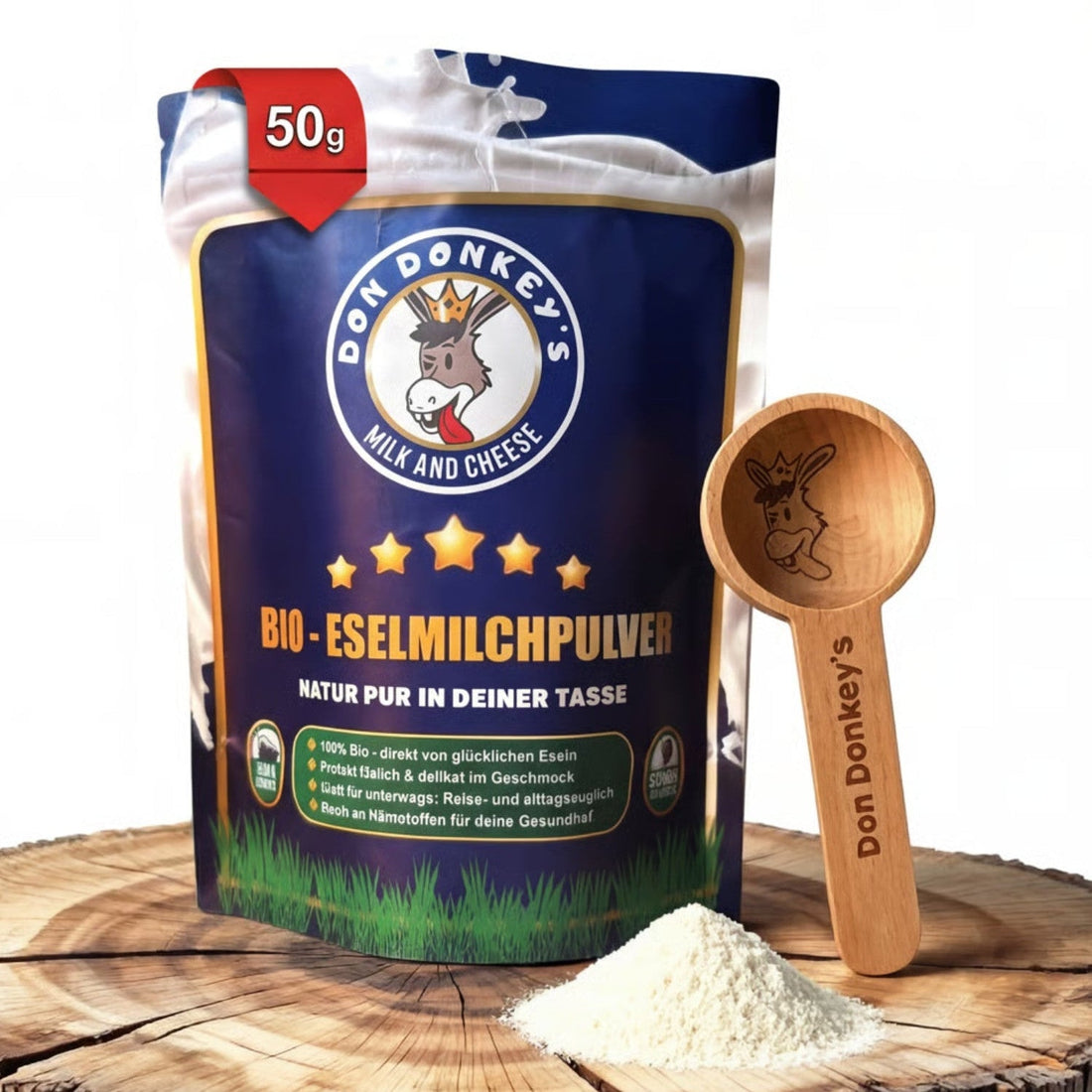
Donkey Milk Powder
Donkey milk in powder form
For anyone who prefers a longer shelf life: our donkey milk in powder form – easy to store and portion.
20g · Unit price: €1.245,00 / 1 kg · incl. VAT, plus shipping