
 Buyer protection

Donkey milk research · Study 147
Human milk fortifiers in the lab: how protein and fat break down in a digestion model
In a digestion model for preterm infants, protein in human milk with a cow milk-based fortifier was 30 % hydrolysed before digestion, with a donkey milk-based fortifier 11 %. After digestion, proteolysis was similar in both at 33 %, lipolysis at 54 %; the donkey milk fortifier gave a lower ratio of ω6 to ω3 fatty acids.
At a glance · swipe or use the arrows
The key figures
Study design
How it was studied
Laboratory study by INRAE and Institut Agro in Rennes (France) with Italian institutions, including CNR in Grugliasco and the neonatal unit in Turin. Human milk was fortified either with an experimental donkey milk-derived fortifier or with a commercial cow milk-derived fortifier and digested in a dynamic in vitro digestion system set to the digestion of preterm infants. Particle size and structure, protein breakdown (proteolysis), fat breakdown (lipolysis) and free polyunsaturated fatty acids were measured. Assessed based on the abstract: number of digestion runs, origin of the human milk and composition of the fortifiers are not reported there.
Results
What the study measured
In the gastric phase, particles were larger with the donkey milk fortifier than with the cow milk fortifier. The authors attribute this to protein aggregates surrounding the fat globules.
Before digestion, protein with the cow milk fortifier was 30 % hydrolysed, with the donkey milk fortifier 11 %. The cow milk product contains extensively hydrolysed proteins, the donkey milk product intact proteins.
After digestion this difference was smaller: net proteolysis was similar in both variants at 33 %.
The donkey milk fortifier contained a higher proportion of ω3 fatty acids and gave a lower ratio of free ω6 to ω3 fatty acids throughout digestion.
Lipolysis at the end of digestion was similar in both variants at 54 %.
Authors’ conclusion: The authors write that the donkey milk fortifier could represent a “better source” of protein and lipids for preterm infants. We do not adopt this assessment: an artificial digestion model was measured, not tolerance or growth in infants. Donkey milk is not a substitute for breast milk or infant formula; infant feeding belongs in medical hands.
Critical appraisal
Strengths and limitations
Digestion model, not infantsClear limitation
A dynamic in vitro system mimics parts of digestion, but not absorption into the body, metabolism or tolerance.
Conclusion goes beyond the dataClear limitation
The rating as a “better source” rests on lab measurements. Protein and fat breakdown after digestion were similar in both variants.
Only the abstract assessedNote
Number of runs, variability, fortifier composition and origin of the human milk are unknown.
Possible conflicts of interestNote
According to the 2018 trial protocol, three co-authors are inventors of a patent on a donkey milk fortifier. This paper’s declarations could not be checked from the abstract.
Controlled direct comparisonStrength
Both fortifiers were digested with the same human milk in the same model, so differences can be attributed to the fortifier.
Editorial note: The paper compares under laboratory conditions how two fortifiers in human milk are broken down. It provides basic knowledge for neonatal care but no statement about donkey milk as a food. Donkey milk is not a substitute for breast milk or infant formula; infant feeding belongs in medical hands. To the research archive.
Research question for DON DONKEY’S®
How do the fat globules and protein structure of our donkey milk change on thawing, measured by particle size before and after thawing the same batch?
Original publication
Supplementing human milk with a donkey or bovine milk derived fortifier: Consequences on proteolysis, lipolysis and particle structure under in vitro dynamic digestion.
Original title: Supplementing human milk with a donkey or bovine milk derived fortifier: Consequences on proteolysis, lipolysis and particle structure under in vitro dynamic digestion.
Nebbia S., Deglaire A., Ménard O., Henry G., Barberis E., Manfredi M., Bertino E., Coscia A., Dupont D., Giribaldi M., Cavallarin L.
Food Chemistry · 2022 · 395, 133579
STLO, INRAE, Institut Agro, Rennes, France, and CNR Institute of Sciences of Food Production, Grugliasco, Italy (according to the authors’ details)
DOI: 10.1016/j.foodchem.2022.133579
Transparency: funding and conflicts of interest could not be checked from the abstract. According to the 2018 trial protocol, three co-authors are inventors of a patent on a donkey milk fortifier. No product-related statement for DON DONKEY’S®.
Summarised and checked by the DON DONKEY’S editorial team against the original publication · As of: November 2026
The study summarised above was carried out independently of DON DONKEY’S® and does not relate to our products. It serves solely to inform about the state of research.
DON DONKEY’S® donkey milk and donkey milk powder are foods. They are not intended to prevent, treat or cure any disease and do not replace medical advice.

From our shop
DON DONKEY’S® donkey milk
100 % donkey milk · raw milk, frozen
On this page we report the findings of a published study. Independently of that, you will find our donkey milk here: 100 % donkey milk, frozen as raw milk.
100 ml bottle / 100ml · Unit price: €249,00 / 1 l · incl. VAT, plus shipping
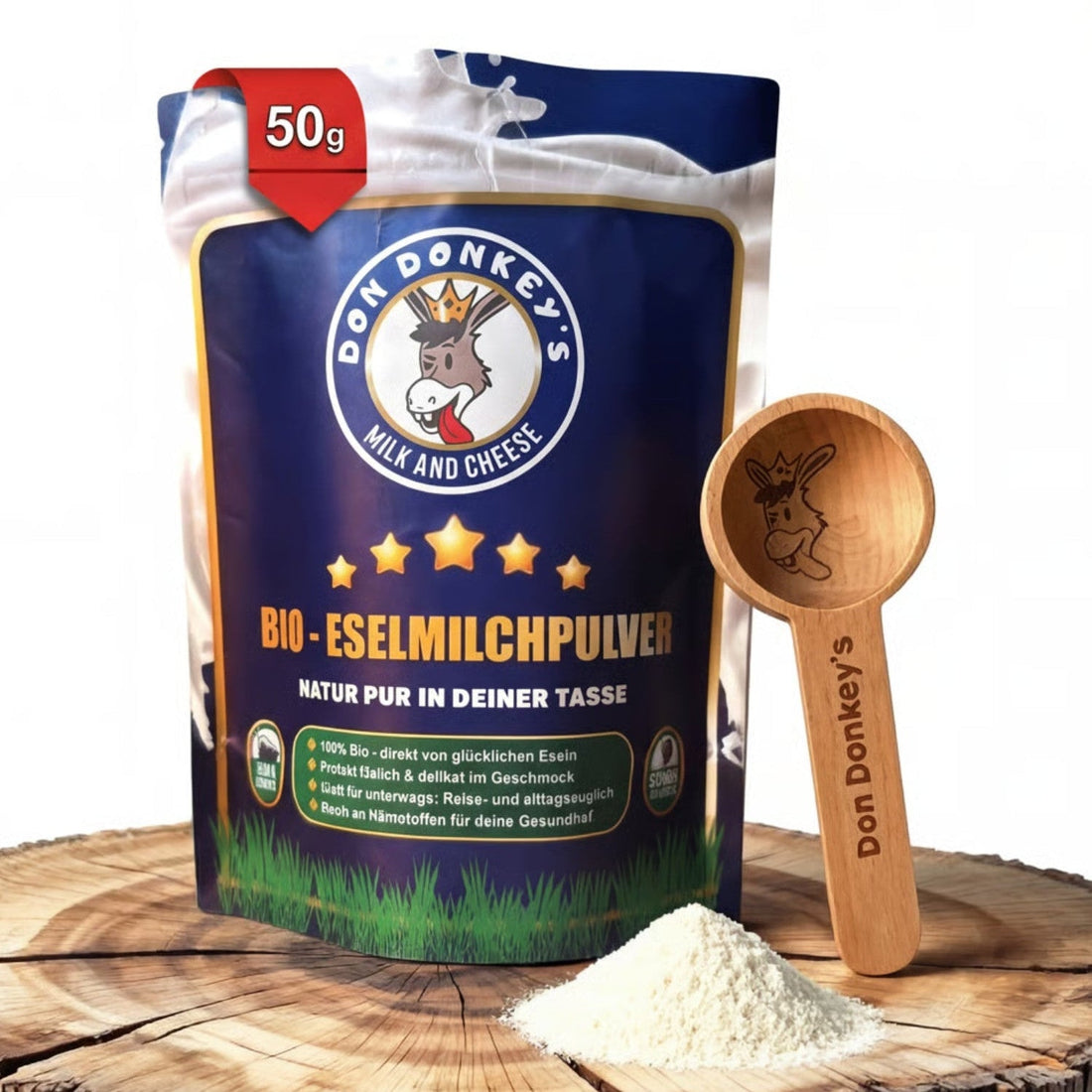
Also in our shop
Donkey Milk Powder
Donkey milk in powder form
For anyone who prefers a longer shelf life: our donkey milk in powder form – easy to store and portion.
20g · Unit price: €1.245,00 / 1 kg · incl. VAT, plus shipping