
 Buyer protection

Donkey milk research · Study 145
A donkey milk fortifier for preterm infants: the plan of a clinical trial
The trial protocol from Turin describes how preterm infants under 32 weeks of gestation or under 1500 g birth weight receive human milk with a donkey milk-based or a cow milk-based fortifier for at least 21 days. 62 infants per group are planned; the primary outcome is at least one interruption of tube feeding lasting 8 hours or more.
At a glance · swipe or use the arrows
The key figures
Study design
How it was studied
Protocol of a randomised, controlled, single-blind trial at the neonatal unit of the University of Turin (Italy). Preterm infants with a gestational age under 32 weeks or a birth weight under 1500 g who receive exclusively their mother’s or donor milk (more than 80 ml/kg/day within the first 4 weeks) are enrolled. They are allocated 1:1 to a group with a multi-component fortifier and protein concentrate based on cow’s milk (commercial) or on donkey milk (not commercially available), each for at least 21 days, with individual adjustment according to blood urea nitrogen (BUN). The donkey milk products were made by ultrafiltration of pasteurised donkey milk, re-pasteurisation and freeze-drying, and stored at −80 °C. The primary outcome is at least one interruption of tube feeding lasting 8 hours or more; further outcomes include gastric emptying, reflux monitoring, clinical events, laboratory values and growth up to 18 months corrected age. The full text was assessed.
Interactive chart · values from the study
Multi-component fortifier: composition per 100 g of powder
Source: Table 1 of the study (Coscia et al., 2018), values per 100 g of product.
Second analysis
Calcium and phosphate in the fortifiers
Source: Tables 1 and 2 of the study (Coscia et al., 2018), values per 100 g of product.
Results
What the study measured
The paper is a trial protocol and contains no results. It sets out what is to be measured: the primary outcome is the proportion of infants with at least one interruption of tube feeding lasting 8 hours or more.
For the sample size, the authors assume 45 % of infants affected so far and a reduction of 25 %. With a 5 % error risk and 80 % power, this gives 62 infants per group.
Per 100 g, the donkey milk-based multi-component fortifier contains 22.5 g protein, 59.0 g lactose, no maltodextrin and 3.6 g fat; the cow milk product contains 20.0 g protein, 6.0 g lactose, 60.0 g maltodextrin and 0.4 g fat.
The donkey milk-based protein concentrate contains 43 g protein per 100 g, the cow milk-based one 88.5 g. Different amounts of powder are therefore used depending on the product to reach the same fortification level.
Fortification is adjusted weekly according to blood urea nitrogen: below 10 mg/dl one level up, 10 to 16 mg/dl unchanged, above 16 mg/dl one level down.
Growth is recorded up to 18 months corrected age. The authors expect around 100 eligible infants per year; in 2014 the unit admitted 115 preterm infants under 32 weeks and under 1500 g.
Authors’ conclusion: The authors describe the trial as the first to test a donkey milk-derived fortifier in preterm infants and see a possible innovation if tolerance or other outcomes prove more favourable. As this is a protocol, the paper itself does not yet show any difference between the fortifiers. Donkey milk is not a substitute for breast milk or infant formula; infant feeding belongs in medical hands.
Critical appraisal
Strengths and limitations
Protocol without resultsClear limitation
The paper only describes the plan of the trial. Whether the groups differ cannot be read from it.
Conflict of interest through a patentClear limitation
According to the declaration, four authors are inventors of a patent on the described donkey milk fortifier.
Single-blind onlyNote
Nursing staff know the group allocation and also assess signs of intolerance. The authors themselves name this as a possible weakness.
Special product, not a retail foodNote
The fortifiers were specially produced as foods for special medical purposes. No conclusions about commercially available donkey milk are possible.
Registered, pre-specified designStrength
Randomisation, primary outcome, sample size and intention-to-treat analysis are pre-specified and entered in the registry under ISRCTN70022881.
Editorial note: The protocol is carefully structured and discloses its primary outcome and sample size. It concerns a clinically produced special product for neonatal care, not donkey milk as a food. Donkey milk is not a substitute for breast milk or infant formula; infant feeding belongs in medical hands. To the research archive.
Research question for DON DONKEY’S®
How do the protein and lactose content of our donkey milk change when it is kept chilled after thawing, measured at several time points from the same batch?
Original publication
Nutritional adequacy of a novel human milk fortifier from donkey milk in feeding preterm infants: study protocol of a randomized controlled clinical trial.
Original title: Nutritional adequacy of a novel human milk fortifier from donkey milk in feeding preterm infants: study protocol of a randomized controlled clinical trial.
Coscia A., Bertino E., Tonetto P., Peila C., Cresi F., Arslanoglu S., Moro G. E., Spada E., Milani S., Giribaldi M., Antoniazzi S., Conti A., Cavallarin L.
Nutrition Journal · 2018 · 17(1), 6
Neonatal Unit, University of Turin, City of Health and Science of Turin, Italy (according to the paper)
DOI: 10.1186/s12937-017-0308-8
Transparency: funded by Compagnia di San Paolo and the Piedmont Region (“Poli di Innovazione” programme, Por-Fesr 2007–2013). Four authors are inventors of a patent on the donkey milk fortifier; the others declare no conflicts of interest. No product-related statement for DON DONKEY’S®.
Summarised and checked by the DON DONKEY’S editorial team against the original publication · As of: November 2026
The study summarised above was carried out independently of DON DONKEY’S® and does not relate to our products. It serves solely to inform about the state of research.
DON DONKEY’S® donkey milk and donkey milk powder are foods. They are not intended to prevent, treat or cure any disease and do not replace medical advice.

From our shop
DON DONKEY’S® donkey milk
100 % donkey milk · raw milk, frozen
On this page we report the findings of a published study. Independently of that, you will find our donkey milk here: 100 % donkey milk, frozen as raw milk.
100 ml bottle / 100ml · Unit price: €249,00 / 1 l · incl. VAT, plus shipping
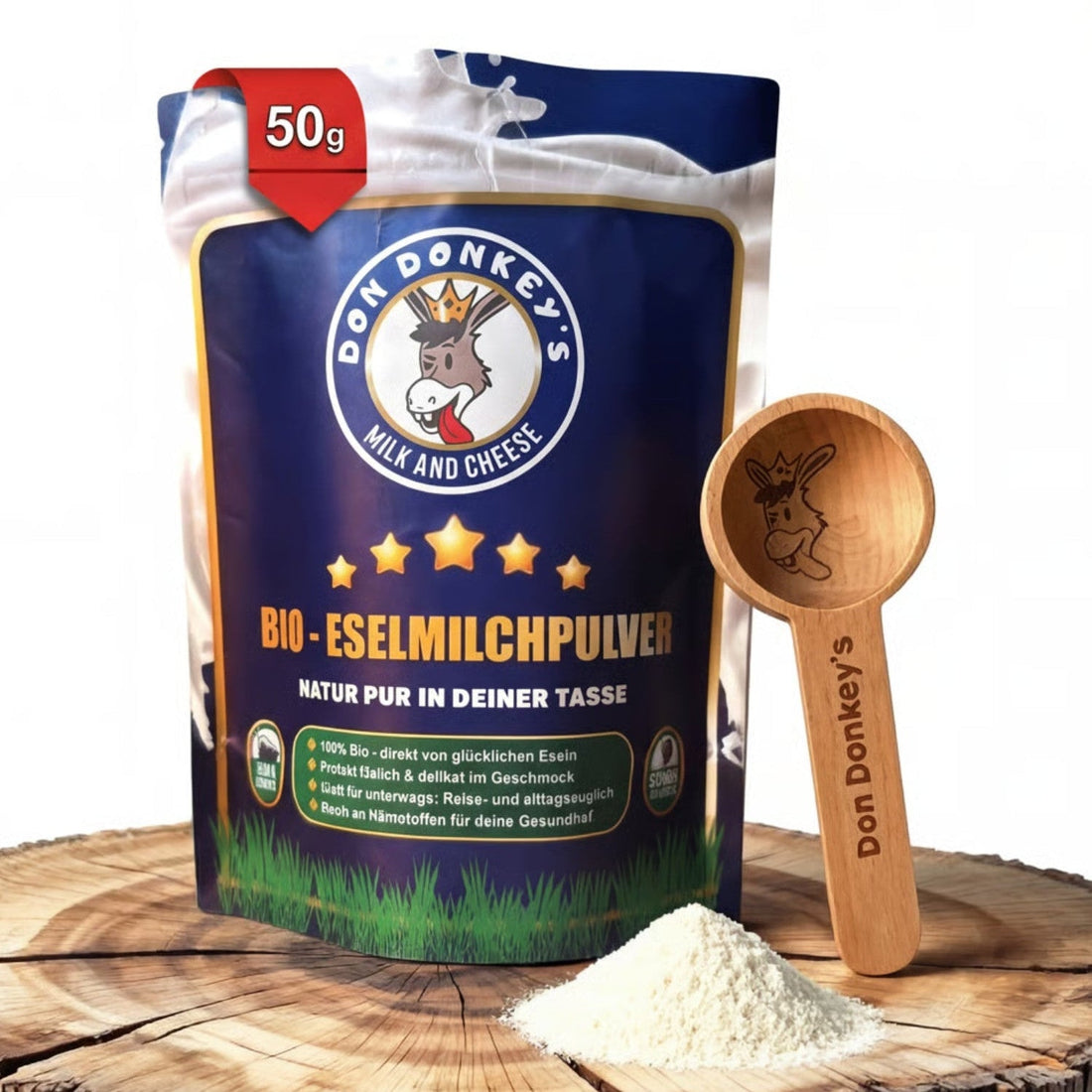
Also in our shop
Donkey Milk Powder
Donkey milk in powder form
For anyone who prefers a longer shelf life: our donkey milk in powder form – easy to store and portion.
20g · Unit price: €1.245,00 / 1 kg · incl. VAT, plus shipping