
 Buyer protection

Donkey milk research · Study 143
Donkey colostrum and milk: measurements in a mouse tumour model
The authors found a total of 476 possible metabolites in donkey colostrum and mature milk, 34 of which differed between the two samples. In mice implanted with 4T1 tumour cells, they report smaller primary tumours and lower relative liver and lung weights after colostrum or milk, with no change in body weight.
At a glance · swipe or use the arrows
The key figures
Study design
How it was studied
Animal study by a research group at Shenyang Agricultural University (China): first, donkey colostrum and mature milk were compared by metabolomics. Mice with tumours from the mouse cell line 4T1 (a model for triple-negative breast tumours) then received colostrum or milk. Primary tumour volume, relative liver and lung weight as an indirect indication of spread, body weight and, by immunohistochemistry, the proteins cleaved caspase-3, Bax, MMP2 and CD31 in tumour tissue were measured. Assessed based on the abstract: animal numbers, dose, route of administration, duration and figures are not reported there.
Results
What the study measured
Metabolomics revealed 476 possible metabolites in both types of milk. 34 differed: 25 were higher and 9 lower in colostrum than in mature milk.
The authors report that both samples contain known constituents that the literature links to tumour research; the abstract does not list them individually.
In mice with 4T1 tumours, primary tumour volume was significantly smaller after colostrum or milk, according to the abstract.
Relative liver and lung weights were also lower; the animals’ body weight did not change.
In tumour tissue, the authors found more cleaved caspase-3 and Bax, two markers of programmed cell death, and less MMP2 and of the vessel marker CD31.
Authors’ conclusion: The authors conclude that donkey colostrum and milk inhibit the growth and metastasis of 4T1 tumours in mice by inducing apoptosis. This describes a mouse model with a tumour cell line; the paper says nothing about preventing or treating cancer in humans.
Critical appraisal
Strengths and limitations
Mouse model, not humansClear limitation
Implanted 4T1 cells in mice are a laboratory model. Results from such models cannot be transferred to cancer in humans.
Title goes beyond the dataClear limitation
The title speaks of inhibiting tumour progression. According to the abstract, metastasis was assessed indirectly via organ weights, not counted directly.
Only the abstract assessedNote
Animal numbers, dose, route and duration of administration, control groups and measured values are unknown.
Evaluative introductionNote
The abstract opens with general assessments of donkey milk that were not examined in the study itself. We do not adopt them.
Milk analysis and animal experiment combinedStrength
The paper characterises the samples chemically and compares colostrum with mature milk before presenting measurements in the animal model.
Editorial note: The study provides a metabolomic analysis of donkey colostrum and mature milk and measurements in a tumour model in mice. It is basic research and allows no statement about cancer in humans; questions about diet in cancer belong in medical hands. To the research archive.
Research question for DON DONKEY’S®
Do the metabolite profiles of our donkey milk batches differ by stage of lactation, and do they remain comparable after freezing and thawing?
Original publication
Donkey milk inhibits triple-negative breast tumor progression and is associated with increased cleaved-caspase-3 expression.
Original title: Donkey milk inhibits triple-negative breast tumor progression and is associated with increased cleaved-caspase-3 expression.
Li Q., Li M., Zhang J., Shi X., Yang M., Zheng Y., Cao X., Yue X., Ma S.
Food & Function · 2020 · 11(4), 3053–3065
College of Food Science and College of Bioscience and Biotechnology, Shenyang Agricultural University, China (according to the authors’ details)
DOI: 10.1039/c9fo02934f
Transparency: according to the database entry, funded by the National Basic Research Program of China. Conflicts of interest could not be checked from the abstract. No product-related statement for DON DONKEY’S®.
Summarised and checked by the DON DONKEY’S editorial team against the original publication · As of: November 2026
The study summarised above was carried out independently of DON DONKEY’S® and does not relate to our products. It serves solely to inform about the state of research.
DON DONKEY’S® donkey milk and donkey milk powder are foods. They are not intended to prevent, treat or cure any disease and do not replace medical advice.

From our shop
DON DONKEY’S® donkey milk
100 % donkey milk · raw milk, frozen
On this page we report the findings of a published study. Independently of that, you will find our donkey milk here: 100 % donkey milk, frozen as raw milk.
100 ml bottle / 100ml · Unit price: €249,00 / 1 l · incl. VAT, plus shipping
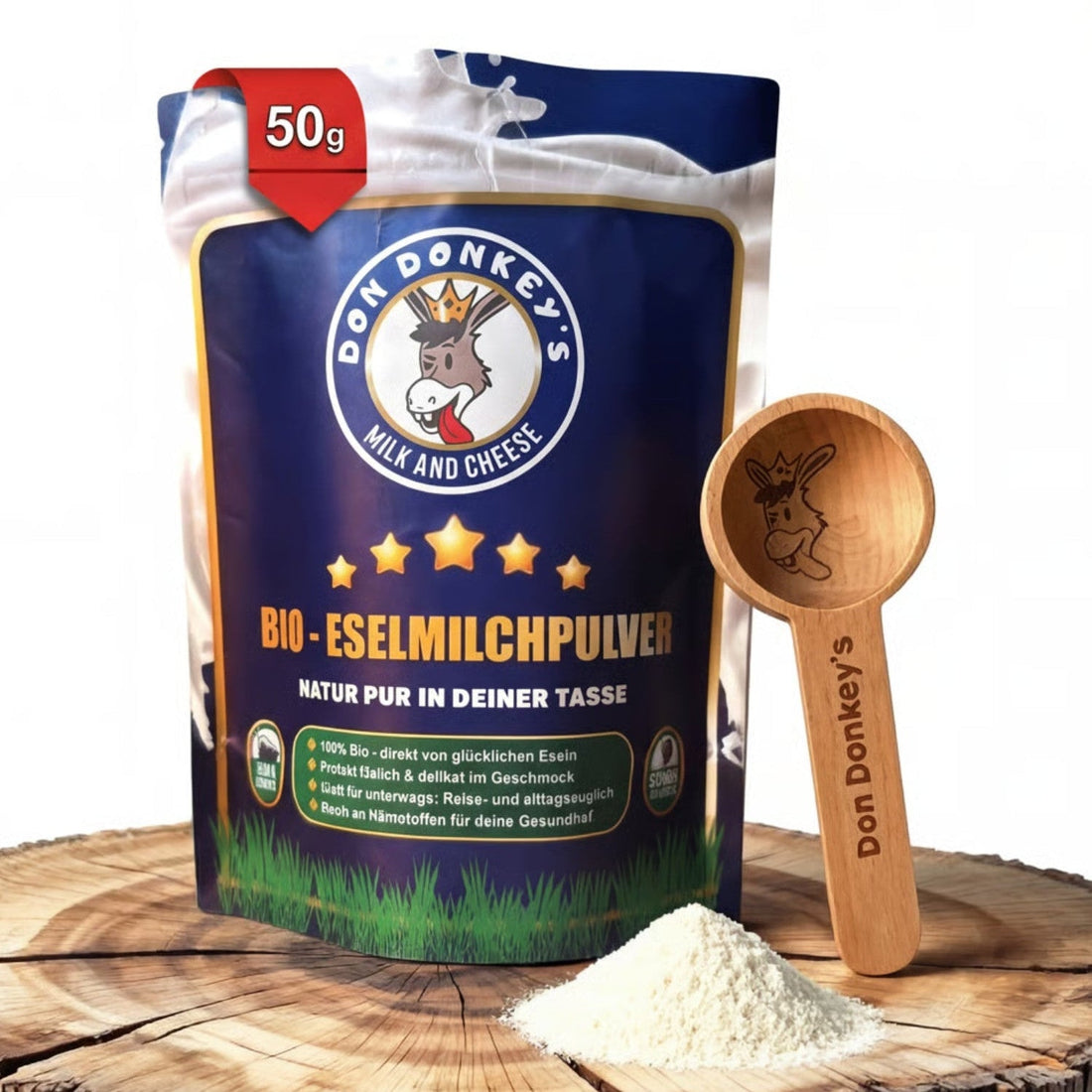
Also in our shop
Donkey Milk Powder
Donkey milk in powder form
For anyone who prefers a longer shelf life: our donkey milk in powder form – easy to store and portion.
20g · Unit price: €1.245,00 / 1 kg · incl. VAT, plus shipping