
 Buyer protection

Donkey milk research · Study 142
Donkey milk in mice: behavioural tests, oxidation markers and melatonin
Male mice received 4 g of donkey milk per kg body weight for 18 days. In the plus maze, the authors report a pattern similar to that of the reference drug diazepam; there were no significant differences in locomotion, coordination or the swim test. In the brain, the authors report less oxidative damage to lipids, and in blood plasma more melatonin.
At a glance · tap the cards
The key figures
Study design
How it was studied
Animal study by research groups at the Federal Universities of Paraíba and Rio Grande do Norte (Brazil): male mice received donkey milk orally (4 g/kg body weight) or a vehicle for 18 days. Single doses of diazepam (1.5 mg/kg orally), fluoxetine and nortriptyline (20 mg/kg each, intraperitoneally) served as positive controls. Behaviour was assessed in the elevated plus maze, the open field, on the rotarod and in the forced swim test. On day 18, oxidative damage to lipids and proteins in the brain and plasma melatonin were measured. Assessed based on the abstract: animal numbers, form of the donkey milk and figures are not reported there.
Results
What the study measured
In the elevated plus maze, repeated donkey milk feeding changed exploratory behaviour in a similar way to diazepam, according to the abstract. The abstract phrases this as reduced exploration of the open arms; this does not match the usual interpretation of the test and cannot be clarified without the full text.
For locomotion (open field), coordination (rotarod) and immobility in the swim test, the authors found no significant differences with donkey milk.
The reference substances fluoxetine and nortriptyline shortened immobility in the swim test; diazepam impaired the mice’s coordination.
In brain tissue, the authors report less oxidative damage to lipids after donkey milk. For proteins, the abstract mentions no difference.
Plasma melatonin levels were higher after repeated donkey milk feeding.
Authors’ conclusion: The authors consider donkey milk a “promising food” in the context of anxiety-related disorders, without depressant effects on the central nervous system. This conclusion goes far beyond the measurements: the behaviour of healthy male mice in laboratory tests was measured, not a disease and not humans.
Critical appraisal
Strengths and limitations
Mouse experiment, not humansClear limitation
Behavioural tests in mice are models. They allow no conclusions about anxiety, mood or mental illness in humans.
Title and conclusion go beyond the dataClear limitation
The title speaks of reduced anxiety-like behaviour, the conclusion of a food for anxiety disorders. Healthy animals were studied in laboratory tests.
Contradictory wordingNote
For the plus maze, the abstract describes reduced exploration of the open arms. More exploration is usually read as less anxiety-like behaviour; this cannot be checked without the full text.
Only the abstract assessedNote
Animal numbers, form of the donkey milk, type of vehicle and all measured values are unknown. Only male mice were studied.
Positive controls includedStrength
Diazepam, fluoxetine and nortriptyline were run as reference substances, showing how sensitive the tests were.
Editorial note: The study describes behaviour, oxidation markers and melatonin in mice after 18 days of donkey milk. It is basic research in animals; nothing can be inferred about anxiety, sleep or well-being in humans. To the research archive.
Research question for DON DONKEY’S®
How does the melatonin content of our donkey milk vary with milking time, and does it remain measurably stable through freezing and thawing?
Original publication
Repeated donkey milk consumption reduces anxiety-like behaviors and brain oxidative damage to lipids in mice.
Original title: Repeated donkey milk consumption reduces anxiety-like behaviors and brain oxidative damage to lipids in mice.
de Oliveira Moura Araújo E., Gavioli E. C., Holanda V. A. D., da Silva V. C., Oliveira Nunes Messias T. B., Dutra L. M. G., de Oliveira M. C., Ramos do Egypto Queiroga R. C., Guerra G. C. B., Soares J. K. B.
Behavioural Brain Research · 2023 · 449, 114477
Department of Food Engineering, Federal University of Paraíba, and Department of Biophysics and Pharmacology, Federal University of Rio Grande do Norte, Brazil (according to the authors’ details)
DOI: 10.1016/j.bbr.2023.114477
Transparency: according to the database entry, funded by the Coordenação de Aperfeiçoamento de Pessoal de Nível Superior (CAPES). Conflicts of interest could not be checked from the abstract. No product-related statement for DON DONKEY’S®.
Summarised and checked by the DON DONKEY’S editorial team against the original publication · As of: November 2026
The study summarised above was carried out independently of DON DONKEY’S® and does not relate to our products. It serves solely to inform about the state of research.
DON DONKEY’S® donkey milk and donkey milk powder are foods. They are not intended to prevent, treat or cure any disease and do not replace medical advice.

From our shop
DON DONKEY’S® donkey milk
100 % donkey milk · raw milk, frozen
On this page we report the findings of a published study. Independently of that, you will find our donkey milk here: 100 % donkey milk, frozen as raw milk.
100 ml bottle / 100ml · Unit price: €249,00 / 1 l · incl. VAT, plus shipping
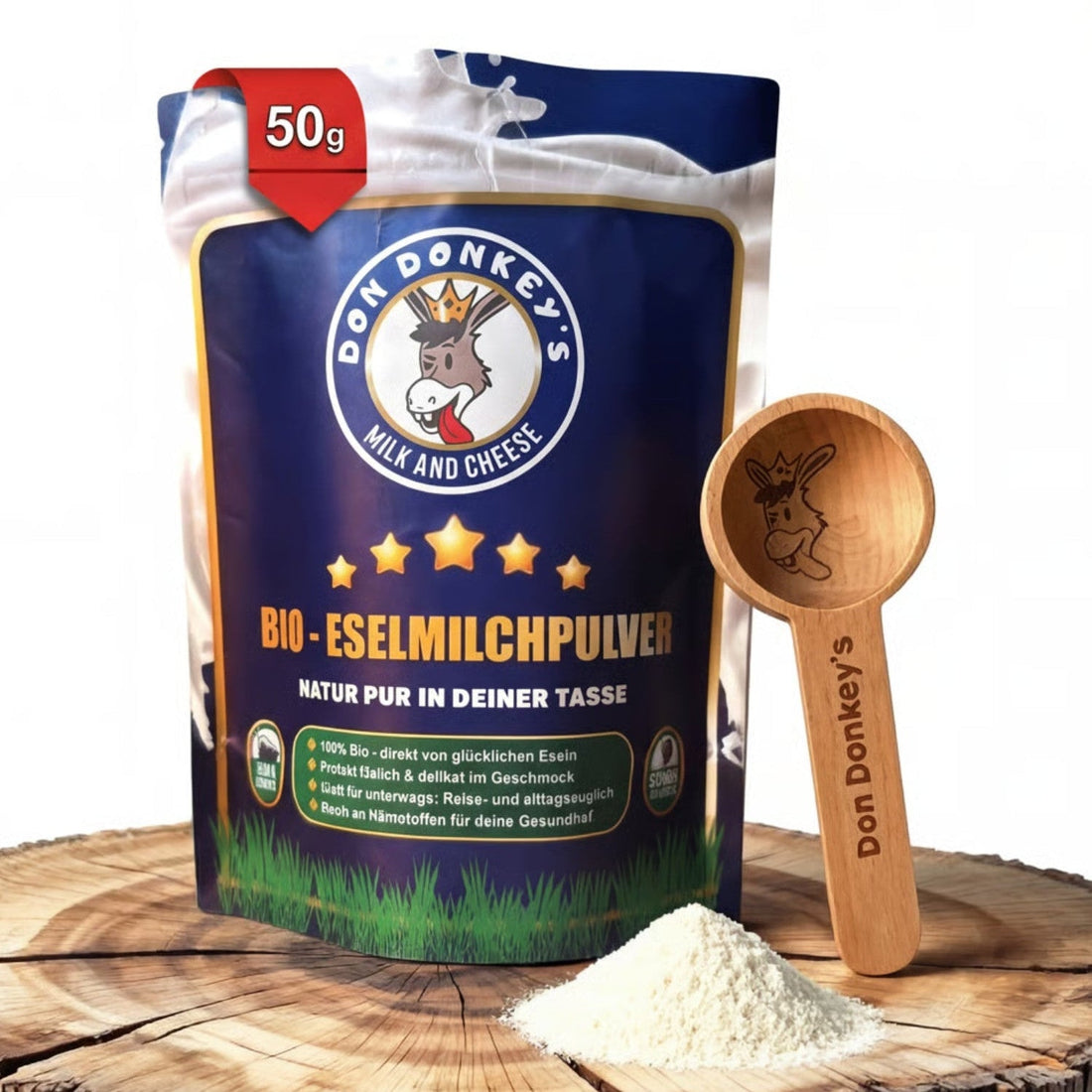
Also in our shop
Donkey Milk Powder
Donkey milk in powder form
For anyone who prefers a longer shelf life: our donkey milk in powder form – easy to store and portion.
20g · Unit price: €1.245,00 / 1 kg · incl. VAT, plus shipping